Buonocore Antimo, Fracasso Alessio, Melcher David
Werner Reichardt Centre for Integrative Neuroscience, Tübingen University, Tübingen, Germany.
Hertie Institute for Clinical Brain Research, Tübingen University, Tübingen, Germany.
PLoS One. 2017 Jun 14;12(6):e0178902. doi: 10.1371/journal.pone.0178902. eCollection 2017.
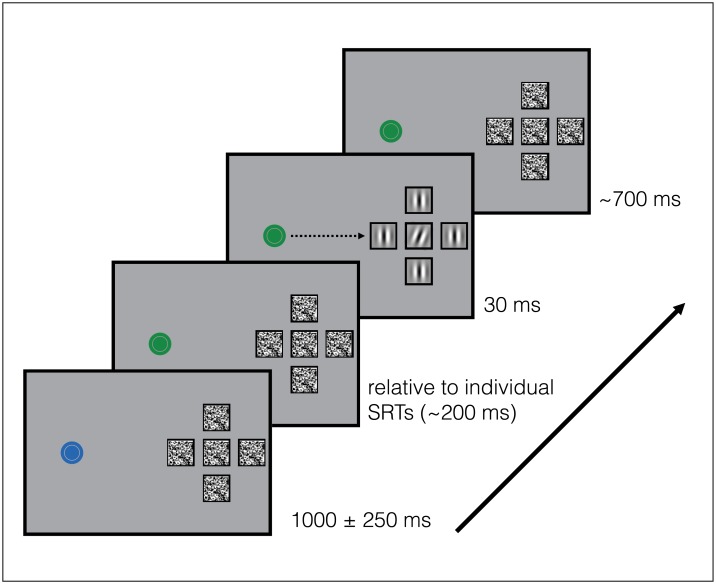
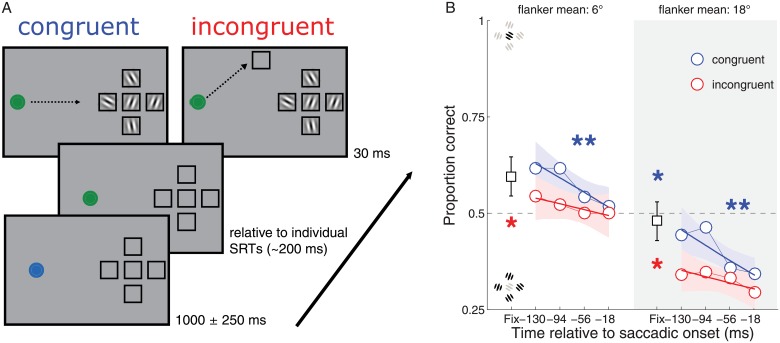
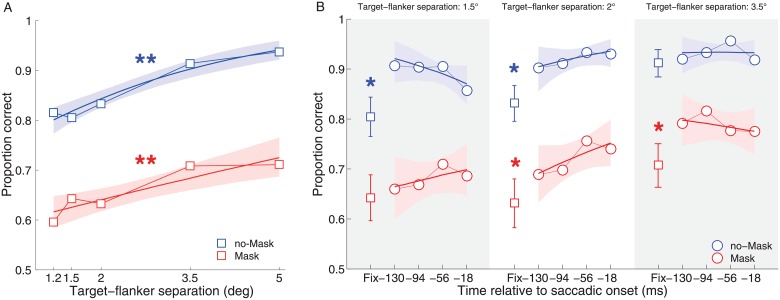
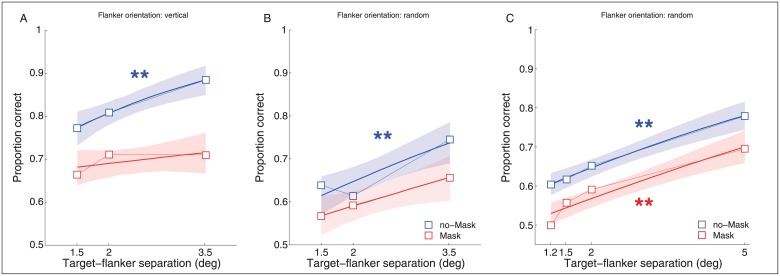
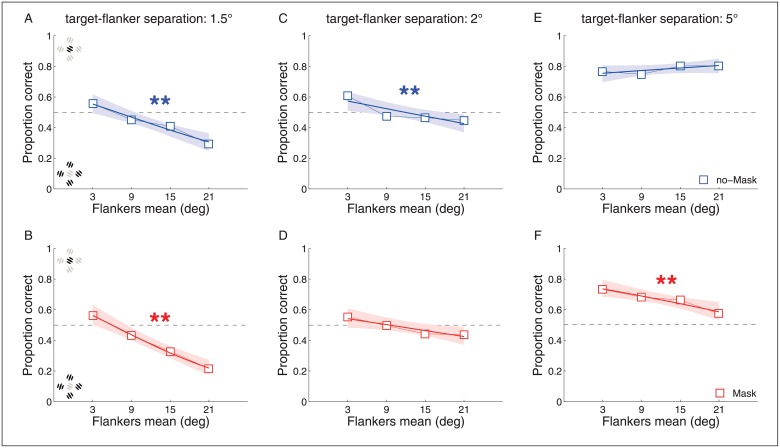
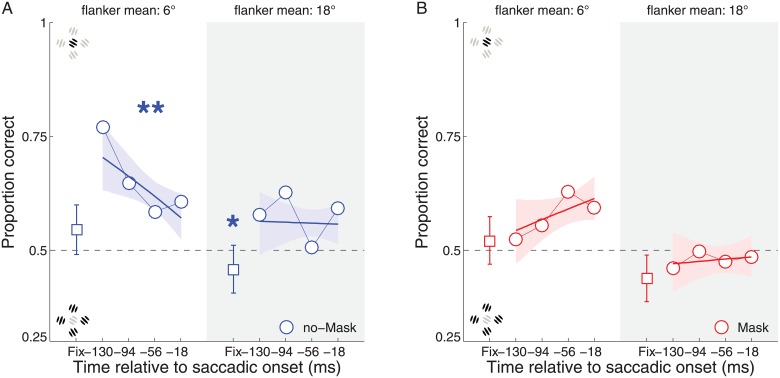
We interact with complex scenes using eye movements to select targets of interest. Studies have shown that the future target of a saccadic eye movement is processed differently by the visual system. A number of effects have been reported, including a benefit for perceptual performance at the target ("enhancement"), reduced influences of backward masking ("un-masking"), reduced crowding ("un-crowding") and spatial compression towards the saccade target. We investigated the time course of these effects by measuring orientation discrimination for targets that were spatially crowded or temporally masked. In four experiments, we varied the target-flanker distance, the presence of forward/backward masks, the orientation of the flankers and whether participants made a saccade. Masking and randomizing flanker orientation reduced performance in both fixation and saccade trials. We found a small improvement in performance on saccade trials, compared to fixation trials, with a time course that was consistent with a general enhancement at the saccade target. In addition, a decrement in performance (reporting the average flanker orientation, rather than the target) was found in the time bins nearest saccade onset when random oriented flankers were used, consistent with spatial pooling around the saccade target. We did not find strong evidence for un-crowding. Overall, our pattern of results was consistent with both an early, general enhancement at the saccade target and a later, peri-saccadic compression/pooling towards the saccade target.
我们通过眼动来与复杂场景进行交互,以选择感兴趣的目标。研究表明,视觉系统对眼跳运动的未来目标的处理方式有所不同。已经报道了许多效应,包括对目标处感知性能的益处(“增强”)、向后掩蔽影响的降低(“去掩蔽”)、拥挤效应的降低(“去拥挤”)以及朝向眼跳目标的空间压缩。我们通过测量在空间上拥挤或时间上被掩蔽的目标的方向辨别来研究这些效应的时间进程。在四个实验中,我们改变了目标-侧翼刺激距离、前向/后向掩蔽的存在、侧翼刺激的方向以及参与者是否进行眼跳。掩蔽和随机化侧翼刺激方向会降低注视和眼跳试验中的表现。我们发现,与注视试验相比,眼跳试验中的表现有小幅改善,其时间进程与眼跳目标处的总体增强一致。此外,当使用随机方向的侧翼刺激时,在最接近眼跳开始的时间间隔内发现表现下降(报告侧翼刺激的平均方向而非目标方向),这与眼跳目标周围的空间合并一致。我们没有找到有力证据支持去拥挤效应。总体而言,我们的结果模式与眼跳目标处早期的总体增强以及后期朝向眼跳目标的眼跳周围压缩/合并均一致。