Hartmann Till S, Zirnsak Marc, Marquis Michael, Hamker Fred H, Moore Tirin
Department of Neurobiology, Harvard Medical School Boston, MA, USA.
Department of Neurobiology and Howard Hughes Medical Institute, Stanford University School of Medicine Stanford, CA, USA.
Front Syst Neurosci. 2017 Mar 21;11:13. doi: 10.3389/fnsys.2017.00013. eCollection 2017.
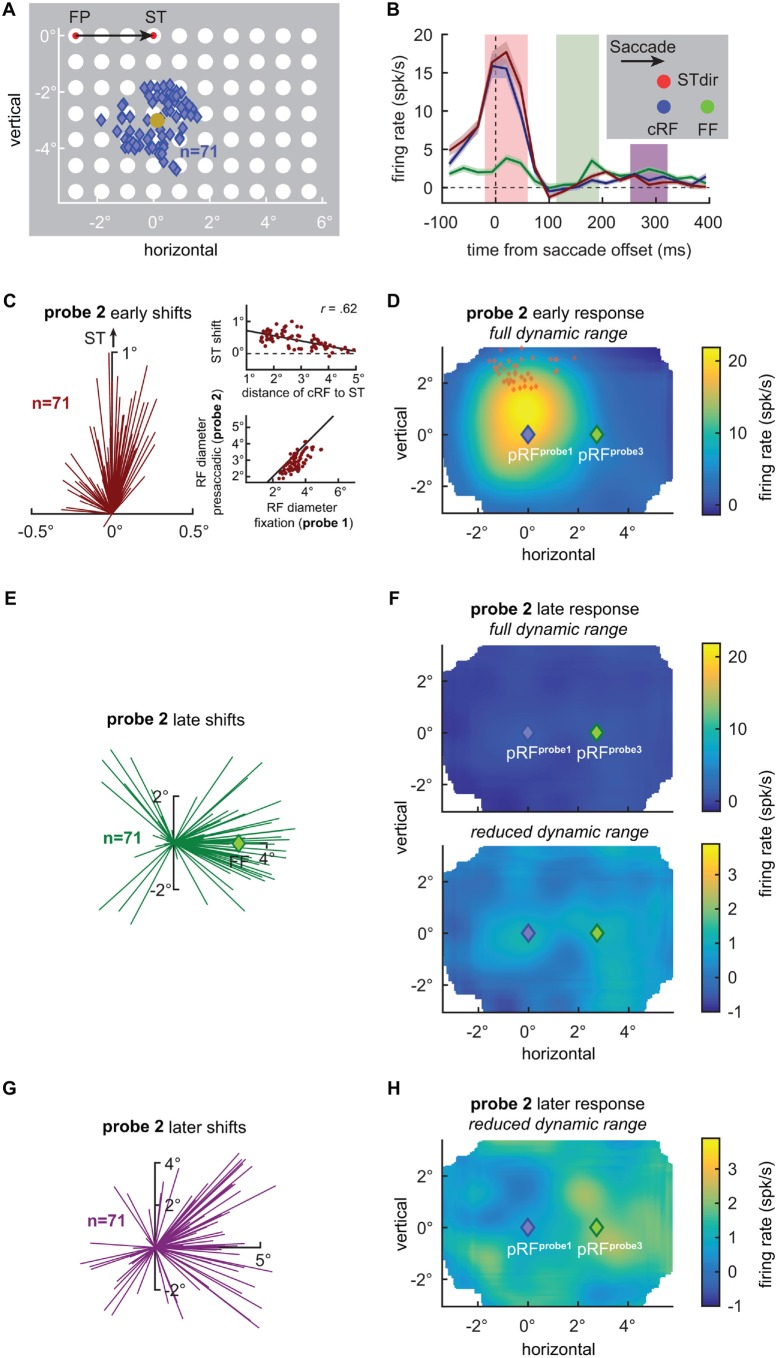
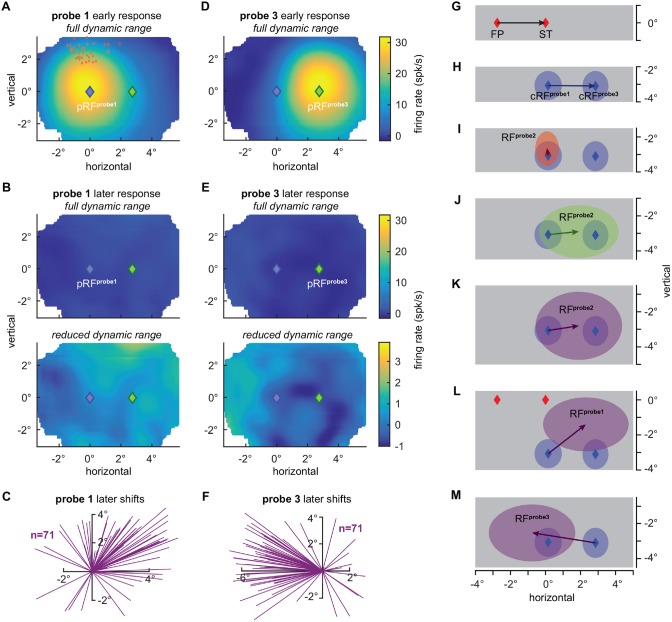
How we perceive the world as stable despite the frequent disruptions of the retinal image caused by eye movements is one of the fundamental questions in sensory neuroscience. Seemingly convergent evidence points towards a mechanism which dynamically updates representations of visual space in anticipation of a movement (Wurtz, 2008). In particular, receptive fields (RFs) of neurons, predominantly within oculomotor and attention related brain structures (Duhamel et al., 1992; Walker et al., 1995; Umeno and Goldberg, 1997), are thought to "remap" to their future, post-movement location prior to an impending eye movement. New studies (Neupane et al., 2016a,b) report observations on RF dynamics at the time of eye movements of neurons in area V4. These dynamics are interpreted as being largely dominated by a remapping of RFs. Critically, these observations appear at odds with a previous study reporting a different type of RF dynamics within the same brain structure (Tolias et al., 2001), consisting of a shrinkage and shift of RFs towards the movement target. Importantly, RFs have been measured with different techniques in those studies. Here, we measured V4 RFs comparable to Neupane et al. (2016a,b) and observe a shrinkage and shift of RFs towards the movement target when analyzing the immediate stimulus response (Zirnsak et al., 2014). When analyzing the late stimulus response (Neupane et al., 2016a,b), we observe RF shifts resembling remapping. We discuss possible causes for these shifts and point out important issues which future studies on RF dynamics need to address.
尽管眼球运动频繁干扰视网膜图像,我们却如何将世界感知为稳定的,这是感觉神经科学中的基本问题之一。看似趋同的证据指向一种机制,该机制会在预期运动时动态更新视觉空间的表征(Wurtz,2008年)。特别是,神经元的感受野(RFs),主要位于动眼神经和与注意力相关的脑结构内(Duhamel等人,1992年;Walker等人,1995年;Umeno和Goldberg,1997年),被认为会在即将发生眼球运动之前“重新映射”到其未来的、运动后的位置。新的研究(Neupane等人,2016a,b)报告了对V4区神经元眼球运动时RF动态的观察结果。这些动态变化在很大程度上被解释为RF的重新映射。关键的是,这些观察结果似乎与之前一项关于同一脑结构内不同类型RF动态的研究相矛盾(Tolias等人,2001年),该研究发现RF会向运动目标收缩和移动。重要的是,在那些研究中,RF是用不同技术测量的。在这里,我们测量了与Neupane等人(2016a,b)类似的V4 RF,并在分析即时刺激反应时观察到RF向运动目标收缩和移动(Zirnsak等人,2014年)。在分析延迟刺激反应时(Neupane等人,2016a,b),我们观察到类似于重新映射的RF移动。我们讨论了这些移动的可能原因,并指出了未来RF动态研究需要解决的重要问题。