Herrera Paloma, Fajreldin Valentina, Rodríguez María Francisca, Kraemer Patricia, Mendoza Carolina, Pineda Ignacio, Burdiles Pamela, Cornejo Marco, Villanueva Julio, Tohá María Dolores, Carrasco-Labra Alonso
Departamento Secretaría Técnica de Garantías Explícitas en Salud (GES) y de Coordinación Evidencial y Metodológica, Subsecretaría de Salud Pública, Ministerio de Salud, Chile.
Unidad de Odontología Basada en Evidencia e Instituto de Investigación en Ciencias Odontológicas, Facultad de Odontología, Universidad de Chile, Chile.
Rev Panam Salud Publica. 2017 Jun 8;41:e67. doi: 10.26633/RPSP.2017.67.
Characterize the implementation process, barriers, and facilitators of evidence-based recommendations in the context of developing clinical practice guidelines (CPGs) generated by the Ministry of Health of Chile, in order to make proposals to optimize the process.
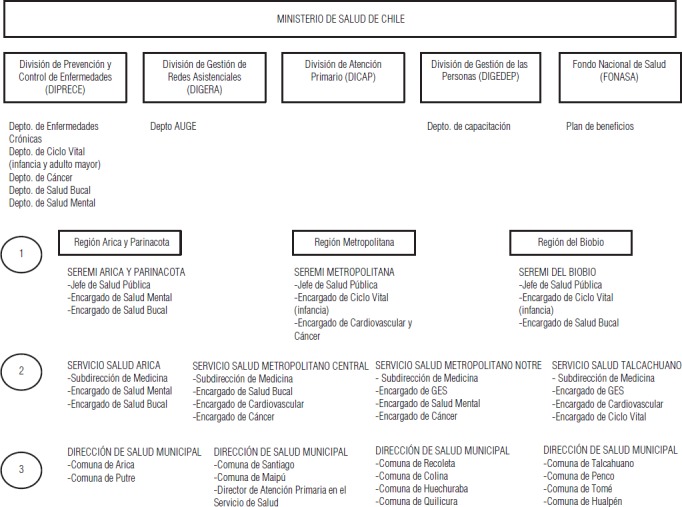
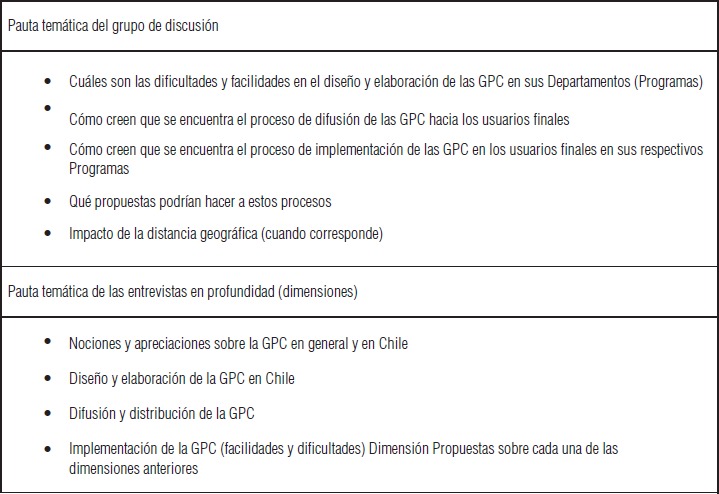
Qualitative "action-oriented research" study. Nineteen semi-structured interviews were conducted and nine discussion groups were organized at various levels of the Chilean public health system. The analysis was conducted using Atlas.ti® software and manually, in a content analysis framework, by categorizing and coding information according to pre-specified dimensions and with the inclusion of emerging categories where relevant.
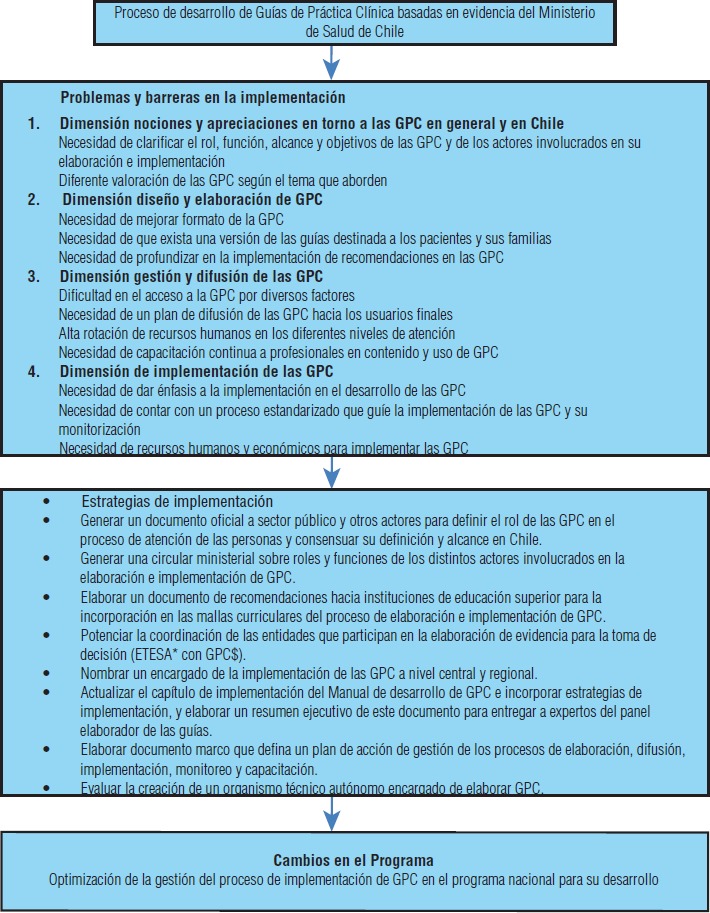
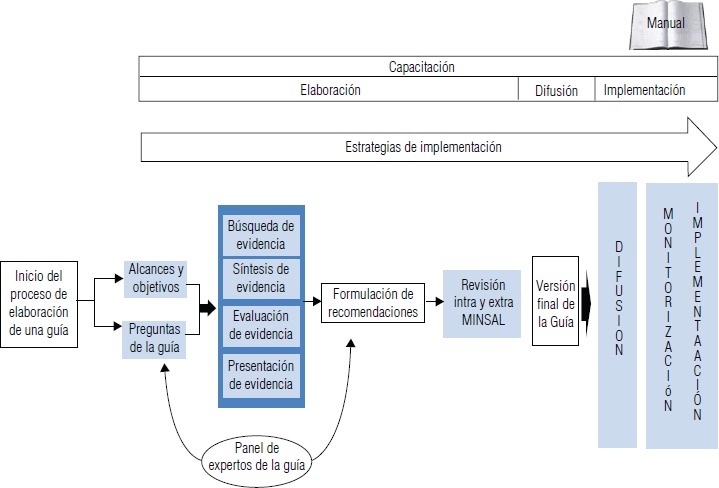
The main challenge mentioned with regard to implementing recommendations is the lack of an explicit and structured process. Actors in the health system recognize difficulties specific to the context in which the recommendations are followed. In this unprecedented institutional review, participants suggested a series of strategies that could be implemented to overcome these challenges, presented in a management flow chart optimized for the development and implementation of CPGs. This process has raised awareness of the importance of implementing CPGs in Chile.
After characterizing the implementation process, barriers, and facilitators, a plan to implement recommendations was developed in order to guide and monitor the process. It would facilitate the implementation of strategies and the introduction of improvements to the CPG development process if key informants inside and outside of the Ministry of Health were included in the review process. Studies of this kind should be conducted with physicians and patients in order to complement the collected information.
在智利卫生部制定临床实践指南(CPG)的背景下,描述循证建议的实施过程、障碍和促进因素,以便提出优化该过程的建议。
定性的“行动导向研究”。在智利公共卫生系统的各级进行了19次半结构化访谈,并组织了9个讨论小组。使用Atlas.ti®软件并手动进行分析,在内容分析框架内,根据预先指定的维度对信息进行分类和编码,并在相关时纳入新出现的类别。
关于实施建议提到的主要挑战是缺乏明确和结构化的过程。卫生系统中的行为者认识到遵循建议时特定背景下的困难。在这次前所未有的机构审查中,参与者提出了一系列可实施的策略来克服这些挑战,并在为CPG的制定和实施优化的管理流程图中呈现。这一过程提高了智利对实施CPG重要性的认识。
在描述了实施过程、障碍和促进因素后,制定了一项实施建议的计划,以指导和监督该过程。如果将卫生部内外的关键信息提供者纳入审查过程,将有助于实施策略并对CPG制定过程进行改进。此类研究应与医生和患者一起进行,以补充所收集的信息。