Aguglia Andrea, Borsotti Antonio, Maina Giuseppe
Dipartimento di Neuroscienze Rita Levi Montalcini, Ospedale San Luigi Gonzaga, Università degli Studi di Torino, Orbassano, Turin, Italy.
Braz J Psychiatry. 2018 Jan-Mar;40(1):6-11. doi: 10.1590/1516-4446-2016-2144. Epub 2017 Jun 12.
To increase understanding of the influence of photoperiod variation in patients with bipolar disorders.
We followed a sample of Italian bipolar patients over a period of 24 months, focusing on inpatients. All patients admitted to the Psychiatric Inpatient Unit of San Luigi Gonzaga Hospital in Orbassano (Turin, Italy) between September 1, 2013 and August 31, 2015 were recruited. Sociodemographic and clinical data were collected.
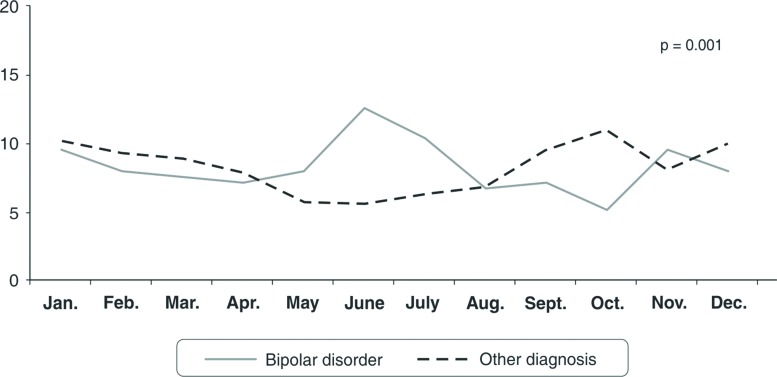
Seven hundred and thirty patients were included. The admission rate for bipolar patients was significantly higher during May, June and July, when there was maximum sunlight exposure, although no seasonal pattern was found. Patients with (hypo)manic episodes were admitted more frequently during the spring and during longer photoperiods than those with major depressive episodes.
Photoperiod is a key element in bipolar disorder, not only as an environmental factor but also as an important clinical parameter that should be considered during treatment.
增进对双相情感障碍患者光周期变化影响的理解。
我们对一组意大利双相情感障碍患者进行了为期24个月的跟踪研究,重点关注住院患者。招募了2013年9月1日至2015年8月31日期间入住意大利都灵奥尔巴萨诺圣路易吉·贡扎加医院精神科住院部的所有患者。收集了社会人口统计学和临床数据。
共纳入730名患者。双相情感障碍患者的入院率在5月、6月和7月显著更高,此时阳光照射量最大,尽管未发现季节性模式。与重度抑郁发作患者相比,(轻)躁狂发作患者在春季和光周期较长时入院更为频繁。
光周期是双相情感障碍的一个关键因素,不仅作为一种环境因素,而且作为治疗期间应考虑的一个重要临床参数。