Fan Xiao, Wang Jin-Zhao, Lin Xiao-Min, Zhang Li
Fujian University of Traditional Chinese Medicine, Fuzhou, Fujian Province, China.
Xiamen Medical College, Xiamen, Fujian Province, China.
Neural Regen Res. 2017 May;12(5):815-825. doi: 10.4103/1673-5374.206653.
The aim of this study was to evaluate the effectiveness and safety of stem cell transplantation for spinal cord injury (SCI).
PubMed, EMBASE, Cochrane, China National Knowledge Infrastructure, China Science and Technology Journal, Wanfang, and SinoMed databases were systematically searched by computer to select clinical randomized controlled trials using stem cell transplantation to treat SCI, published between each database initiation and July 2016.
Randomized controlled trials comparing stem cell transplantation with rehabilitation treatment for patients with SCI. Inclusion criteria: (1) Patients with SCI diagnosed according to the American Spinal Injury Association (ASIA) International standards for neurological classification of SCI; (2) patients with SCI who received only stem cell transplantation therapy or stem cell transplantation combined with rehabilitation therapy; (3) one or more of the following outcomes reported: outcomes concerning neurological function including sensory function and locomotor function, activities of daily living, urination functions, and severity of SCI or adverse effects. Studies comprising patients with complications, without full-text, and preclinical animal models were excluded. Quality of the included studies was evaluated using the Cochrane risk of bias assessment tool and RevMan V5.3 software, provided by the Cochrane Collaboration, was used to perform statistical analysis.
ASIA motor score, ASIA light touch score, ASIA pinprick score, ASIA impairment scale grading improvement rate, activities of daily living score, residual urine volume, and adverse events.
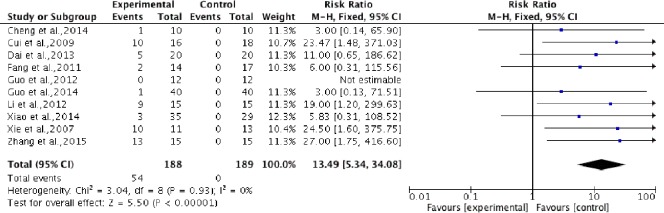
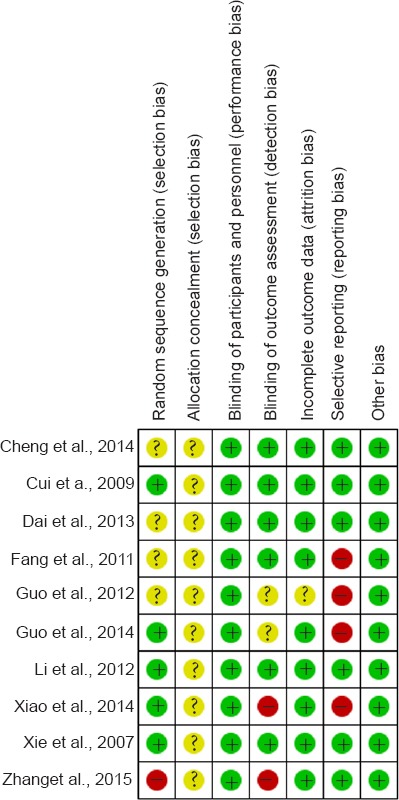
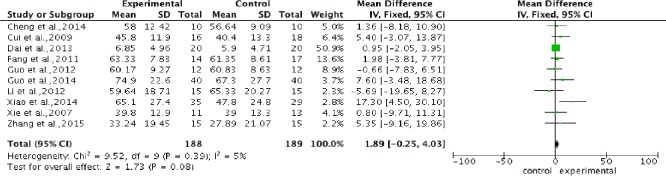
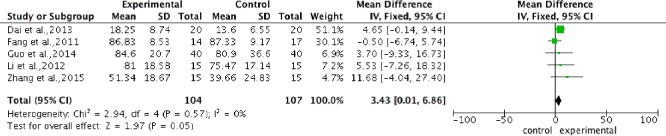
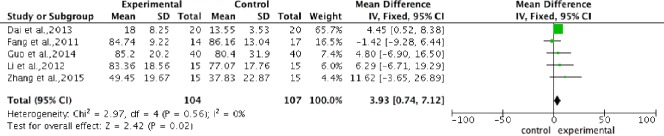
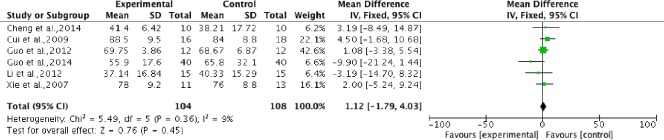
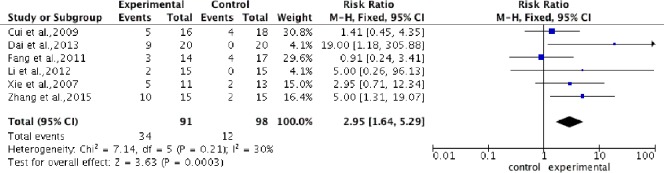
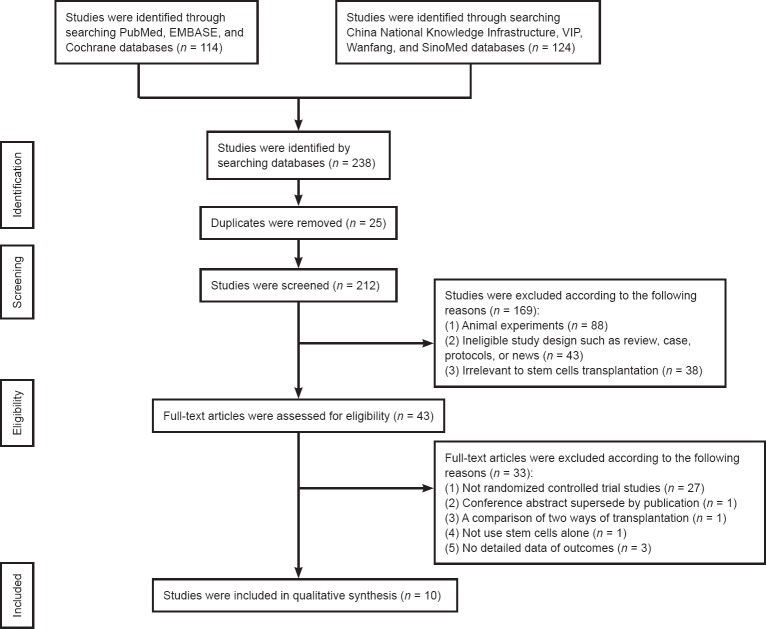
Ten studies comprising 377 patients were included in the analysis and the overall risk of bias was relatively low level. Four studies did not detail how random sequences were generated, two studies did not clearly state the blinding outcome assessment, two studies lacked blinding outcome assessment, one study lacked follow-up information, and four studies carried out selective reporting. Compared with rehabilitation therapy, stem cell transplantation significantly increased the lower limb light touch score (odds ratio () = 3.43, 95% confidence interval (): 0.01 - 6.86, = 0.05), lower limb pinprick score ( = 3.93, 95%: 0.74 - 7.12, = 0.02), ASI grading rate (relative risk () = 2.95, 95%: 1.64 - 5.29, = 0.0003), and notably reduced residual urine volume ( = -8.10, 95%: -15.09 to -1.10, = 0.02). However, stem cell transplantation did not significantly improve motor score ( = 1.89, 95%: -0.25 to 4.03, = 0.08) or activities of daily living score ( = 1.12, 95%: -1.17 to 4.04, = 0.45). Furthermore, stem cell transplantation caused a high rate of mild adverse effects ( = 14.49, 95%: 5.34 - 34.08, < 0.00001); however, these were alleviated in a short time.
Stem cell transplantation was determined to be an efficient and safe treatment for SCI and simultaneously improved sensory and bladder functions. Although associated minor and temporary adverse effects were observed with transplanted stem cells, spinal cord repair and axon remyelination were apparent. More randomized controlled trials with larger sample sizes and longer follow-up times are needed to further validate the effectiveness of stem cell transplantation in the treatment of SCI.
本研究旨在评估干细胞移植治疗脊髓损伤(SCI)的有效性和安全性。
通过计算机系统检索PubMed、EMBASE、Cochrane、中国知网、中国科技期刊数据库、万方数据库和维普数据库,以选取在各数据库建库至2016年7月期间发表的使用干细胞移植治疗SCI的临床随机对照试验。
比较干细胞移植与康复治疗的SCI患者随机对照试验。纳入标准:(1)根据美国脊髓损伤协会(ASIA)国际脊髓损伤神经分类标准诊断为SCI的患者;(2)仅接受干细胞移植治疗或干细胞移植联合康复治疗的SCI患者;(3)报告以下一项或多项结果:涉及神经功能的结果,包括感觉功能和运动功能、日常生活活动、排尿功能以及SCI严重程度或不良反应。排除包含有并发症患者、无全文的研究以及临床前动物模型研究。使用Cochrane偏倚风险评估工具对纳入研究的质量进行评估,并使用Cochrane协作网提供的RevMan V5.3软件进行统计分析。
ASIA运动评分、ASIA轻触觉评分、ASIA针刺觉评分、ASIA损伤量表分级改善率、日常生活活动评分、残余尿量及不良事件。
纳入分析的有10项研究,共377例患者,总体偏倚风险为较低水平。4项研究未详细说明随机序列的产生方式,2项研究未明确说明盲法结果评估,2项研究缺乏盲法结果评估,1项研究缺乏随访信息,4项研究存在选择性报告。与康复治疗相比,干细胞移植显著提高了下肢轻触觉评分(比值比(OR)=3.43,95%置信区间(CI):0.01 - 6.86,P = 0.05)、下肢针刺觉评分(OR = 3.93,95%CI:0.74 - 7.12,P = 0.02)、ASIA分级率(相对危险度(RR)=2.95,95%CI:1.64 - 5.29,P = 0.0003),并显著减少了残余尿量(MD = -8.10,95%CI:-15.09至 -1.10,P = 0.02)。然而,干细胞移植并未显著改善运动评分(MD = 1.89,95%CI:-0.25至4.03,P = 0.08)或日常生活活动评分(MD = 1.12,95%CI:-1.17至4.04,P = 0.45)。此外,干细胞移植导致轻度不良反应的发生率较高(RR = 14.49,95%CI:5.34 - 34.08,P < 0.00001);不过,这些不良反应在短时间内得到缓解。
确定干细胞移植是治疗SCI的一种有效且安全的方法,同时改善了感觉和膀胱功能。尽管观察到移植干细胞存在相关的轻微和暂时不良反应,但脊髓修复和轴突再髓鞘化明显。需要更多样本量更大、随访时间更长的随机对照试验来进一步验证干细胞移植治疗SCI的有效性。