Artola Marta, Ruíz-Avila Laura B, Ramírez-Aportela Erney, Martínez R Fernando, Araujo-Bazán Lidia, Vázquez-Villa Henar, Martín-Fontecha Mar, Oliva María A, Martín-Galiano A Javier, Chacón Pablo, López-Rodríguez María L, Andreu José M, Huecas Sonia
Dept. Química Orgánica I , Facultad de Ciencias Químicas , UCM , 28040 Madrid , Spain.
Centro de Investigaciones Biológicas , CSIC , Ramiro de Maeztu 9 , 28040 Madrid , Spain . Email:
Chem Sci. 2017 Feb 1;8(2):1525-1534. doi: 10.1039/c6sc03792e. Epub 2016 Oct 21.
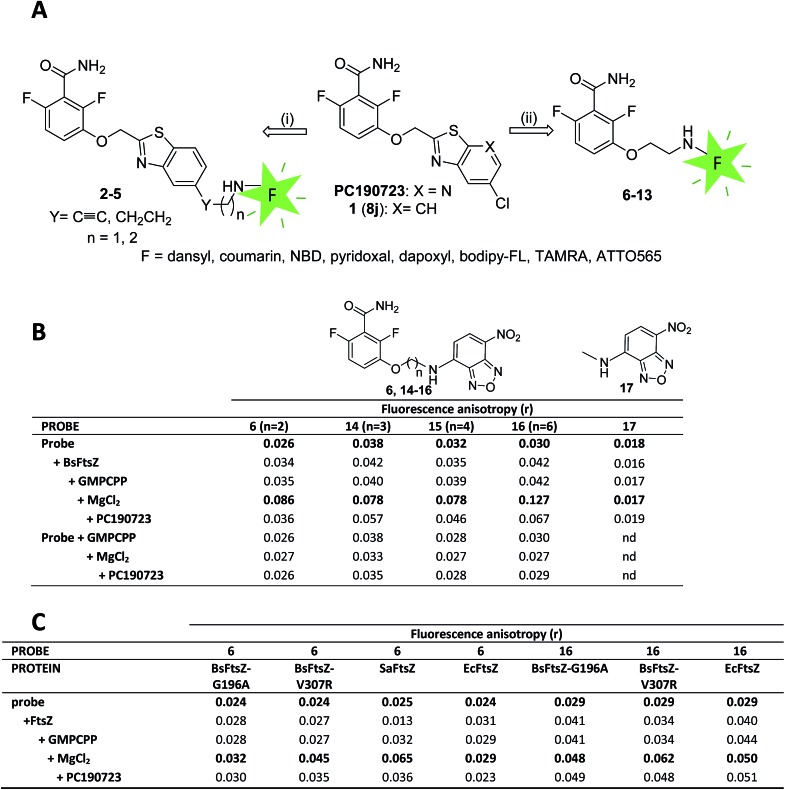
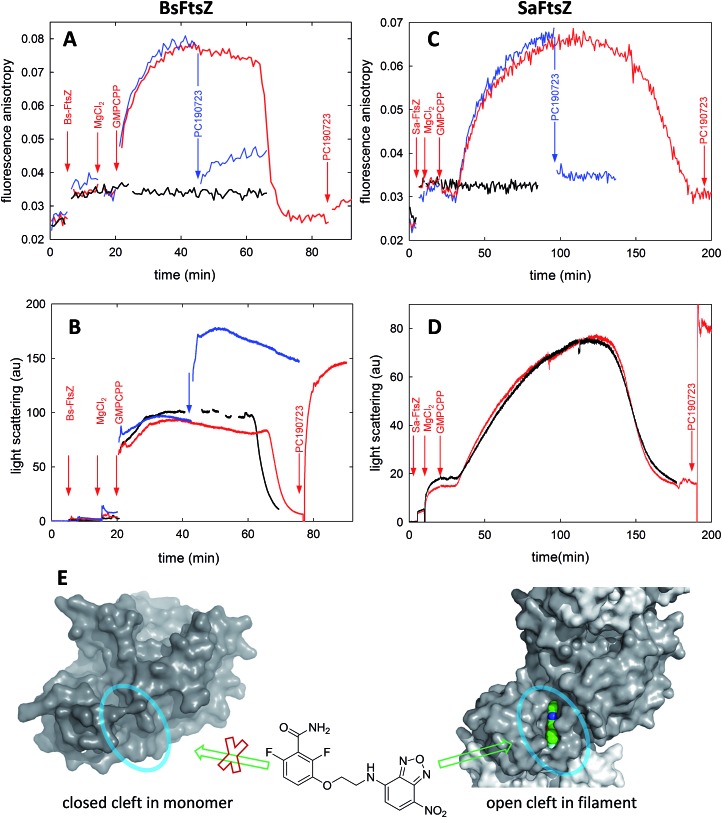
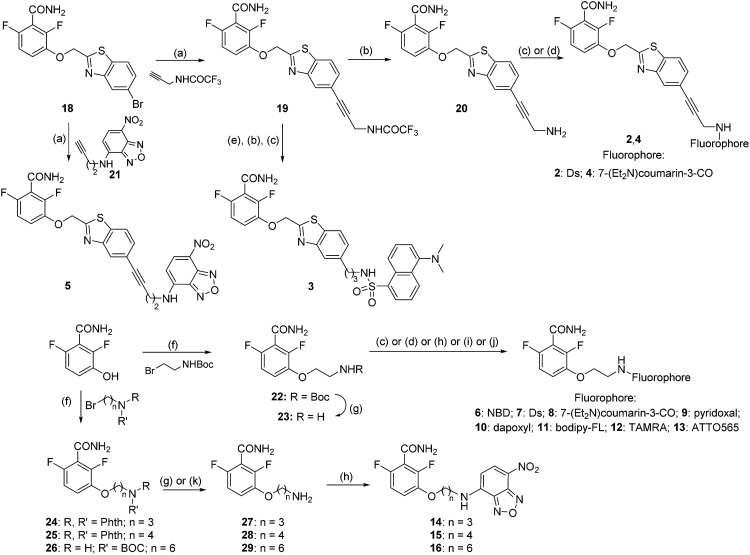
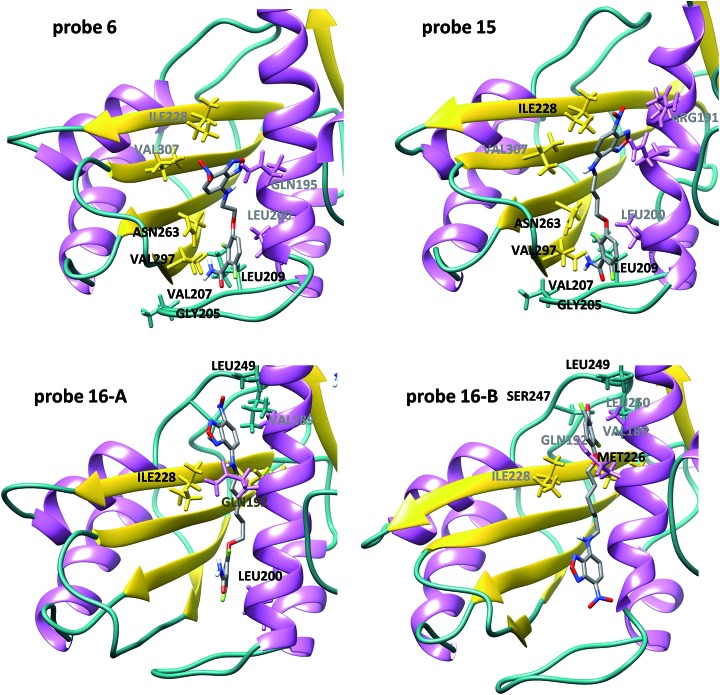
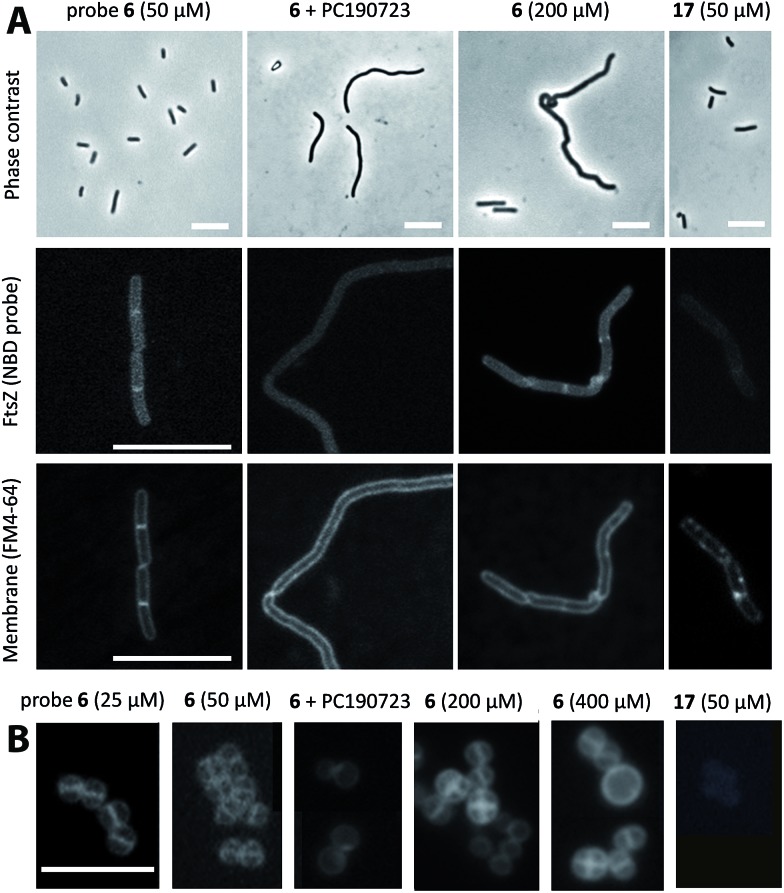
FtsZ is a widely conserved tubulin-like GTPase that directs bacterial cell division and a new target for antibiotic discovery. This protein assembly machine cooperatively polymerizes forming single-stranded filaments, by means of self-switching between inactive and actively associating monomer conformations. The structural switch mechanism was proposed to involve a movement of the C-terminal and N-terminal FtsZ domains, opening a cleft between them, allosterically coupled to the formation of a tight association interface between consecutive subunits along the filament. The effective antibacterial benzamide PC190723 binds into the open interdomain cleft and stabilizes FtsZ filaments, thus impairing correct formation of the FtsZ ring for cell division. We have designed fluorescent analogs of PC190723 to probe the FtsZ structural assembly switch. Among them, nitrobenzoxadiazole probes specifically bind to assembled FtsZ rather than to monomers. Probes with several spacer lengths between the fluorophore and benzamide moieties suggest a binding site extension along the interdomain cleft. These probes label FtsZ rings of live and , without apparently modifying normal cell morphology and growth, but at high concentrations they induce impaired bacterial division phenotypes typical of benzamide antibacterials. During the FtsZ assembly-disassembly process, the fluorescence anisotropy of the probes changes upon binding and dissociating from FtsZ, thus reporting open and closed FtsZ interdomain clefts. Our results demonstrate the structural mechanism of the FtsZ assembly switch, and suggest that the probes bind into the open clefts in cellular FtsZ polymers preferably to unassembled FtsZ in the bacterial cytosol.
FtsZ是一种广泛保守的微管蛋白样GTP酶,它指导细菌细胞分裂,也是抗生素发现的新靶点。这种蛋白质组装机器通过在无活性和主动结合的单体构象之间的自我切换,协同聚合形成单链细丝。结构转换机制被认为涉及FtsZ C末端和N末端结构域的移动,在它们之间打开一个裂缝,与沿着细丝的连续亚基之间紧密结合界面的形成变构偶联。有效的抗菌苯甲酰胺PC190723结合到开放的结构域间裂缝中并稳定FtsZ细丝,从而损害用于细胞分裂的FtsZ环的正确形成。我们设计了PC190723的荧光类似物来探测FtsZ结构组装转换。其中,硝基苯并恶二唑探针特异性结合组装好的FtsZ而不是单体。在荧光团和苯甲酰胺部分之间具有几种间隔长度的探针表明结合位点沿着结构域间裂缝延伸。这些探针标记活细胞的FtsZ环,且不会明显改变正常细胞形态和生长,但在高浓度下它们会诱导出典型的苯甲酰胺抗菌剂的细菌分裂受损表型。在FtsZ组装 - 拆卸过程中,探针的荧光各向异性在与FtsZ结合和解离时发生变化,从而报告FtsZ结构域间裂缝的开放和关闭状态。我们的结果证明了FtsZ组装转换的结构机制,并表明探针优先结合到细胞内FtsZ聚合物的开放裂缝中,而不是细菌细胞质中未组装的FtsZ。