DeLong J P, Gibert J P, Luhring T M, Bachman G, Reed B, Neyer A, Montooth K L
School of Biological Sciences University of Nebraska - Lincoln Lincoln NE USA.
Present address: The University of California, Merced Merced CA USA.
Ecol Evol. 2017 Apr 23;7(11):3940-3950. doi: 10.1002/ece3.2955. eCollection 2017 Jun.
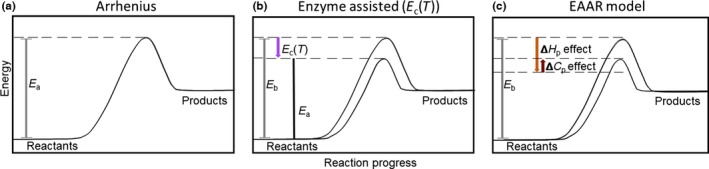
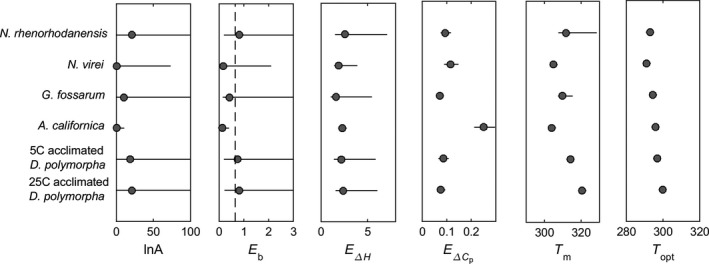
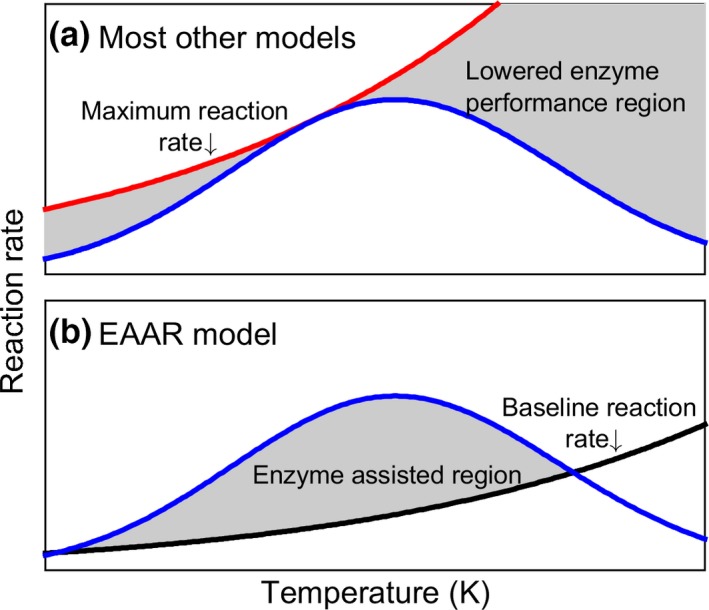
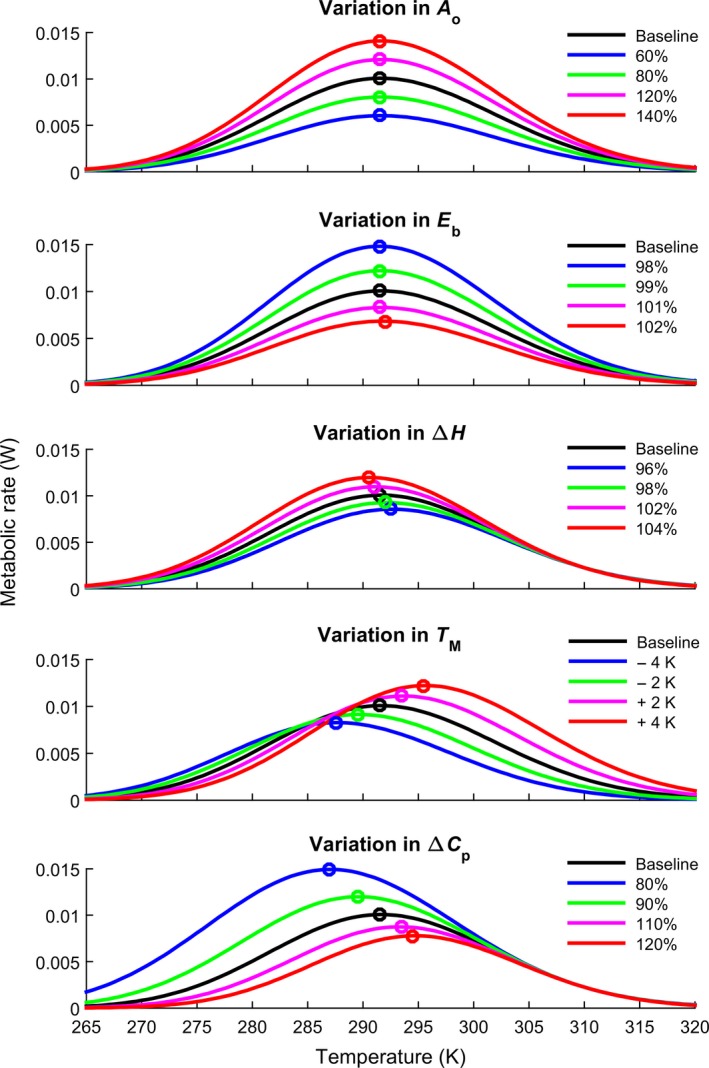
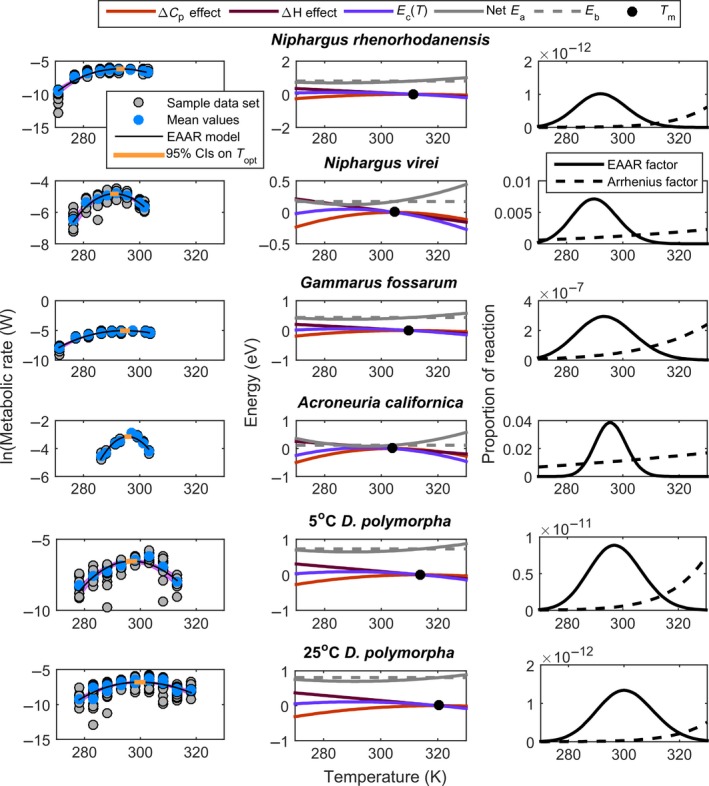
A mechanistic understanding of the response of metabolic rate to temperature is essential for understanding thermal ecology and metabolic adaptation. Although the Arrhenius equation has been used to describe the effects of temperature on reaction rates and metabolic traits, it does not adequately describe two aspects of the thermal performance curve (TPC) for metabolic rate-that metabolic rate is a unimodal function of temperature often with maximal values in the biologically relevant temperature range and that activation energies are temperature dependent. We show that the temperature dependence of metabolic rate in ectotherms is well described by an enzyme-assisted Arrhenius (EAAR) model that accounts for the temperature-dependent contribution of enzymes to decreasing the activation energy required for reactions to occur. The model is mechanistically derived using the thermodynamic rules that govern protein stability. We contrast our model with other unimodal functions that also can be used to describe the temperature dependence of metabolic rate to show how the EAAR model provides an important advance over previous work. We fit the EAAR model to metabolic rate data for a variety of taxa to demonstrate the model's utility in describing metabolic rate TPCs while revealing significant differences in thermodynamic properties across species and acclimation temperatures. Our model advances our ability to understand the metabolic and ecological consequences of increases in the mean and variance of temperature associated with global climate change. In addition, the model suggests avenues by which organisms can acclimate and adapt to changing thermal environments. Furthermore, the parameters in the EAAR model generate links between organismal level performance and underlying molecular processes that can be tested for in future work.
对代谢率对温度的响应有一个机制性的理解,对于理解热生态学和代谢适应至关重要。尽管阿伦尼乌斯方程已被用于描述温度对反应速率和代谢特征的影响,但它并不能充分描述代谢率的热性能曲线(TPC)的两个方面,即代谢率是温度的单峰函数,通常在生物学相关温度范围内具有最大值,以及活化能是温度依赖性的。我们表明,变温动物代谢率的温度依赖性可以通过酶辅助阿伦尼乌斯(EAAR)模型得到很好的描述,该模型考虑了酶对降低反应发生所需活化能的温度依赖性贡献。该模型是根据控制蛋白质稳定性的热力学规则从机制上推导出来的。我们将我们的模型与其他也可用于描述代谢率温度依赖性的单峰函数进行对比,以展示EAAR模型如何比以前的工作有重要进展。我们将EAAR模型拟合到各种分类群的代谢率数据中,以证明该模型在描述代谢率TPC方面的效用,同时揭示不同物种和驯化温度下热力学性质的显著差异。我们的模型提高了我们理解与全球气候变化相关的温度均值和方差增加的代谢和生态后果的能力。此外,该模型还提出了生物体可以适应和应对不断变化的热环境的途径。此外,EAAR模型中的参数在生物体水平性能和潜在分子过程之间建立了联系,可在未来的工作中进行测试。