Kordi Masoumeh, Erfanian Fatemeh, Fakari Farzaneh Rashidi, Dastfan Fatemeh, Nejad Keivan Shariati
Department of Midwifery, School of Nursing and Midwifery, Women's Health Research Center, Mashhad University of Medical Sciences, Mashhad, Iran.
Department of Midwifery, School of Nursing and Midwifery, Mashhad University of Medical Sciences, Mashhad, Iran.
J Educ Health Promot. 2017 Jun 5;6:50. doi: 10.4103/jehp.jehp_115_15. eCollection 2017.
Shoulder dystocia is one of the obstetric emergencies that are accompanied to serious risks for mother and fetus. It necessitates making the method of training of shoulder dystocia management more efficient, i.e., better management and giving services with higher quality. Thus, this study was carried out to compare the impact of training by simulation and oral technique on the skill of the employed midwives in obstetric clinics at Mashhad city (Iran) in shoulder dystocia management during 2012.
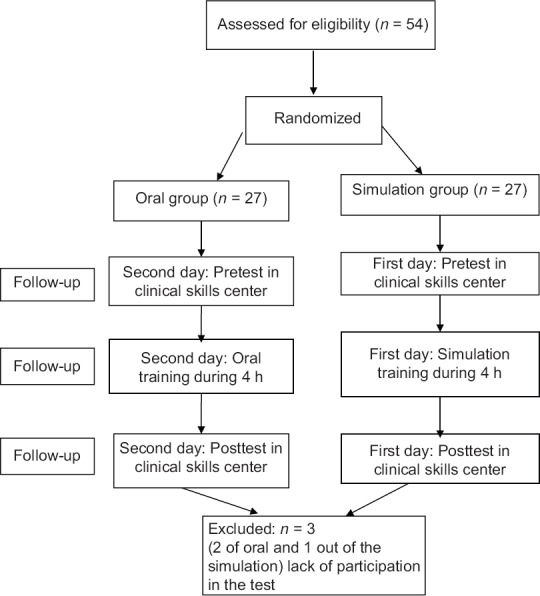
The current research is a double-group clinical trial that was conducted on 51 members of the employed midwives in the obstetric clinic at Mashhad city in 2012. The questionnaire of personal specification and awareness about shoulder dystocia and practical examination (objective-structured clinical examination) were employed as tools for data collection. The learners were divided into two groups by randomized allocation. Training was done by the presentation of lecture in the oral content group and a short movie was displayed at the end of it. The shoulder dystocia management technique was simulated in another group and through role-playing of instructor application of moulage (station) training was conducted. The period of the training course (4 h) and content of the educational workshop was identical for both groups. The practical examination was held for the learners before and immediately after training course. The given data were analyzed by means of statistical descriptive tests including Mann-Whitney U-test and Wilcoxon test via SPSS software (version 16). The significance level was considered as ( < 0.05) in all cases.
The total mean score was significantly increased for the variable of shoulder dystocia management skill after intervention in both groups ( < 0.0001). Similarly, the results of Mann-Whitney U-test statistical tests indicated that total mean score for the variable of shoulder dystocia management skill after the intervention was significantly greater in simulation group than in an oral group ( = 0.040).
Training in simulated delivery room by means of role-playing is an efficient method for training shoulder dystocia management skill, so it is recommended to use this program in the training of this skill.
肩难产是一种产科急症,会给母婴带来严重风险。这就需要提高肩难产处理的培训方法的效率,即更好地管理并提供更高质量的服务。因此,本研究旨在比较模拟培训和口头技术培训对2012年伊朗马什哈德市产科诊所在职助产士处理肩难产技能的影响。
本研究是一项双组临床试验,于2012年对马什哈德市产科诊所的51名在职助产士进行。个人信息问卷、肩难产认知问卷以及实践考试(客观结构化临床考试)被用作数据收集工具。通过随机分配将学习者分为两组。口头内容组通过讲座授课进行培训,并在最后播放一部短片。另一组模拟肩难产处理技术,并通过指导教师应用人体模型进行角色扮演开展(模拟场景)培训。两组的培训课程时长(4小时)和教育工作坊内容相同。在培训课程前后分别对学习者进行实践考试。通过SPSS软件(版本16)使用包括曼-惠特尼U检验和威尔科克森检验在内的统计描述性检验对所得数据进行分析。所有情况下的显著性水平均设定为(<0.05)。
两组干预后肩难产处理技能变量的总平均分均显著提高(<0.0001)。同样,曼-惠特尼U检验统计结果表明,干预后模拟组肩难产处理技能变量的总平均分显著高于口头组(=0.040)。
通过角色扮演在模拟产房进行培训是一种有效的肩难产处理技能培训方法,因此建议在该技能培训中使用此方案。