Alhoshani Ali R, Hafez Mohamed M, Husain Sufia, Al-Sheikh Abdel Malek, Alotaibi Moureq R, Al Rejaie Salim S, Alshammari Musaad A, Almutairi Mashal M, Al-Shabanah Othman A
Department of Pharmacology and Toxicology, College of Pharmacy, King Saud University, P.O. Box 2457, Riyadh, 11451, Kingdom of Saudi Arabia.
Department of Pathology, College of Medicine, King Saud University, P.O. Box 2457, Riyadh, 11451, Kingdom of Saudi Arabia.
BMC Nephrol. 2017 Jun 15;18(1):194. doi: 10.1186/s12882-017-0601-y.
Cisplatin (CP) is commonly used in the treatment of different types of cancer but nephrotoxicity has been a major limiting factor. Therefore, the present study aimed to study the possible protective effect of rutin against nephrotoxicity induced by cisplatin in rats.
Forty male Wistar albino rats were randomly divided into 4 groups. Rats of group 1 control group intraperitoneal (i.p.) received 2.5 ml/kg, group 2 CP group received single dose 5 mg/kg cisplatin i.p. group 3 rutin group orally received 30 mg/kg rutin group 4 (CP plus rutin) received CP and rutin as in group 2 and 3. Kidneys were harvested for histopathology and for the study the gene expression of c-Jun N-terminal kinases (JNK), Mitogen-activated protein kinase 4 (MKK4), MKK7, P38 mitogen-activated protein kinases (P38), tumor necrosis factors alpha (TNF-α), TNF Receptor-Associated Factor 2 (TRAF2), and interleukin-1 alpha (IL-1-α).
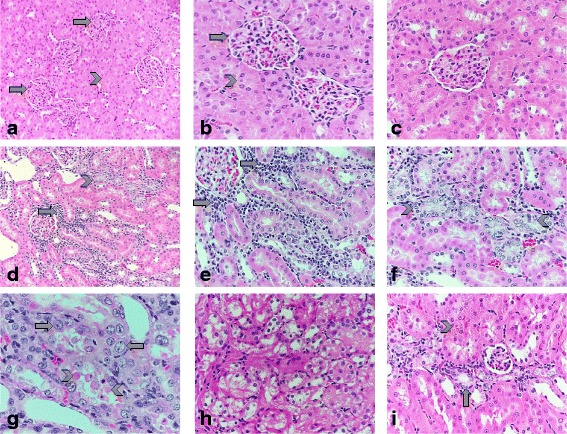
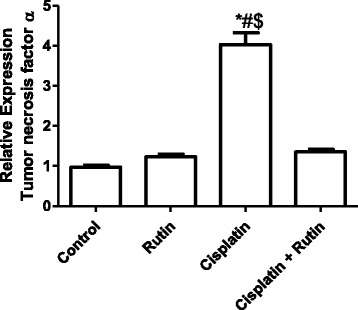
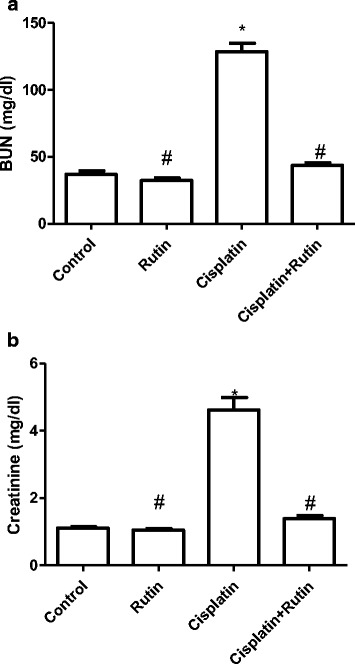
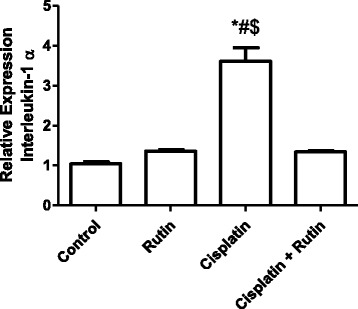
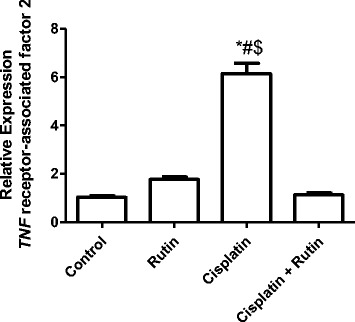
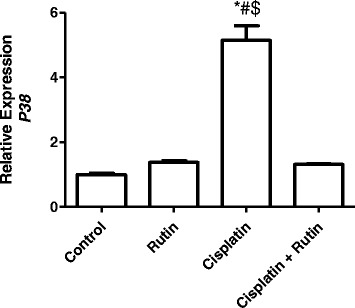
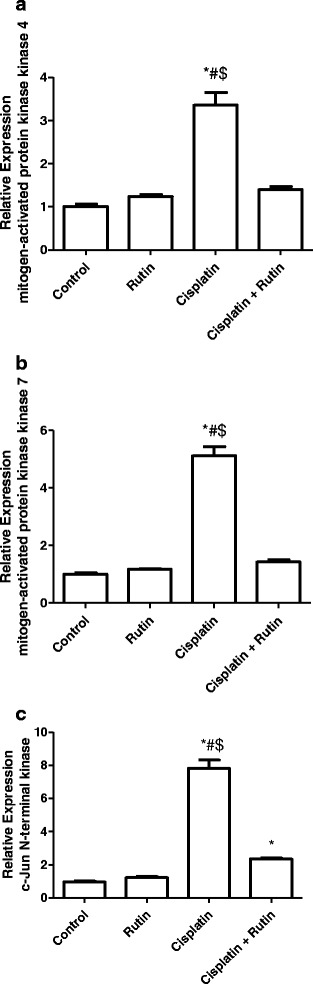
The cisplatin single dose administration to rats induced nephrotoxicity associated with a significant increase in blood urea nitrogen (BUN) and serum creatinine and significantly increase Malondialdehyde (MDA) in kidney tissues by 230 ± 5.5 nmol/g compared to control group. The animal treated with cisplatin showed a significant increase in the expression levels of the IL-1α (260%), TRFA2 (491%), P38 (410%), MKK4 (263%), MKK7 (412%), JNK (680%) and TNF-α (300%) genes compared to control group. Additionally, histopathological examination showed that cisplatin-induced interstitial congestion, focal mononuclear cell inflammatory, cell infiltrate, acute tubular injury with reactive atypia and apoptotic cells. Rutin administration attenuated cisplatin-induced alteration in gene expression and structural and functional changes in the kidney. Additionally, histopathological examination of kidney tissues confirmed gene expression data.
The present study suggested that the anti-oxidant and anti-inflammatory effect of rutin may prevent CP-induced nephrotoxicity via decreasing the oxidative stress, inhibiting the interconnected ROS/JNK/TNF/P38 MAPK signaling pathways, and repairing the histopathological changes against cisplatin administration.
顺铂(CP)常用于治疗不同类型的癌症,但肾毒性一直是一个主要限制因素。因此,本研究旨在探讨芦丁对顺铂诱导的大鼠肾毒性可能的保护作用。
将40只雄性Wistar白化大鼠随机分为4组。第1组为对照组,腹腔注射(i.p.)2.5 ml/kg;第2组为CP组,腹腔注射单剂量5 mg/kg顺铂;第3组为芦丁组,口服30 mg/kg芦丁;第4组(CP加芦丁组),按第2组和第3组的方式给予顺铂和芦丁。采集肾脏进行组织病理学检查,并研究c-Jun氨基末端激酶(JNK)、丝裂原活化蛋白激酶4(MKK4)、MKK7、P38丝裂原活化蛋白激酶(P38)、肿瘤坏死因子α(TNF-α)、TNF受体相关因子2(TRAF2)和白细胞介素-1α(IL-1-α)的基因表达。
给大鼠单次注射顺铂可诱导肾毒性,与对照组相比,血尿素氮(BUN)和血清肌酐显著升高,肾组织中丙二醛(MDA)显著增加,达到230±5.5 nmol/g。与对照组相比,接受顺铂治疗的动物IL-1α(260%)、TRFA2(491%)、P38(410%)、MKK4(263%)、MKK7(412%)、JNK(680%)和TNF-α(300%)基因的表达水平显著升高。此外,组织病理学检查显示,顺铂可导致间质充血、局灶性单核细胞炎症、细胞浸润、急性肾小管损伤伴反应性异型增生和凋亡细胞。芦丁给药减轻了顺铂诱导的基因表达改变以及肾脏的结构和功能变化。此外,肾脏组织的组织病理学检查证实了基因表达数据。
本研究表明,芦丁的抗氧化和抗炎作用可能通过降低氧化应激、抑制相互关联的ROS/JNK/TNF/P38 MAPK信号通路以及修复顺铂给药引起的组织病理学变化来预防CP诱导的肾毒性。