Mi Hong, Liu Feng-Bin, Li Hai-Wen, Hou Jiang-Tao, Li Pei-Wu
Department of Gastroenterology, the First Affiliated Hospital of Guangzhou University of Chinese Medicine, Guangzhou, 510405, China.
First School of Clinic Medicine, Guangzhou University of Chinese Medicine, Guangzhou, 510405, China.
BMC Complement Altern Med. 2017 Jun 15;17(1):315. doi: 10.1186/s12906-017-1794-0.
Inflammatory bowel disease (IBD), denominated by Crohn's disease and ulcerative colitis, is often associated with abdominal pain, diarrhea and bloody stool. The standard protocols for treating colitis conditions are not satisfactory; thus, complementary and alternative medicines have been increasingly accepted by IBD sufferers worldwide. In this study, we aimed to elucidate the anti-inflammatory effect of Chang-An-Shuan (CAS), a 6-herb Chinese medicinal formula, on 2, 4, 6-trinitrobenzenesulfonic acid (TNBS)-induced colitis in rats and the underlying mechanisms.
Sprague-Dawley rats were administered with rectal gavage of 2.5% TNBS in 50% ethanol for the induction of experimental colitis which is considered as a model for Crohn's disease. Upon the TNBS induction, rats were given CAS at 0.5 g/kg/day or 5 g/kg/day for 10 days. The application of salicylazosulfapyridine (0.5 g/kg/day) was served as a positive reference drug for the colitis condition. The efficacy and mechanistic action of CAS were evaluated by means of histopathological and biochemical approaches such as histological staining, real-time polymerase chain reaction, Western blotting analysis and enzyme-linked immunosorbent assay.
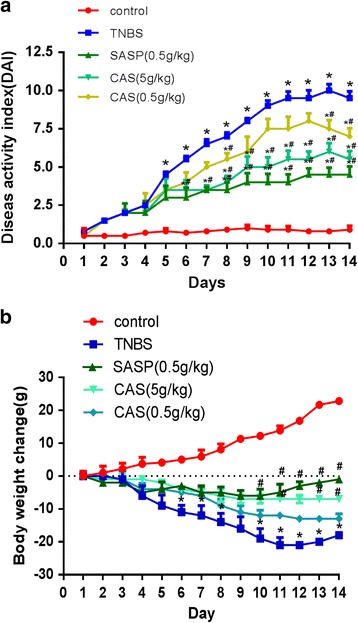
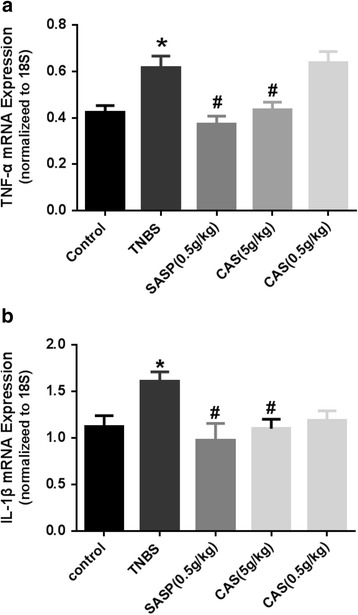
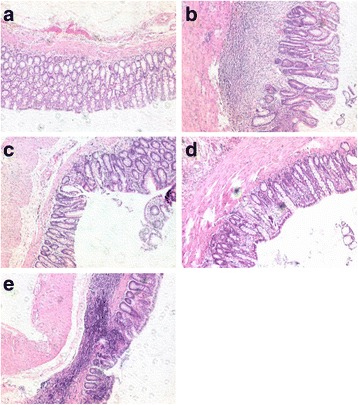
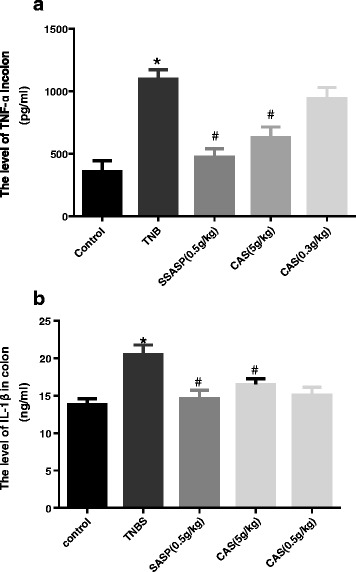
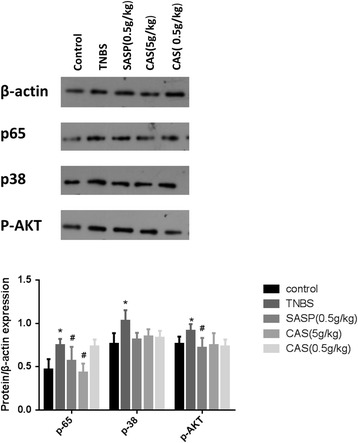
Oral administration of CAS at 5 g/kg/day, but not 0.5 g/kg/day, significantly ameliorated the severity of TNBS-induced colitis as evidenced by the reduced loss of body weight, alleviated diarrhea and decreased bloody stool. While lowering the disease activity index, the administration of CAS lessened mucosal lesions thus mucosal integrity of the colitis rats was notably improved. Further, the CAS treatment also significantly suppressed the mRNA and protein levels of pro-inflammatory cytokines, namely interleukin-1β and tumor necrosis factor-α while enhancing the level of anti-inflammatory cytokine IL-10 in the TNBS-treated rats. Importantly, the ameliorative effect of CAS was related to an inhibition of the nuclear factor-κB (NF-κB) signaling pathway by downregulating the expression levels of NF-κBp-65, p-38 and p-AKT.
We suggest that CAS is a potential alternative remedial approach for treating IBD conditions, and the anti-inflammatory effect of CAS is associated with the down-regulation of the NF-κB signaling pathway and the balanced production of pro- and anti-inflammatory cytokines.
炎症性肠病(IBD)以克罗恩病和溃疡性结肠炎为代表,常伴有腹痛、腹泻和便血。治疗结肠炎的标准方案并不令人满意;因此,补充和替代药物越来越受到全球IBD患者的认可。在本研究中,我们旨在阐明长安栓(CAS),一种由6味中药组成的中药配方,对2,4,6-三硝基苯磺酸(TNBS)诱导的大鼠结肠炎的抗炎作用及其潜在机制。
将2.5%TNBS溶于50%乙醇中,经直肠灌胃给予Sprague-Dawley大鼠,诱导实验性结肠炎,该模型被认为是克罗恩病的模型。在TNBS诱导后,给予大鼠0.5 g/kg/天或5 g/kg/天的CAS,持续10天。应用柳氮磺胺吡啶(0.5 g/kg/天)作为结肠炎的阳性对照药物。通过组织病理学和生化方法,如组织学染色、实时聚合酶链反应、蛋白质印迹分析和酶联免疫吸附测定,评估CAS的疗效和作用机制。
每天口服5 g/kg/天的CAS,而不是0.5 g/kg/天,显著改善了TNBS诱导的结肠炎的严重程度,表现为体重减轻减少、腹泻减轻和便血减少。在降低疾病活动指数的同时,给予CAS减轻了黏膜损伤,从而显著改善了结肠炎大鼠的黏膜完整性。此外,CAS治疗还显著抑制了促炎细胞因子白细胞介素-1β和肿瘤坏死因子-α的mRNA和蛋白质水平,同时提高了TNBS处理大鼠中抗炎细胞因子IL-10的水平。重要的是,CAS的改善作用与通过下调NF-κBp-65、p-38和p-AKT的表达水平抑制核因子-κB(NF-κB)信号通路有关。
我们认为CAS是治疗IBD的一种潜在替代治疗方法,其抗炎作用与NF-κB信号通路的下调以及促炎和抗炎细胞因子的平衡产生有关。