Becker Ricardo G, Gregianin Lauro J, Galia Carlos R, Jesus-Garcia Filho Reynaldo, Toller Eduardo A, Badell Gerardo, Nakagawa Suely A, David Alexandre, Baptista André M, Yonamime Eduardo S, Serafini Osvaldo A, Penna Valter, Santos Julie Francine C, Brunetto Algemir L
Service of Orthopedics and Traumatology, Hospital de Clínicas de Porto Alegre (HCPA), Rua Ramiro Barcelos, 2350, Bairro Santa Cecilia, Porto Alegre, RS, 90035-903, Brazil.
Department of Pediatrics, HCPA, Universidade Federal do Rio Grande do Sul (UFRGS), Porto Alegre, Brazil.
BMC Cancer. 2017 Jun 15;17(1):420. doi: 10.1186/s12885-017-3391-5.
Relapse in localized Ewing sarcoma patients has been a matter of concern regarding poor prognosis. Therefore, we investigated the impact of local control modality (surgery, surgery plus radiotherapy, and radiotherapy) on clinical outcomes such as survival and recurrence in patients with non-metastatic Ewing sarcoma treated on the first Brazilian Collaborative Group Trial of the Ewing Family of Tumors (EWING1).
Seventy-three patients with localized Ewing sarcoma of bone aged < 30 years were included. The treating physicians defined the modality of local control based on the recommendations of the coordinating center and the patient and tumor characteristics. Possible associations of local control modality with local failure (LF), disease-free survival (DFS), event-free survival (EFS), overall survival (OS), and clinical characteristics were analyzed.
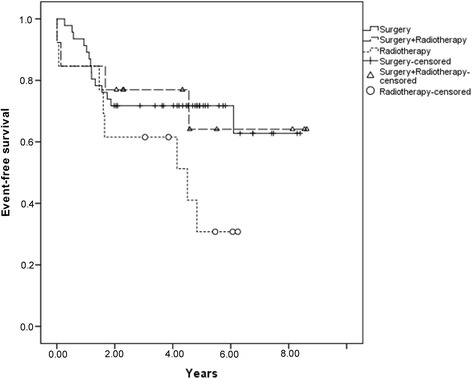
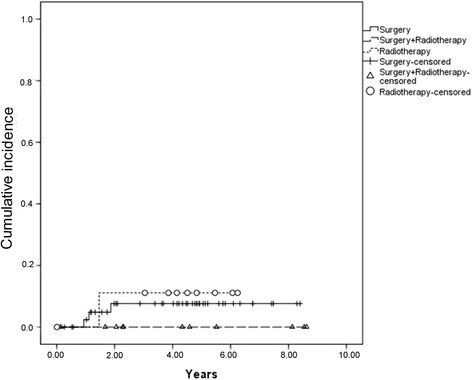
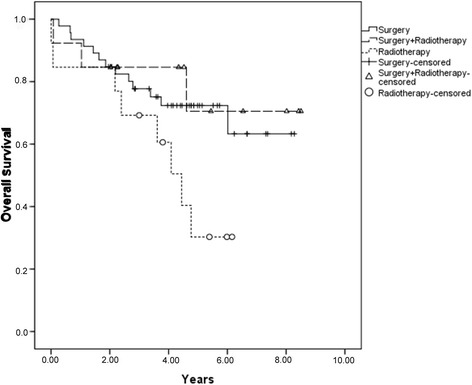
Mean patient age was 12.8 years (range, 2 to 25 years) and median follow-up time was 4.5 years (range, 2.3 to 6.7 years). Forty-seven patients underwent surgery, 13 received radiotherapy, and 13 received both. The 5-year EFS, OS, and DFS for all patients was 62.1%, 63.3%, and 73.1%, respectively. The 5-year cumulative incidence (CI) of LF was 7.6% for surgery, 11.1% for radiotherapy, and 0% for postoperative radiotherapy (PORT) (p = 0.61). The 5-year EFS was 71.7% for surgery, 30.8% for radiotherapy, and 64.1% for PORT (p = 0.009).
There was a significant effect of local control modality on EFS and OS in the study. Surgery and PORT modalities yielded very close results. The group treated with radiotherapy alone had considerably worse outcomes. This may be confounded by greater risk factors in these patients. There was no significant effect of local control modality on the CI of LF and DFS.
局部尤因肉瘤患者的复发一直是预后不良的一个令人担忧的问题。因此,我们在巴西尤因肿瘤家族首个协作组试验(EWING1)中,研究了局部控制方式(手术、手术加放疗和单纯放疗)对非转移性尤因肉瘤患者生存和复发等临床结局的影响。
纳入73例年龄小于30岁的局限性骨尤因肉瘤患者。治疗医生根据协调中心的建议以及患者和肿瘤特征确定局部控制方式。分析局部控制方式与局部失败(LF)、无病生存(DFS)、无事件生存(EFS)、总生存(OS)以及临床特征之间可能存在的关联。
患者平均年龄为12.8岁(范围2至25岁),中位随访时间为4.5年(范围2.3至6.7年)。47例患者接受了手术,13例接受了放疗,13例接受了手术加放疗。所有患者的5年EFS、OS和DFS分别为62.1%、63.3%和73.1%。手术组的5年LF累积发生率为7.6%,放疗组为11.1%,术后放疗(PORT)组为0%(p = 0.61)。手术组的5年EFS为71.7%,放疗组为30.8%,PORT组为64.1%(p = 0.009)。
在本研究中,局部控制方式对EFS和OS有显著影响。手术和PORT方式产生的结果非常接近。单纯放疗组的结局明显更差。这可能与这些患者存在更多危险因素有关。局部控制方式对LF和DFS的累积发生率没有显著影响。