Bora Pablo, Majumdar Anish S
Stempeutics Research Private Limited, Akshay Tech Park, # 72&73, 2nd Floor, EPIP Zone, Phase 1, Whitefield, Bangalore, 560066, India.
Present Address: Department of Molecular Biology & Genetics, Faculty of Science, Jihočeská univerzita v Českých Budějovicích (University of South Bohemia), Branišovská 31, 37005, České Budějovice, Czech Republic.
Stem Cell Res Ther. 2017 Jun 15;8(1):145. doi: 10.1186/s13287-017-0598-y.
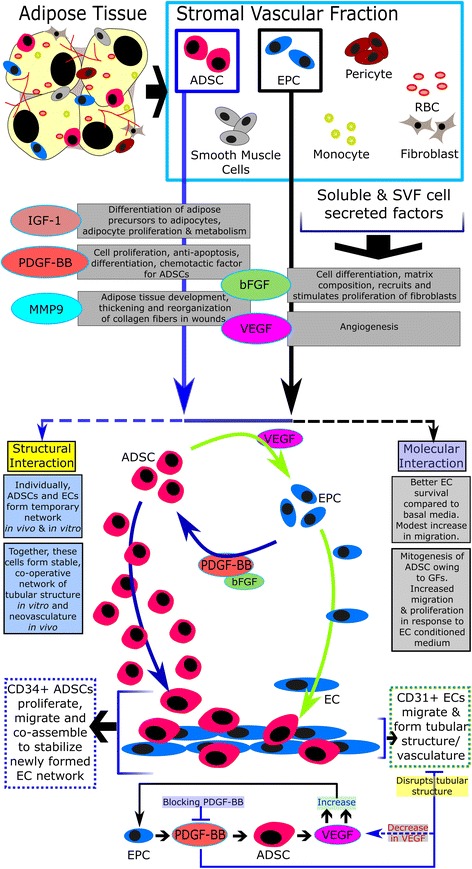
Adipose/fat tissue provides an abundant source of stromal vascular fraction (SVF) cells for immediate administration and can also give rise to a substantial number of cultured, multipotent adipose-derived stromal cells (ADSCs). Recently, both SVF and ADSCs have gained wide-ranging translational significance in regenerative medicine. Initially used for cosmetic breast enhancement, this mode of treatment has found use in many diseases involving immune disorders, tissue degeneration, and ischaemic conditions. In this review, we try to address several important aspects of this field, outlining the biology, technology, translation, and challenges related to SVF- and ADSC-based therapies. Starting from the basics of SVF and ADSC isolation, we touch upon recently developed technologies, addressing elements of novel methods and devices under development for point-of-care isolation of SVF. Characterisation of SVF cells and ADSCs is also an evolving area and we look into unusual expression of CD34 antigen as an interesting marker for such purposes. Based on reports involving different cells of the SVF, we draw a potential mode of action, focussing on angiogenesis since it involves multiple cells, unlike immunomodulation which is governed predominantly by ADSCs. We have looked into the latest research, experimental therapies, and clinical trials which are utilising SVF/ADSCs in conditions such as multiple sclerosis, Crohn's disease, peripheral neuropathy, osteoarthritis, diabetic foot ulcer, and so forth. However, problems have arisen with regards to the lack of proper regulatory guidelines for such therapies and, since the introduction of US Food and Drug Administration draft guidelines and the Reliable and Effective Growth for Regenerative Health Options that Improve Wellness (REGROW) Act, the debate became more public with regards to safe and efficacious use of these cells.
脂肪组织为即时给药提供了丰富的基质血管成分(SVF)细胞来源,还能产生大量培养的、多能的脂肪来源基质细胞(ADSC)。近来,SVF和ADSC在再生医学中都具有广泛的转化意义。这种治疗方式最初用于美容丰胸,现已在许多涉及免疫紊乱、组织退化和缺血性疾病的病症中得到应用。在本综述中,我们试图探讨该领域的几个重要方面,概述与基于SVF和ADSC的疗法相关的生物学、技术、转化及挑战。从SVF和ADSC分离的基础知识入手,我们谈及最近开发的技术,涉及正在研发的用于即时护理分离SVF的新方法和设备的要素。SVF细胞和ADSC的表征也是一个不断发展的领域,我们研究CD34抗原的异常表达作为用于此目的的一个有趣标志物。基于涉及SVF不同细胞的报告,我们得出一种潜在的作用模式,重点关注血管生成,因为它涉及多种细胞,这与主要由ADSC主导的免疫调节不同。我们研究了在多发性硬化症、克罗恩病、周围神经病变、骨关节炎、糖尿病足溃疡等病症中利用SVF/ADSC的最新研究、实验性疗法和临床试验。然而,此类疗法缺乏适当的监管指南引发了问题,并且自美国食品药品监督管理局(FDA)发布指南草案以及《改善健康的再生健康选项可靠有效增长(REGROW)法案》出台以来,关于安全有效使用这些细胞的争论变得更加公开化。