Chouhan Nitin Singh, Wolf Reinhard, Heisenberg Martin
Rudolf-Virchow-Center, 97080 Würzburg, Germany.
Learn Mem. 2017 Jun 15;24(7):318-321. doi: 10.1101/lm.045039.117. Print 2017 Jul.
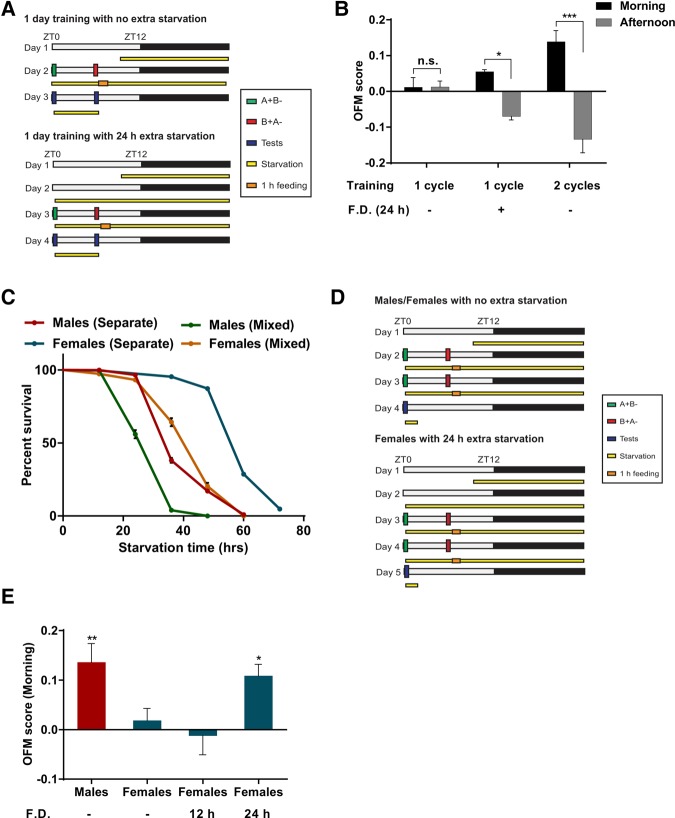
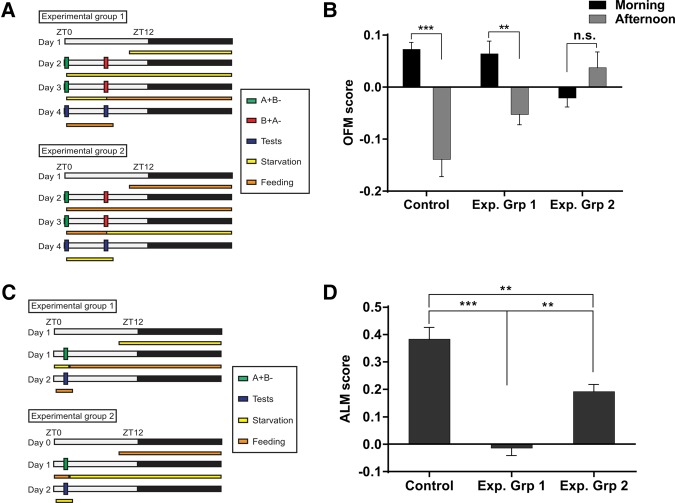
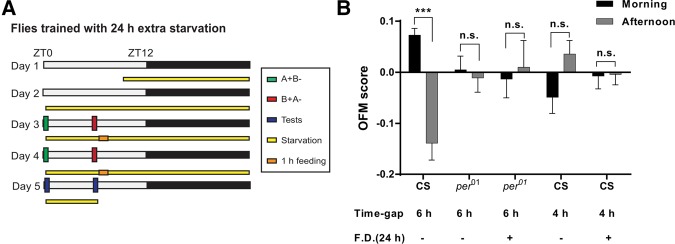
Starvation causes a motivational state that facilitates diverse behaviors such as feeding, walking, and search. Starved can form odor/feeding-time associations but the role of starvation in encoding of "time" is poorly understood. Here we show that the extent of starvation is correlated with the fly's ability to establish odor/feeding-time memories. Prolonged starvation promotes odor/feeding-time associations after just a single cycle of reciprocal training. We also show that starvation is required for acquisition but is dispensable for retrieval of odor/feeding-time memory. Finally, even with extended starvation, a functional circadian oscillator is indispensable for establishing odor/feeding-time memories.
饥饿会引发一种动机状态,这种状态会促进诸如进食、行走和搜寻等多种行为。饥饿的果蝇能够形成气味/进食时间关联,但饥饿在“时间”编码中的作用却鲜为人知。在这里,我们表明饥饿程度与果蝇建立气味/进食时间记忆的能力相关。长时间饥饿在经过一个单一周期的相互训练后就能促进气味/进食时间关联。我们还表明,获取气味/进食时间记忆需要饥饿,但检索该记忆时饥饿并非必需。最后,即使饥饿时间延长,功能性昼夜节律振荡器对于建立气味/进食时间记忆也是不可或缺的。