Sharafeddin Farahnaz, Koohpeima Fatemeh, Razazan Nader
Dept. of Operative Dentistry, Biomaterials Research Center, School of Dentistry, Shiraz University of Medical Sciences, Shiraz, Iran.
Dept. of Operative Dentistry, School of Dentistry, Shiraz University of Medical Sciences, Shiraz, Iran.
J Dent (Shiraz). 2017 Jun;18(2):82-87.
The bond strength of composites with different adhesive systems with dentin is an important factor in long term durability of composite restorations. The effect of titanium tetrafluoride (TiF) as anti caries agent and sodium hypochlorite (NaOCl) as disinfectant on the shear bond of nanofilled and silorane based composite resins have not been investigated in previous studies.
This study was conducted to determine bond strength between dentin and two composite systems, by means of shear bond test using TiF and NaOCl.
Middle dentin of 60 intact extracted maxillary premolar teeth were exposed by sectioning the crowns at a depth of 2mm from central groove and parallel to the occlusal surface. Standardized smear layer was created using a 600-grit silicon carbide paper and then samples were embedded in acrylic resin blocks. Then the samples were randomly divided into 6 \groups summarized as Group I: Z350, Group II: Z350+ NaOCl, Group III: Z350+ TiF, Group IV: P90, Group V: P90+ NaOCl, Group VI: P90+ TiF according to manufacturer's instruction. Then samples were subjected to shear bond strength (SBS) test using universal testing machine and data were analyzed using ANOVA and Tukey tests (< 0.05).
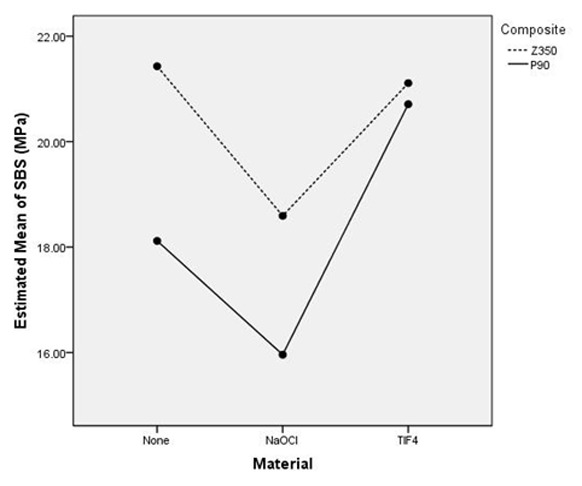
Application of 5% NaOCl caused a significant decrease in SBS of nanofilled composite resin (= 0.004), and also silorane based composite resin (= 0.006). Application of 4% TiF caused a significant increase in SBS of silorane based composite resin (= 0.001). The effect of TiF on nanofilled composite was not statistically significant.
Using TiF has a positive effect on increasing the shear bond while NaOCl has negative effect on bond strength.
不同粘结系统的复合材料与牙本质的粘结强度是复合树脂修复体长期耐久性的重要因素。以往研究尚未探讨四氟化钛(TiF)作为防龋剂和次氯酸钠(NaOCl)作为消毒剂对纳米填充和硅氧烷基复合树脂剪切粘结的影响。
本研究旨在通过使用TiF和NaOCl的剪切粘结试验来确定牙本质与两种复合系统之间的粘结强度。
将60颗完整拔除的上颌前磨牙的中层牙本质从中央沟处向牙合面平行方向切割,深度为2mm,暴露中层牙本质。使用600目碳化硅砂纸制备标准化的玷污层,然后将样本嵌入丙烯酸树脂块中。然后根据制造商的说明,将样本随机分为6组,分别为:第I组:Z350;第II组:Z350 + NaOCl;第III组:Z350 + TiF;第IV组:P90;第V组:P90 + NaOCl;第VI组:P90 + TiF。然后使用万能试验机对样本进行剪切粘结强度(SBS)测试,并使用方差分析和Tukey检验(<0.05)分析数据。
应用5%的NaOCl导致纳米填充复合树脂的SBS显著降低(=0.004),硅氧烷基复合树脂的SBS也显著降低(=0.006)。应用4%的TiF导致硅氧烷基复合树脂的SBS显著增加(=0.001)。TiF对纳米填充复合树脂的影响无统计学意义。
使用TiF对增加剪切粘结有积极作用,而NaOCl对粘结强度有负面影响。