Righy Cássia, do Brasil Pedro Emmanuel Americano, Vallés Jordi, Bozza Fernando A, Martin-Loeches Ignacio
National Institute of Infectious Disease Evandro Chagas, Oswaldo Cruz Foundation (FIOCRUZ), Rio de Janeiro, Brazil.
ICU, Paulo Niemeyer Brain Institute, Rio de Janeiro, Brazil.
Ann Intensive Care. 2017 Dec;7(1):67. doi: 10.1186/s13613-017-0291-4. Epub 2017 Jun 15.
Early-onset ventilator-associated pneumonia (EO-VAP) is the leading cause of morbidity and mortality in comatose patients. However, VAP prevention bundles focus mainly on late-onset VAP and may be less effective in preventing EO-VAP in comatose patients. Systemic antibiotic administration at the time of intubation may have a role in preventing EO-VAP. Therefore, we evaluated the effectiveness of systemic antibiotic administration in VAP prevention in comatose patients through a systematic review and meta-analysis.
We searched for studies published through December 2015 that evaluated systemic antibiotic prophylaxis in comatose patients. Two authors independently selected and evaluated full-length reports of randomized clinical trials or prospective cohorts in patients aged >16 years that evaluated the impact of systemic antibiotics at the time of intubation on EO-VAP compared to placebo or no prophylaxis. The outcome variables were the incidence of EO-VAP, the duration of mechanical ventilation, ICU length of stay, and ICU mortality.
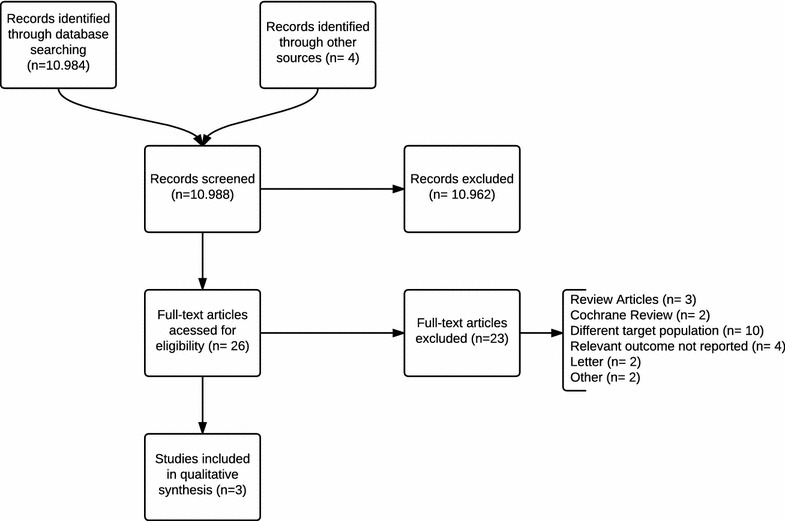
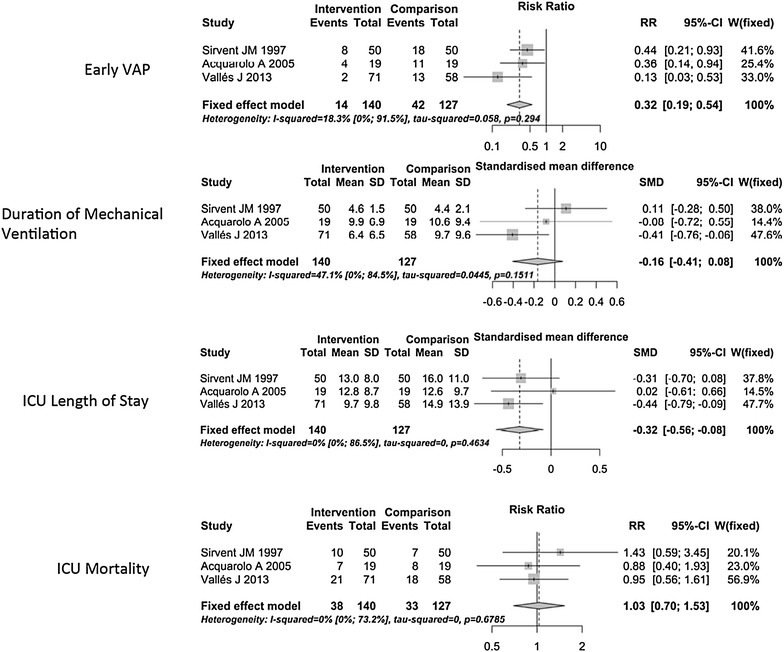
We identified 10,988 citations, yielding 26 articles for further analysis; three studies with 267 patients were finally analyzed. Most patients (n = 135) were comatose due to head trauma. Systemic antibiotic administration was associated with decreased incidence of EO-VAP (RR 0.32; 95% CI 0.19-0.54) and shorter ICU LOS (standardized mean difference -0.32; 95% CI -0.56 to -0.08), but had no effect on mortality (RR 1.03; 95% CI 0.7-1.53) or duration of mechanical ventilation (standardized mean difference -0.16; 95% CI -0.41 to 0.08).
Antibiotic prophylaxis in comatose patients reduced the incidence of EO-VAP and decreased the ICU stay slightly. Future trials are needed to confirm these results.
早发性呼吸机相关性肺炎(EO-VAP)是昏迷患者发病和死亡的主要原因。然而,呼吸机相关性肺炎预防集束主要关注晚发性VAP,在预防昏迷患者的EO-VAP方面可能效果较差。插管时全身性使用抗生素可能在预防EO-VAP中发挥作用。因此,我们通过系统评价和荟萃分析评估了全身性使用抗生素在预防昏迷患者VAP中的有效性。
我们检索了截至2015年12月发表的评估昏迷患者全身性抗生素预防的研究。两位作者独立选择并评估了年龄>16岁患者的随机临床试验或前瞻性队列的全文报告,这些研究评估了插管时全身性抗生素与安慰剂或不进行预防相比对EO-VAP的影响。结局变量为EO-VAP的发生率、机械通气时间、ICU住院时间和ICU死亡率。
我们识别出10988条引文,产生26篇文章以供进一步分析;最终分析了3项研究中的267例患者。大多数患者(n = 135)因头部外伤而昏迷。全身性使用抗生素与EO-VAP发生率降低(RR 0.32;95%CI 0.19 - 0.54)和ICU住院时间缩短(标准化均数差 -0.32;95%CI -0.56至 -0.08)相关,但对死亡率(RR 1.03;95%CI 0.7 - 1.53)或机械通气时间(标准化均数差 -0.16;95%CI -0.41至0.08)无影响。
昏迷患者的抗生素预防降低了EO-VAP的发生率,并略微缩短了ICU住院时间。需要进一步的试验来证实这些结果。