Kajonius Petri, Mac Giolla Erik
Department of Psychology, University of Gothenburg, Gothenburg, Sweden.
Department of Behavioral Sciences, University West, Trollhättan, Sweden.
PLoS One. 2017 Jun 16;12(6):e0179646. doi: 10.1371/journal.pone.0179646. eCollection 2017.
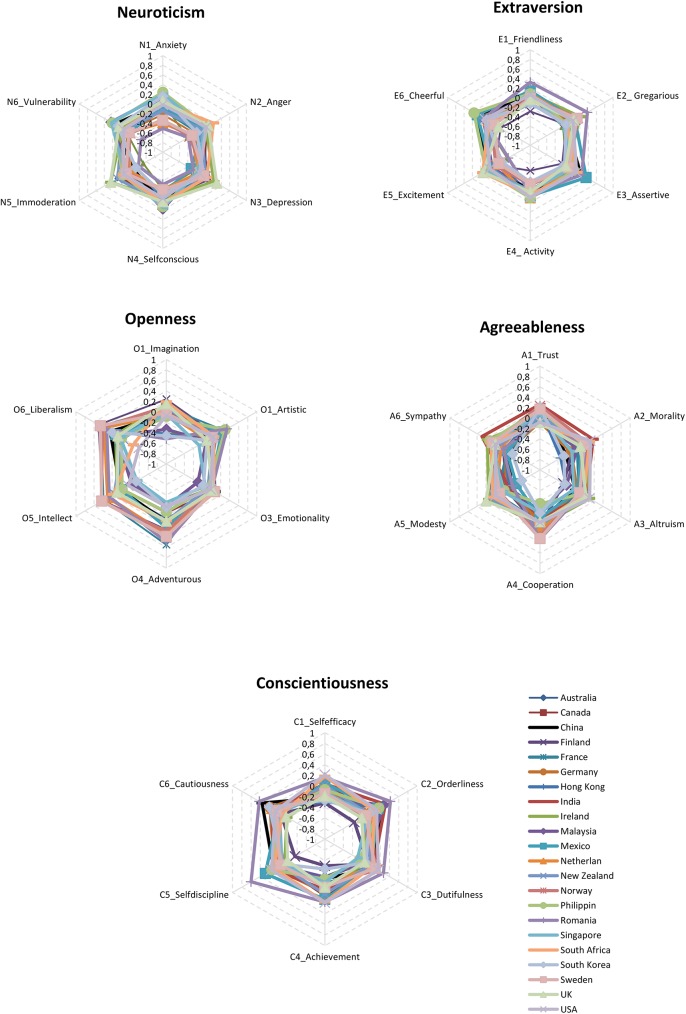
In the current climate of migration and globalization, personality characteristics of individuals from different countries have received a growing interest. Previous research has established reliable differences in personality traits across countries. The present study extends this research by examining 30 personality traits in 22 countries, based on an online survey in English with large national samples (NTotal = 130,602). The instrument used was a comprehensive, open-source measure of the Five Factor Model (FFM) (IPIP-NEO-120). We postulated that differences in personality traits between countries would be small, labeling this a Similarities Hypothesis. We found support for this in three stages. First, similarities across countries were observed for model fits for each of the five personality trait structures. Second, within-country sex differences for the five personality traits showed similar patterns across countries. Finally, the overall the contribution to personality traits from countries was less than 2%. In other words, the relationship between a country and an individual's personality traits, however interesting, are small. We conclude that the most parsimonious explanation for the current and past findings is a cross-country personality Similarities Hypothesis.
在当前移民和全球化的大环境下,来自不同国家的个体的性格特征受到了越来越多的关注。以往的研究已经证实了不同国家在人格特质方面存在可靠的差异。本研究在此基础上进行拓展,基于一项面向各国大量样本(总样本量(N_{Total}=130,602))的英文在线调查,对22个国家的30种人格特质进行了考察。所使用的工具是五因素模型(FFM)的一种全面的开源测量方法(IPIP-NEO-120)。我们假设各国之间人格特质的差异会很小,将此称为相似性假设。我们在三个阶段找到了对这一假设的支持。首先,观察到五个个性特质结构中的每一个在各国的模型拟合上都存在相似性。其次,五个个性特质的国内性别差异在各国呈现出相似的模式。最后,各国对人格特质的总体贡献小于2%。换句话说,一个国家与个体人格特质之间的关系,无论多么有趣,都是微小的。我们得出结论,对当前和以往研究结果最简洁的解释是跨国人格相似性假设。