Leiden University Medical Center, Center for Proteomics and Metabolomics, Leiden, The Netherlands.
University of Applied Sciences Leiden, Leiden, The Netherlands.
Sci Rep. 2017 Jun 16;7(1):3733. doi: 10.1038/s41598-017-03838-y.
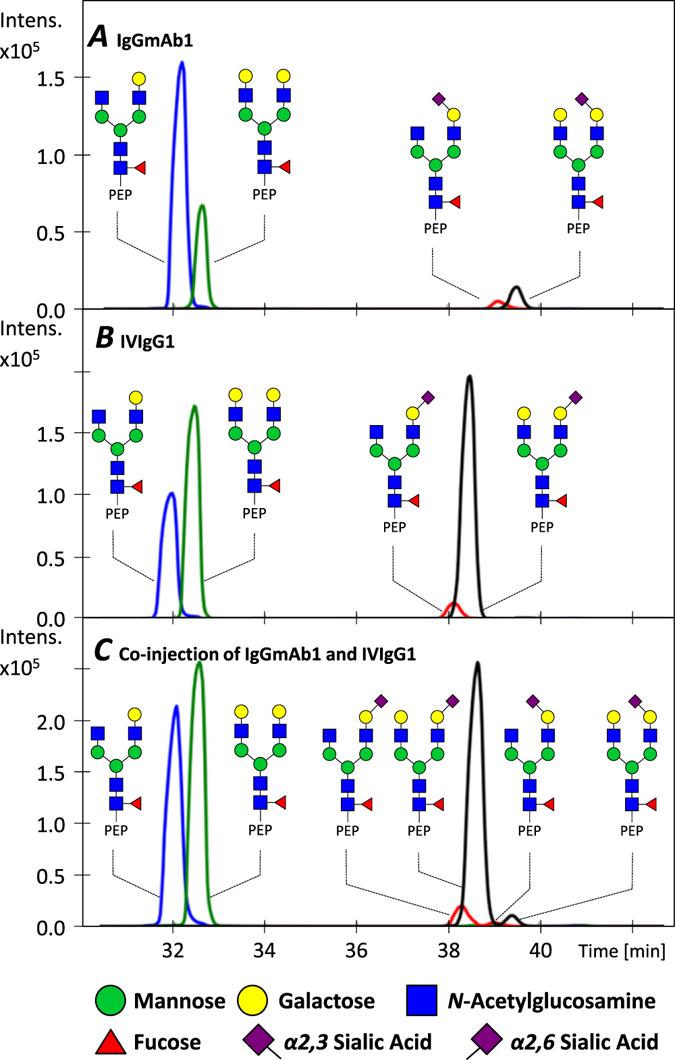
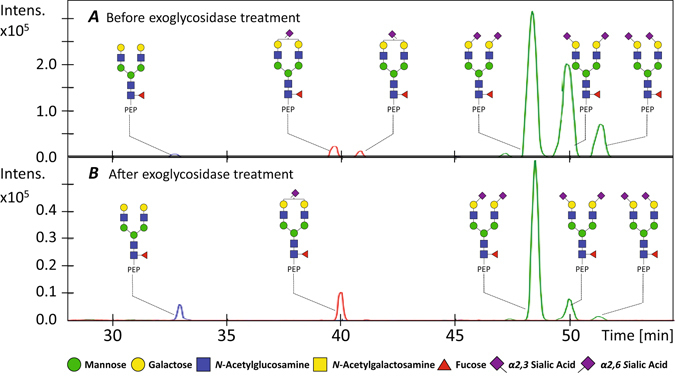
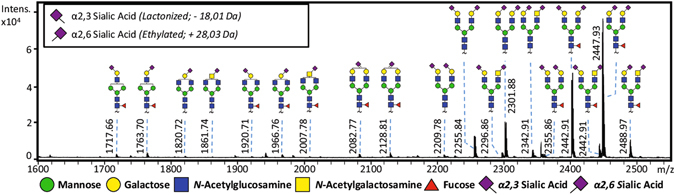
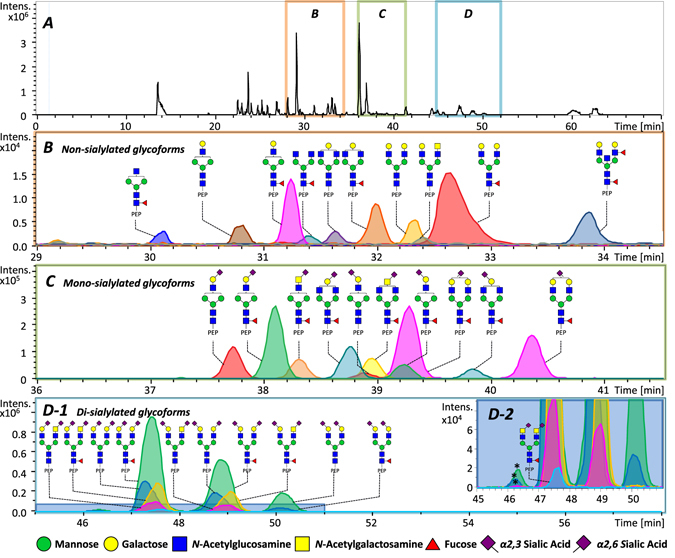
Sialylation is a glycosylation feature that occurs in different linkages at the non-reducing end of a glycan moiety, the linkage isomers are often differentially associated with various biological processes. Due to very similar physico-chemical properties, the separation of isomeric sialylated glycopeptides remains challenging but of utmost importance in the biomedicine and biotechnology, including biomarker discovery, glyco-engineering and biopharmaceutical characterization. This study presents the implementation of a high-resolution separation platform based on capillary electrophoresis - mass spectrometry (CE-MS) allowing for the selective analysis of α2,3- and α2,6-sialylated glycopeptides. These differentially linked glycopeptides showed an identical fragmentation pattern (collision induced dissociation) but different electrophoretic mobilities, allowing for baseline separation of the different linkages without the need for an extensive sample preparation. The different migration behavior between the two moieties was found to correlate with differences in pK values. Using a novel methodology adapted from the so-called internal standard CE approach, a relative difference of 3.4·10 in pK unit was determined. This approach was applied for the analysis of tryptic glycopeptides of prostate specific antigen, which shows highly complex and heterogeneous glycosylation. The developed platform therefore appears attractive for the identification of differentially linked sialic acids that may be related to pathological conditions.
唾液酸化是一种糖基化特征,发生在聚糖部分的非还原末端的不同连接上,连接异构体通常与各种生物过程相关。由于具有非常相似的物理化学性质,因此分离异构唾液酸化糖肽仍然具有挑战性,但在包括生物标志物发现、糖工程和生物制药特性分析在内的生物医学和生物技术中至关重要。本研究提出了一种基于毛细管电泳-质谱(CE-MS)的高分辨率分离平台的实施,该平台允许选择性分析α2,3-和α2,6-唾液酸化糖肽。这些不同连接的糖肽表现出相同的片段化模式(碰撞诱导解离),但电泳迁移率不同,允许在无需广泛的样品制备的情况下对不同连接进行基线分离。发现两种结构之间的不同迁移行为与 pK 值的差异相关。使用一种新的方法学,该方法学源自所谓的内标 CE 方法,确定了 3.4·10 的 pK 单位相对差异。该方法应用于前列腺特异性抗原的胰蛋白酶糖肽分析,其显示出高度复杂和异质的糖基化。因此,开发的平台似乎很有吸引力,可以用于鉴定可能与病理状况相关的不同连接的唾液酸。