Department of Immunology and Microbiology, University of Colorado School of Medicine, Aurora, Colorado, USA.
Department of Biostatistics and Informatics, Colorado School of Public Health, Aurora, Colorado, USA.
Sci Rep. 2017 Jun 16;7(1):3633. doi: 10.1038/s41598-017-03295-7.
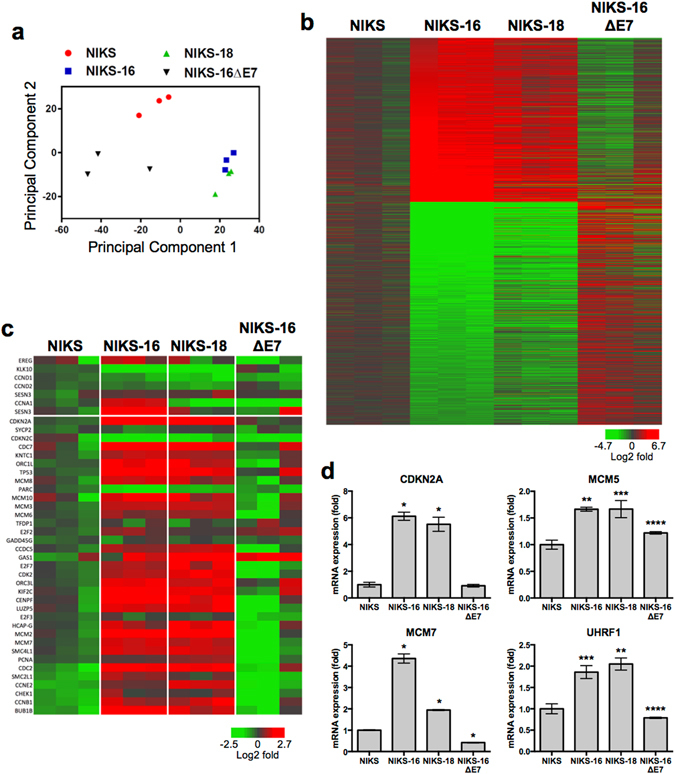
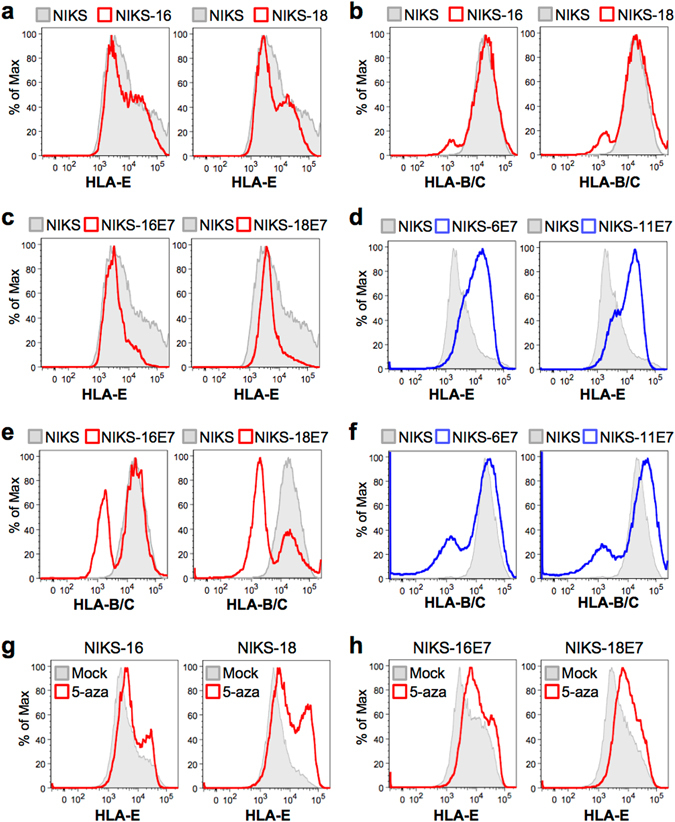
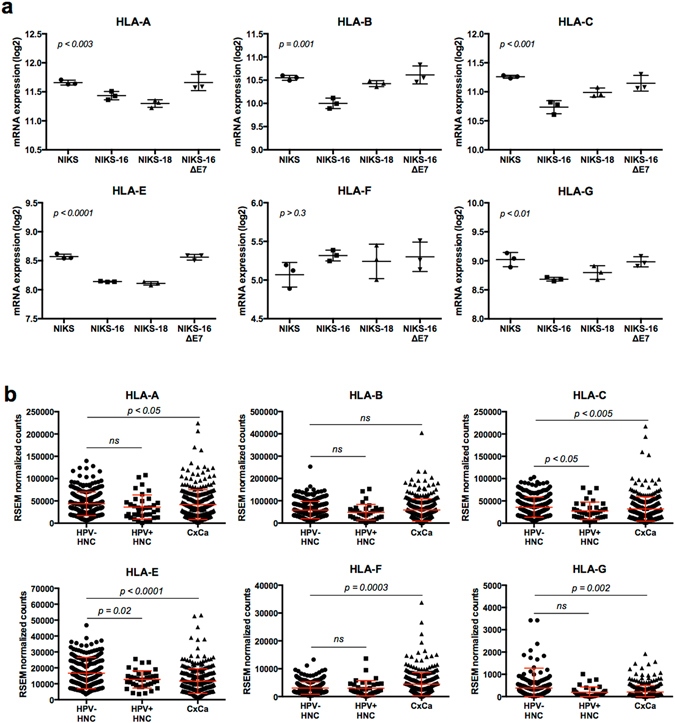
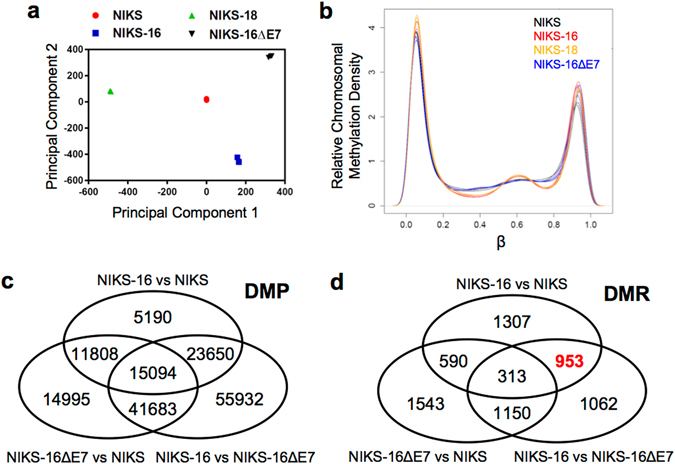
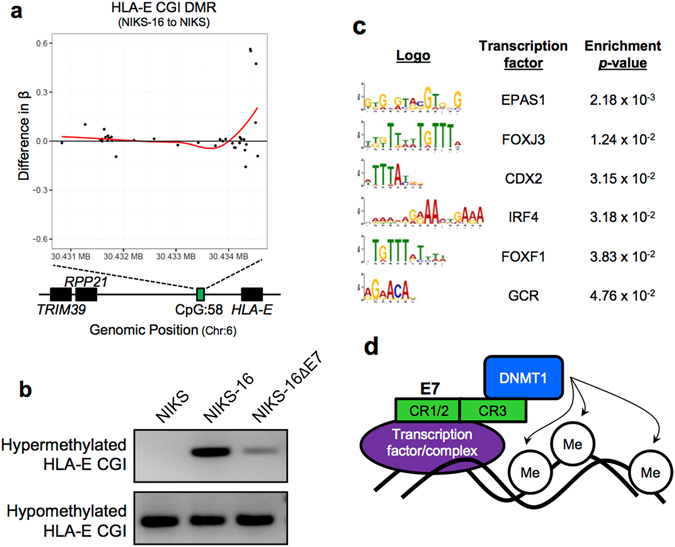
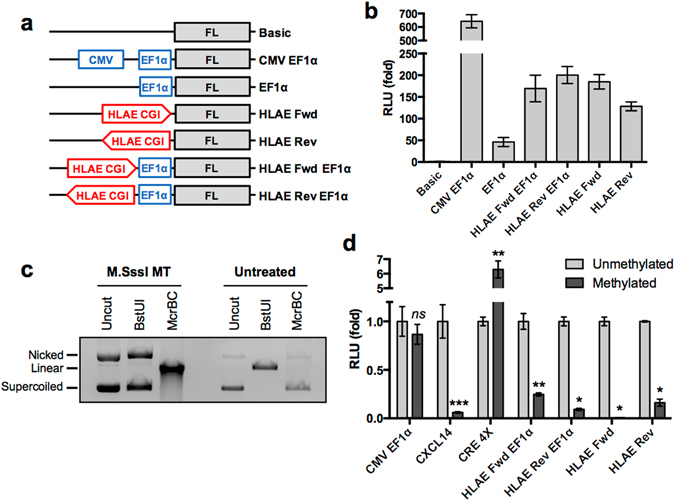
Human papillomavirus (HPV) infection distinctly alters methylation patterns in HPV-associated cancer. We have recently reported that HPV E7-dependent promoter hypermethylation leads to downregulation of the chemokine CXCL14 and suppression of antitumor immune responses. To investigate the extent of gene expression dysregulated by HPV E7-induced DNA methylation, we analyzed parallel global gene expression and DNA methylation using normal immortalized keratinocyte lines, NIKS, NIKS-16, NIKS-18, and NIKS-16∆E7. We show that expression of the MHC class I genes is downregulated in HPV-positive keratinocytes in an E7-dependent manner. Methylome analysis revealed hypermethylation at a distal CpG island (CGI) near the HLA-E gene in NIKS-16 cells compared to either NIKS cells or NIKS-16∆E7 cells, which lack E7 expression. The HLA-E CGI functions as an active promoter element which is dramatically repressed by DNA methylation. HLA-E protein expression on cell surface is downregulated by high-risk HPV16 and HPV18 E7 expression, but not by low-risk HPV6 and HPV11 E7 expression. Conversely, demethylation at the HLA-E CGI restores HLA-E protein expression in HPV-positive keratinocytes. Because HLA-E plays an important role in antiviral immunity by regulating natural killer and CD8 T cells, epigenetic downregulation of HLA-E by high-risk HPV E7 may contribute to virus-induced immune evasion during HPV persistence.
人乳头瘤病毒(HPV)感染明显改变 HPV 相关癌症中的甲基化模式。我们最近报道 HPV E7 依赖性启动子超甲基化导致趋化因子 CXCL14 的下调和抗肿瘤免疫反应的抑制。为了研究 HPV E7 诱导的 DNA 甲基化所导致的基因表达失调的程度,我们使用正常永生化角质形成细胞系 NIKS、NIKS-16、NIKS-18 和 NIKS-16∆E7 进行了平行的全局基因表达和 DNA 甲基化分析。我们发现 HPV 阳性角质形成细胞中 MHC Ⅰ类基因的表达呈 E7 依赖性下调。甲基组分析显示,与 NIKS 细胞或缺乏 E7 表达的 NIKS-16∆E7 细胞相比,NIKS-16 细胞中 HLA-E 基因附近的远端 CpG 岛(CGI)呈超甲基化。HLA-E CGI 作为一个活性启动子元件,其活性被 DNA 甲基化显著抑制。高危型 HPV16 和 HPV18 E7 表达下调 HLA-E 蛋白在细胞表面的表达,而非低危型 HPV6 和 HPV11 E7 表达。相反,HLA-E CGI 的去甲基化恢复了 HPV 阳性角质形成细胞中的 HLA-E 蛋白表达。由于 HLA-E 通过调节自然杀伤细胞和 CD8 T 细胞在抗病毒免疫中发挥重要作用,高危型 HPV E7 的表观遗传下调可能有助于 HPV 持续存在期间病毒诱导的免疫逃逸。