Sugar Elizabeth A, Venugopal Vidya, Thorne Jennifer E, Frick Kevin D, Holland Gary N, Wang Robert C, Almanzor Robert, Jabs Douglas A, Holbrook Janet T
Department of Biostatistics, The Johns Hopkins Bloomberg School of Public Health, Baltimore, Maryland; Department of Epidemiology, The Johns Hopkins Bloomberg School of Public Health, Baltimore, Maryland; Center for Clinical Trials, The Johns Hopkins Bloomberg School of Public Health, Baltimore, Maryland; Division of Biostatistics and Bioinformatics, The Sidney Kimmel Comprehensive Cancer Center, The Johns Hopkins School of Medicine, Baltimore, Maryland.
Department of Epidemiology, University of Pittsburgh, Pittsburgh, Pennsylvania.
Ophthalmology. 2017 Nov;124(11):1662-1669. doi: 10.1016/j.ophtha.2017.05.015. Epub 2017 Jun 16.
To evaluate longitudinal vision-related quality of life (VRQoL) in patients with noninfectious uveitis.
Cohort study using randomized controlled trial data.
Patients with active or recently active intermediate uveitis, posterior uveitis, or panuveitis enrolled in the Multicenter Steroid Treatment Trial and Follow-up Study.
Data from the 25-item National Eye Institute Visual Functioning Questionnaire (NEI-VFQ-25) for the first 3 years after randomization were evaluated semiannually. Analyses were stratified by assigned treatment (129 implants vs. 126 systemic therapies) because of substantial differences in the trajectories of VRQoL. The impact of baseline measurements of visual function (visual acuity and visual field), demographics, and disease characteristics was assessed using generalized estimating equations.
Primary outcome was the NEI-VFQ-25 composite score over 3 years after randomization.
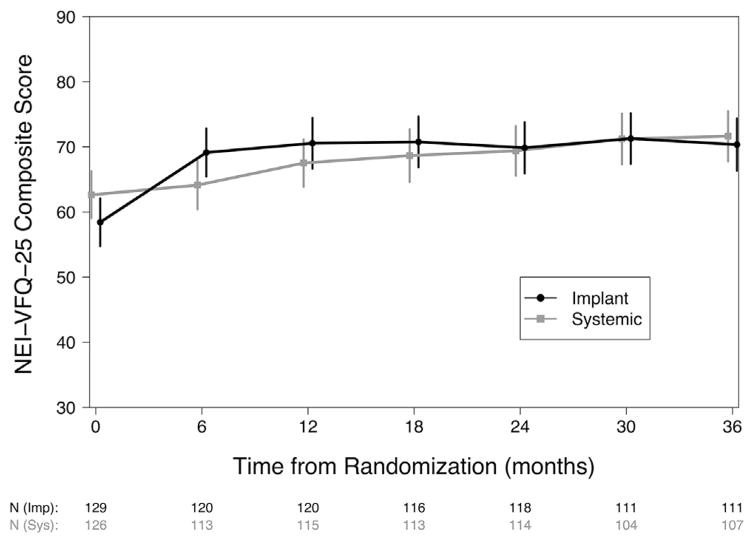
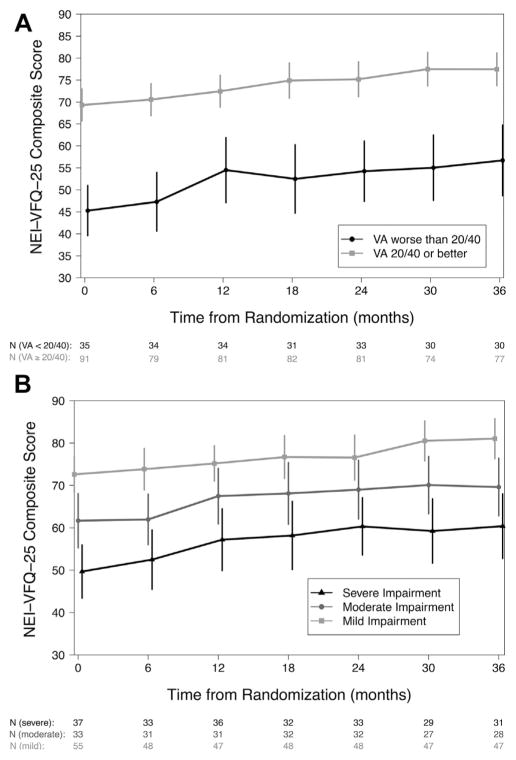
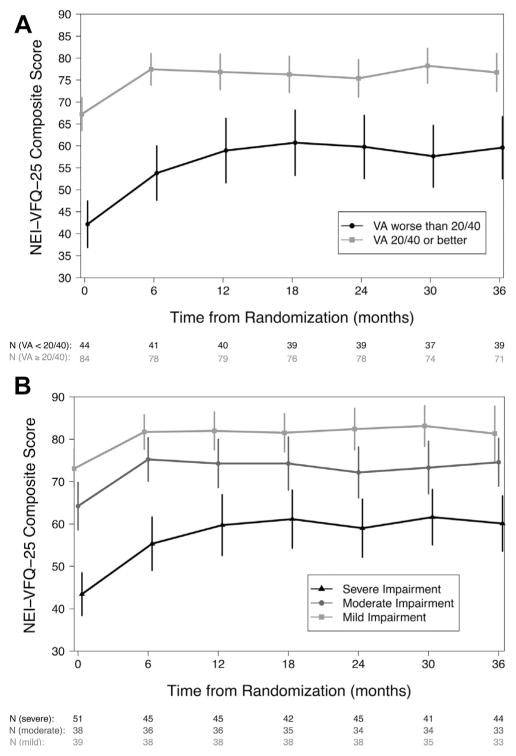
Individuals in both treatment groups showed similar improvement in NEI-VFQ-25 scores after 3 years of follow-up (implant: 11.9 points; 95% confidence interval [CI], 8.6-15.2; P < 0.001; systemic: 9.0 points; 95% CI, 5.6-12.3; P < 0.001; P = 0.21 for interaction). Individuals in the implant group showed a substantial improvement during the first 6 months followed by stable scores, whereas individuals in the systemic group showed a steady improvement over the course of follow-up. Worse initial visual acuity and visual fields were associated with lower initial NEI-VFQ-25 scores for both treatment groups. In the systemic group, these differences were maintained throughout follow-up. In the implant group, individuals with initial visual acuity worse than 20/40 showed additional improvement in NEI-VFQ-25 score to come within -7 points (95% CI, -15.0 to 0.9) of those with visual acuity 20/40 or better initially, a clinically meaningful but not statistically significant difference (P = 0.081). Results based on sensitivity analyses showed similar patterns.
Both treatment groups demonstrated significant improvements in NEI-VFQ-25 scores; however, the improvement was immediate for the implant group as opposed to gradual for the systemic group. Poorer visual function was associated significantly with initial differences in NEI-VFQ-25 scores. However, only individuals in the implant group with poor visual acuity were able to overcome their initial deficits by the end of 3 years.
评估非感染性葡萄膜炎患者与视力相关的纵向生活质量(VRQoL)。
使用随机对照试验数据的队列研究。
参加多中心类固醇治疗试验及随访研究的活动性或近期活动性中间葡萄膜炎、后葡萄膜炎或全葡萄膜炎患者。
对随机分组后前3年的25项美国国立眼科研究所视觉功能问卷(NEI-VFQ-25)数据每半年评估一次。由于VRQoL轨迹存在显著差异,分析按指定治疗方式分层(129例植入治疗与126例全身治疗)。使用广义估计方程评估视觉功能(视力和视野)、人口统计学和疾病特征的基线测量的影响。
主要结局是随机分组后3年的NEI-VFQ-25综合评分。
两个治疗组的个体在随访3年后NEI-VFQ-25评分均有相似改善(植入治疗组:11.9分;95%置信区间[CI],8.6 - 15.2;P < 0.001;全身治疗组:9.0分;95% CI,5.6 - 12.3;P < 0.001;交互作用P = 0.21)。植入治疗组个体在最初6个月有显著改善,随后评分稳定,而全身治疗组个体在随访过程中呈稳步改善。两个治疗组中,较差的初始视力和视野与较低的初始NEI-VFQ-25评分相关。在全身治疗组中,这些差异在整个随访过程中持续存在。在植入治疗组中,初始视力低于20/40的个体NEI-VFQ-25评分额外改善,与初始视力为20/40或更好的个体相差在-7分以内(95% CI,-15.0至0.9),这是一个具有临床意义但无统计学显著性的差异(P = 0.081)。敏感性分析结果显示类似模式。
两个治疗组的NEI-VFQ-25评分均有显著改善;然而,植入治疗组的改善是即时的,而全身治疗组是渐进的。较差的视觉功能与NEI-VFQ-25评分的初始差异显著相关。然而,只有植入治疗组中视力差的个体在3年末能够克服其初始缺陷。