Evidera, Bethesda, Maryland.
Allergan Inc, Irvine, California.
JAMA Ophthalmol. 2014 Mar;132(3):310-8. doi: 10.1001/jamaophthalmol.2013.7639.
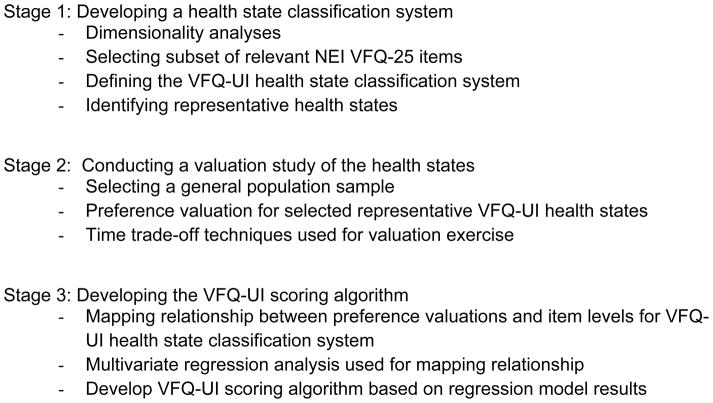
Understanding how individuals value health states is central to patient-centered care and to health policy decision making. Generic preference-based measures of health may not effectively capture the impact of ocular diseases. Recently, 6 items from the National Eye Institute Visual Function Questionnaire-25 were used to develop the Visual Function Questionnaire-Utility Index health state classification, which defines visual function health states.
To describe elicitation of preferences for health states generated from the Visual Function Questionnaire-Utility Index health state classification and development of an algorithm to estimate health preference scores for any health state.
DESIGN, SETTING, AND PARTICIPANTS: Nonintervention, cross-sectional study of the general community in 4 countries (Australia, Canada, United Kingdom, and United States). A total of 607 adult participants were recruited from local newspaper advertisements. In the United Kingdom, an existing database of participants from previous studies was used for recruitment.
Eight of 15,625 possible health states from the Visual Function Questionnaire-Utility Index were valued using time trade-off technique.
A θ severity score was calculated for Visual Function Questionnaire-Utility Index-defined health states using item response theory analysis. Regression models were then used to develop an algorithm to assign health state preference values for all potential health states defined by the Visual Function Questionnaire-Utility Index.
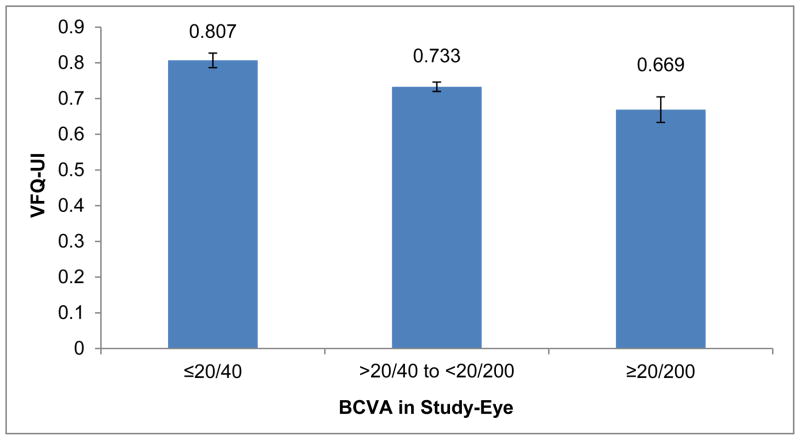
Health state preference values for the 8 states ranged from a mean (SD) of 0.343 (0.395) to 0.956 (0.124). As expected, preference values declined with worsening visual function. Results indicate that the Visual Function Questionnaire-Utility Index describes states that participants view as spanning most of the continuum from full health to dead.
Visual Function Questionnaire-Utility Index health state classification produces health preference scores that can be estimated in vision-related studies that include the National Eye Institute Visual Function Questionnaire-25. These preference scores may be of value for estimating utilities in economic and health policy analyses.
了解个体如何看待健康状况是患者为中心的护理和卫生政策决策的核心。通用的基于偏好的健康衡量标准可能无法有效地捕捉眼部疾病的影响。最近,使用国家眼科研究所视觉功能问卷-25 的 6 个项目来开发视觉功能问卷效用指数健康状况分类,该分类定义了视觉功能健康状况。
描述从视觉功能问卷效用指数健康状况分类中得出的健康状况偏好的启发式方法,并开发一种算法来估算任何健康状况的健康偏好评分。
设计、设置和参与者:在 4 个国家(澳大利亚、加拿大、英国和美国)的一般社区进行的非干预、横断面研究。从当地报纸广告中招募了总共 607 名成年参与者。在英国,利用以前研究的参与者的现有数据库进行招募。
使用时间权衡技术对视觉功能问卷效用指数中的 15625 种可能健康状态中的 8 种进行了估值。
使用项目反应理论分析为视觉功能问卷效用指数定义的健康状态计算了θ严重程度评分。然后,使用回归模型开发了一种算法,为视觉功能问卷效用指数定义的所有潜在健康状态分配健康状态偏好值。
8 种状态的健康状态偏好值范围从 0.343(0.395)到 0.956(0.124)的平均值(标准差)。如预期的那样,偏好值随着视觉功能的恶化而下降。结果表明,视觉功能问卷效用指数描述了参与者认为从完全健康到死亡的大部分连续体的状态。
视觉功能问卷效用指数健康状况分类产生的健康偏好评分可在包括国家眼科研究所视觉功能问卷-25 的视力相关研究中进行估计。这些偏好评分在经济和卫生政策分析中的效用估计中可能具有价值。