Liu Bin, Yang Fan, Chou Kuo-Chen
School of Computer Science and Technology, Harbin Institute of Technology Shenzhen Graduate School, Shenzhen, Guangdong 518055, China; Key Laboratory of Network Oriented Intelligent Computation, Harbin Institute of Technology Shenzhen Graduate School, Shenzhen, Guangdong 518055, China; Gordon Life Science Institute, Belmont, MA 02478, USA.
School of Computer Science and Technology, Harbin Institute of Technology Shenzhen Graduate School, Shenzhen, Guangdong 518055, China.
Mol Ther Nucleic Acids. 2017 Jun 16;7:267-277. doi: 10.1016/j.omtn.2017.04.008. Epub 2017 Apr 13.
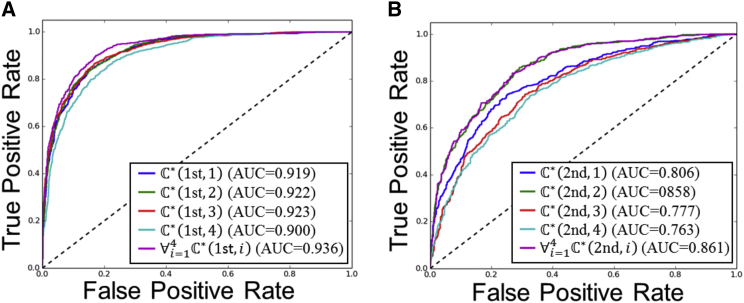
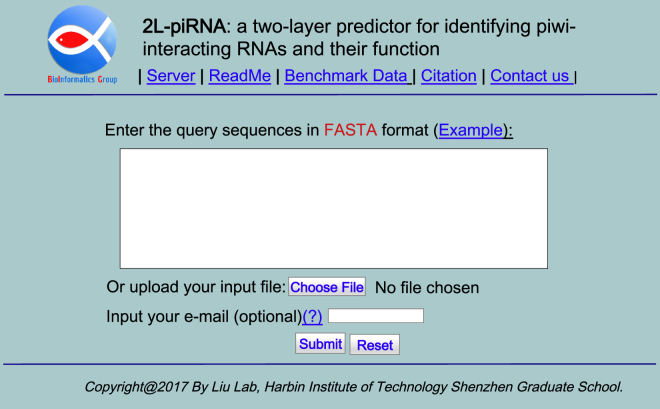
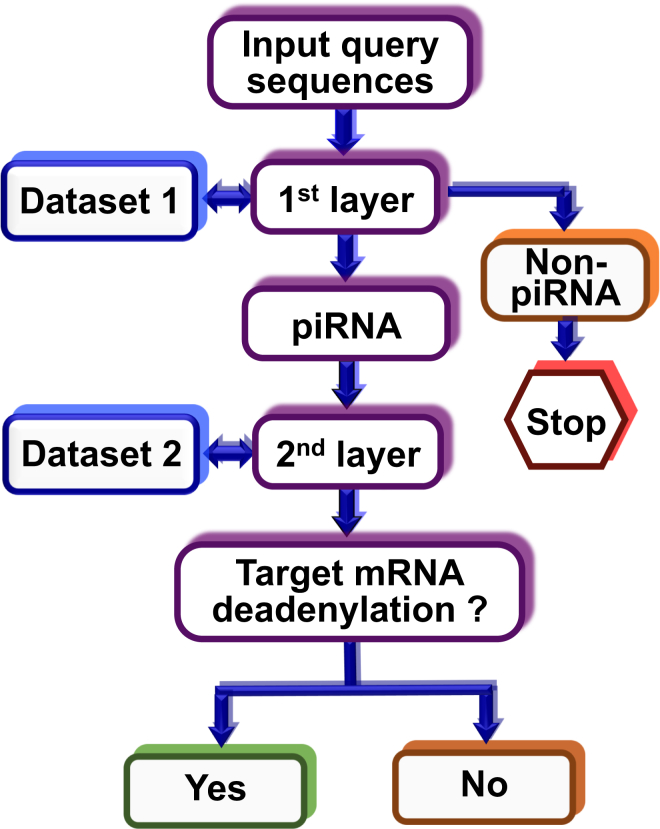
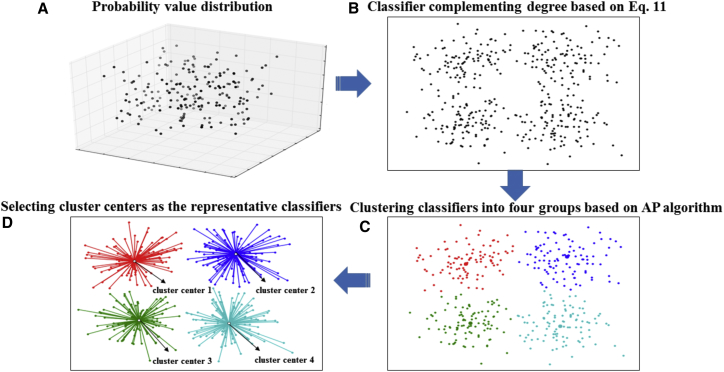
Involved with important cellular or gene functions and implicated with many kinds of cancers, piRNAs, or piwi-interacting RNAs, are of small non-coding RNA with around 19-33 nt in length. Given a small non-coding RNA molecule, can we predict whether it is of piRNA according to its sequence information alone? Furthermore, there are two types of piRNA: one has the function of instructing target mRNA deadenylation, and the other does not. Can we discriminate one from the other? With the avalanche of RNA sequences emerging in the postgenomic age, it is urgent to address the two problems for both basic research and drug development. Unfortunately, to the best of our knowledge, so far no computational methods whatsoever could be used to deal with the second problem, let alone deal with the two problems together. Here, by incorporating the physicochemical properties of nucleotides into the pseudo K-tuple nucleotide composition (PseKNC), we proposed a powerful predictor called 2L-piRNA. It is a two-layer ensemble classifier, in which the first layer is for identifying whether a query RNA molecule is piRNA or non-piRNA, and the second layer for identifying whether a piRNA is with or without the function of instructing target mRNA deadenylation. Rigorous cross-validations have indicated that the success rates achieved by the proposed predictor are quite high. For the convenience of most biologists and drug development scientists, the web server for 2L-piRNA has been established at http://bioinformatics.hitsz.edu.cn/2L-piRNA/, by which users can easily get their desired results without the need to go through the mathematical details.
PIWI相互作用RNA(piRNA)参与重要的细胞或基因功能,并与多种癌症相关,是一类长度约为19 - 33个核苷酸的小型非编码RNA。对于一个小型非编码RNA分子,我们能否仅根据其序列信息预测它是否为piRNA?此外,piRNA有两种类型:一种具有指导靶mRNA去腺苷酸化的功能,另一种则没有。我们能否将它们区分开来?在后基因组时代,随着RNA序列的大量涌现,从基础研究和药物开发的角度来看,迫切需要解决这两个问题。不幸的是,据我们所知,到目前为止还没有任何计算方法可用于处理第二个问题,更不用说同时处理这两个问题了。在这里,通过将核苷酸的物理化学性质纳入伪K元核苷酸组成(PseKNC),我们提出了一种强大的预测器,称为2L-piRNA。它是一个两层的集成分类器,其中第一层用于识别查询的RNA分子是piRNA还是非piRNA,第二层用于识别piRNA是否具有指导靶mRNA去腺苷酸化的功能。严格的交叉验证表明,所提出的预测器取得的成功率相当高。为了方便大多数生物学家和药物开发科学家,已在http://bioinformatics.hitsz.edu.cn/2L-piRNA/建立了2L-piRNA的网络服务器,用户可以通过该服务器轻松获得他们想要的结果,而无需了解数学细节。