David H. Koch Institute for Integrative Cancer Research, Massachusetts Institute of Technology, 500 Main Street, Cambridge, MA 02142, USA.
David H. Koch Institute for Integrative Cancer Research, Massachusetts Institute of Technology, 500 Main Street, Cambridge, MA 02142, USA.
Vaccine. 2018 May 24;36(22):3161-3168. doi: 10.1016/j.vaccine.2017.05.094. Epub 2017 Jun 19.
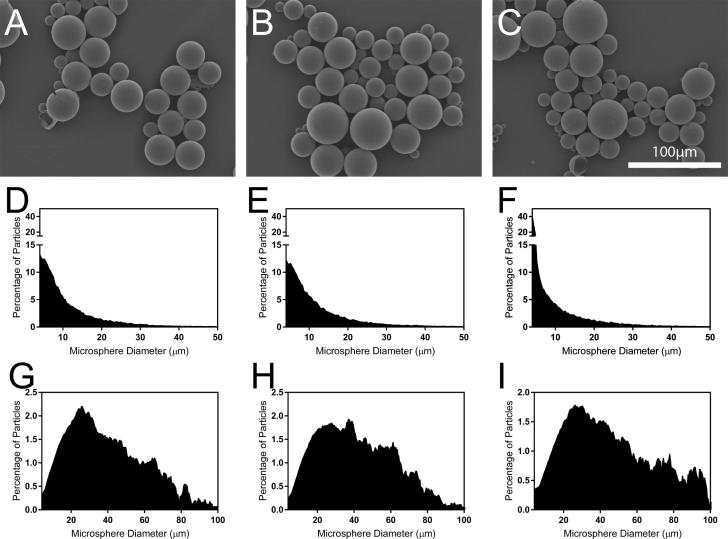
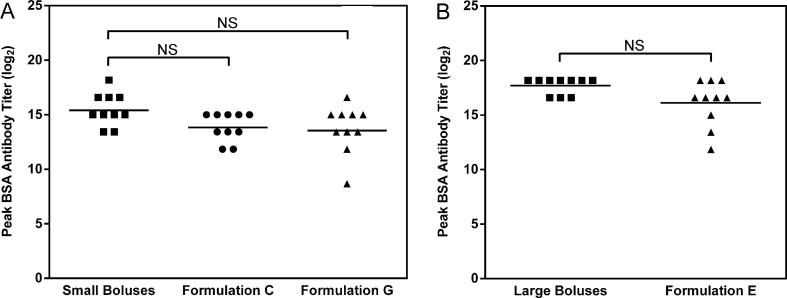
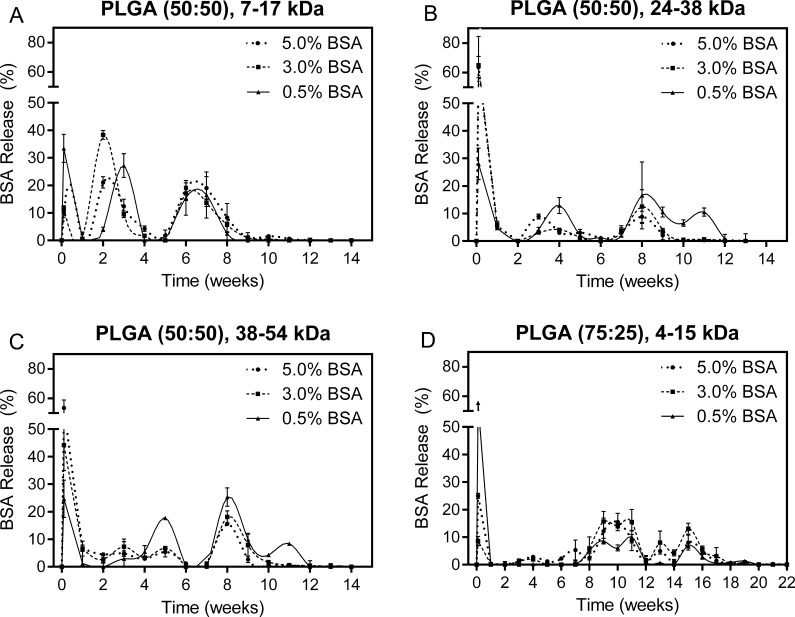
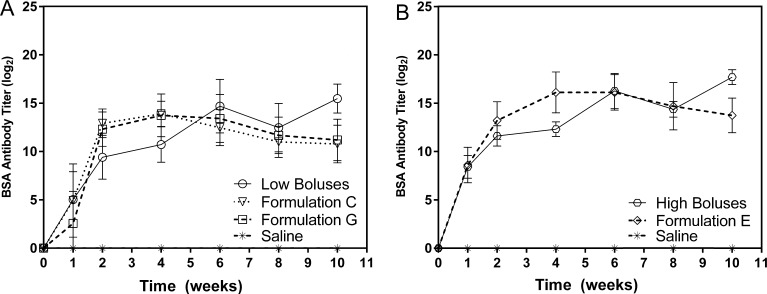
The World Health Organization's Expanded Programme on Immunization has led to a dramatic rise in worldwide vaccination rates over the past 40years, yet 19.4 million infants remain underimmunized each year. Many of these infants have received at least one vaccine dose but may remain unprotected because they did not receive subsequent booster doses due to logistical challenges. This study aimed to develop injectable controlled release microparticles with kinetics that mimic common vaccine dosing regimens consisting of large antigen doses administered periodically over the course of months in order to eliminate the need for boosters. Sixteen poly(lactic-co-glycolic acid) (PLGA) microsphere formulations containing bovine serum albumin (BSA) as a model vaccine antigen were screened in vitro to determine their respective release kinetics. Three formulations that exhibited desirable pulsatile release profiles were then selected for studying immunogenicity in mice. Two low-dose microsphere formulations induced peak anti-BSA IgG antibody titers of 13.9±1.3 and 13.7±2.2 log compared to 15.5±1.5 log for a series of three bolus injections delivered at 0, 4, and 8weeks with an equivalent cumulative dose. Similarly, high-dose formulations induced peak antibody titers that were 16.1±2.1 log compared to 17.7±2.2 log for controls. All three microparticle formulations studied in vivo induced peak antibody titers that were statistically similar to bolus controls. These results suggest that pulsatile antigen release from polymeric microparticles is a promising approach for single-injection vaccination, which could potentially reduce the logistical burden associated with immunization in the developing world.
世界卫生组织扩大免疫规划在过去 40 年中使全球疫苗接种率大幅上升,但每年仍有 1940 万婴儿未接种疫苗。这些婴儿中有许多已经接种了至少一剂疫苗,但由于后勤方面的挑战,他们可能仍然没有得到保护。本研究旨在开发具有动力学特征的可注射控释微球,其动力学特征模拟常见的疫苗接种方案,即每隔几个月定期给予大剂量抗原,以消除加强针的需要。本研究筛选了 16 种含有牛血清白蛋白(BSA)作为模型疫苗抗原的聚(乳酸-共-乙醇酸)(PLGA)微球制剂,以确定其各自的释放动力学。然后选择三种具有理想脉冲释放特征的制剂用于研究在小鼠中的免疫原性。两种低剂量微球制剂诱导的抗 BSA IgG 抗体峰值滴度分别为 13.9±1.3 和 13.7±2.2 log,而 0、4 和 8 周时给予三次注射的一系列剂量分别为 15.5±1.5 log,具有相同的累积剂量。同样,高剂量制剂诱导的抗体峰值滴度为 16.1±2.1 log,而对照组为 17.7±2.2 log。体内研究的三种微球制剂均诱导的抗体峰值滴度与注射对照组统计学上相似。这些结果表明,从聚合物微球中脉冲释放抗原是一种有前途的单次接种疫苗方法,这可能会减少发展中国家免疫接种相关的后勤负担。