Vestri Ambra, Pierucci Federica, Frati Alessia, Monaco Lucia, Meacci Elisabetta
Department of Experimental and Clinical Biomedical Sciences "Mario Serio", Molecular and Applied Biology Research Unit, University of FlorenceFlorence, Italy.
Interuniversity Institutes of MyologyFirenze, Italy.
Front Pharmacol. 2017 Jun 2;8:296. doi: 10.3389/fphar.2017.00296. eCollection 2017.
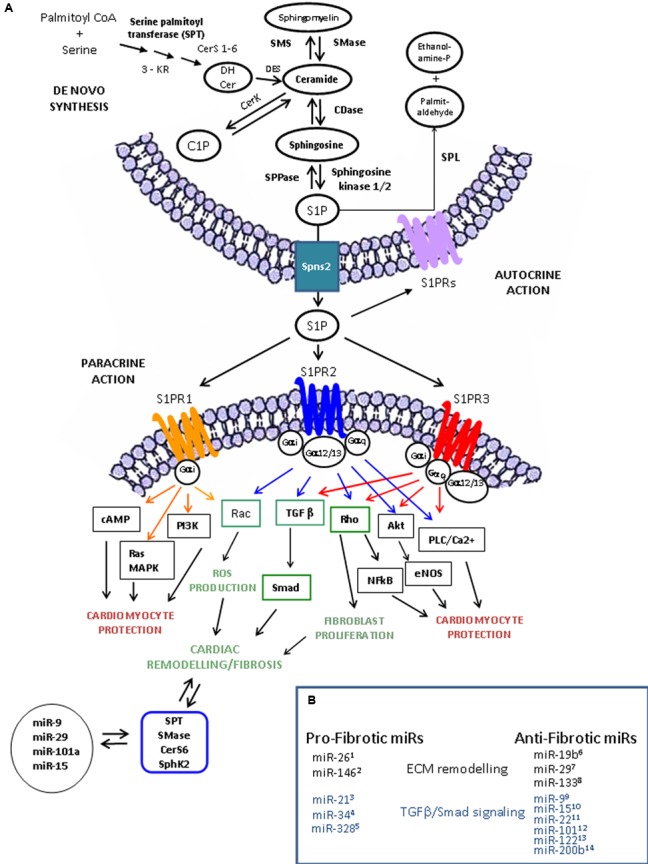
Sphingosine 1-phosphate (S1P) is a bioactive lipid that is characterized by a peculiar mechanism of action. In fact, S1P, which is produced inside the cell, can act as an intracellular mediator, whereas after its export outside the cell, it can act as ligand of specific G-protein coupled receptors, which were initially named endothelial differentiation gene (Edg) and eventually renamed sphingosine 1-phosphate receptors (S1PRs). Among the five S1PR subtypes, S1PR1, S1PR2 and S1PR3 isoforms show broad tissue gene expression, while S1PR4 is primarily expressed in immune system cells, and S1PR5 is expressed in the central nervous system. There is accumulating evidence for the important role of S1P as a mediator of many processes, such as angiogenesis, carcinogenesis and immunity, and, ultimately, fibrosis. After a tissue injury, the imbalance between the production of extracellular matrix (ECM) and its degradation, which occurs due to chronic inflammatory conditions, leads to an accumulation of ECM and, consequential, organ dysfunction. In these pathological conditions, many factors have been described to act as pro- and anti-fibrotic agents, including S1P. This bioactive lipid exhibits both pro- and anti-fibrotic effects, depending on its site of action. In this review, after a brief description of sphingolipid metabolism and signaling, we emphasize the involvement of the S1P/S1PR axis and the downstream signaling pathways in the development of fibrosis. The current knowledge of the therapeutic potential of S1PR subtype modulators in the treatment of the cardiac functions and fibrinogenesis are also examined.
1-磷酸鞘氨醇(S1P)是一种具有独特作用机制的生物活性脂质。事实上,在细胞内产生的S1P可作为细胞内介质发挥作用,而在其分泌到细胞外后,它可作为特定G蛋白偶联受体的配体,这些受体最初被命名为内皮分化基因(Edg),最终被重新命名为1-磷酸鞘氨醇受体(S1PRs)。在五种S1PR亚型中,S1PR1、S1PR2和S1PR3亚型具有广泛的组织基因表达,而S1PR4主要在免疫系统细胞中表达,S1PR5在中枢神经系统中表达。越来越多的证据表明,S1P作为血管生成、致癌作用、免疫以及最终纤维化等许多过程的介质发挥着重要作用。组织损伤后,由于慢性炎症状态导致细胞外基质(ECM)产生与降解之间的失衡,会导致ECM积累,进而引起器官功能障碍。在这些病理状态下,许多因素被描述为促纤维化和抗纤维化因子,包括S1P。这种生物活性脂质根据其作用部位表现出促纤维化和抗纤维化两种作用。在本综述中,在简要描述鞘脂代谢和信号传导后,我们强调了S1P/S1PR轴及其下游信号通路在纤维化发展中的作用。还研究了目前关于S1PR亚型调节剂在治疗心脏功能和纤维蛋白生成方面治疗潜力的知识。