Kashihara Shiho, Kanayama Noriaki, Miyatani Makoto, Nakao Takashi
Department of Psychology, Graduate School of Education, Hiroshima UniversityHiroshima, Japan.
Institute of Biomedical and Health Sciences, Hiroshima UniversityHiroshima, Japan.
Front Psychol. 2017 Jun 2;8:890. doi: 10.3389/fpsyg.2017.00890. eCollection 2017.
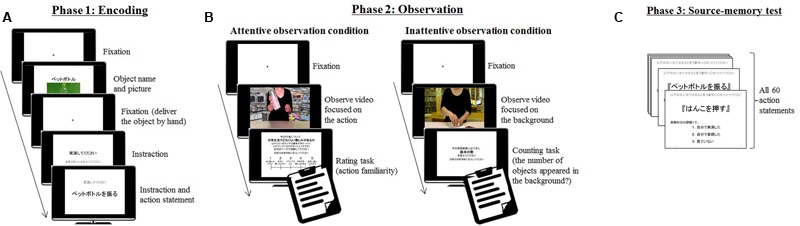
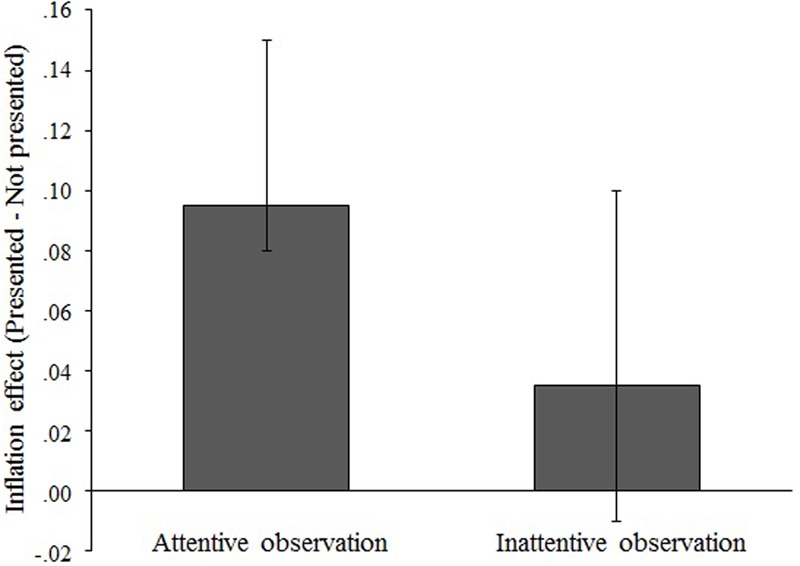
Recent studies have repeatedly demonstrated a false memory phenomenon in which people falsely remember having performed an action by oneself when in fact they have only observed the action by another person. We investigated the attentional effect to the action itself on the observation inflation. Fifty-four participants first performed and read actions (Phase 1); then, they observed the action video that showed another's actions (Phase 2), some of which they had not performed in Phase 1. In the Phase 2, they were required to focus on either the actor's performance (i.e., attentive observation condition) or irrelevant objects, which were presented in the background (i.e., inattentive observation condition) to modulate their attention. Around 2 weeks later, participants took a surprise source-memory test (Phase 3). In this phase, we asked them to judge whether they "performed," "read," or "not presented" the action in Phase 1. Three participants were removed from analysis, because they could not attend Phase 3 within 10-16 days after completion of the second phase. We found observation inflation only in the attentive condition, which contradicted the notions from other false memory studies that showed that attention to the target stimuli reduced false memory in general. We discussed the observation inflation mechanism from the perspective of the "like me" system, including the mirror neuron system, self-ownership, and self-agency.
最近的研究反复证明了一种错误记忆现象,即人们错误地记得自己执行了某个动作,而实际上他们只是观察到了别人执行该动作。我们研究了对动作本身的注意力对观察膨胀的影响。54名参与者首先执行并阅读动作(第一阶段);然后,他们观看了展示他人动作的动作视频(第二阶段),其中一些动作他们在第一阶段并未执行。在第二阶段,要求他们要么专注于演员的表演(即注意力集中的观察条件),要么专注于背景中呈现的无关物体(即注意力不集中的观察条件),以此来调节他们的注意力。大约两周后,参与者进行了一次意外的源记忆测试(第三阶段)。在这个阶段,我们要求他们判断在第一阶段他们是“执行了”、“阅读了”还是“未呈现过”该动作。三名参与者被排除在分析之外,因为他们在第二阶段完成后的10 - 16天内无法参加第三阶段。我们发现只有在注意力集中的条件下才出现观察膨胀,这与其他错误记忆研究的观点相矛盾,其他研究表明,一般来说,对目标刺激的注意力会减少错误记忆。我们从“像我”系统的角度讨论了观察膨胀机制,包括镜像神经元系统、自我所有权和自我能动性。