Guo Wei, Gao Yibo, Li Ning, Shao Fei, Wang Chunni, Wang Pan, Yang Zhenlin, Li Renda, He Jie
Department of Thoracic Surgery, National Cancer Center/Cancer Hospital, Chinese Academy of Medical Sciences and Peking Union Medical College, Chaoyang, Beijing 10021, P.R. China.
Oncol Rep. 2017 Aug;38(2):665-675. doi: 10.3892/or.2017.5714. Epub 2017 Jun 13.
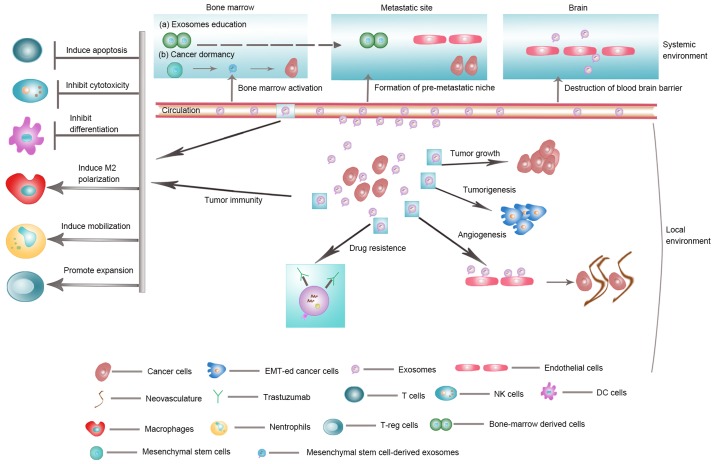
The past decade has witnessed an exponential increase in research on exosomes. For many years considered to be extracellular debris, exosomes are now considered important mediators in intercellular communication. The capability of exosomes to transfer proteins, DNA, mRNA, as well as non-coding RNAs has made them an attractive focus of research into the pathogenesis of different diseases, including cancer. Increasing evidence suggests that tumor cells release a large sum of exosomes, which may not only influence proximal tumor cells and stromal cells in local microenvironment, but also can exert systemic effects when participating in blood circulation. In this study, we review the current understanding on this topic. The literature outlines two broad facets of exosomes in cancer: 1) promotion of tumor growth, tumorigenesis, tumor angiogenesis, tumor immune escape, drug resistance, and metastasis and 2) their role as promising biomarkers for cancer diagnosis and even as potential treatment targets for cancer patients.
在过去十年中,对外泌体的研究呈指数级增长。多年来,外泌体一直被认为是细胞外碎片,而现在它被视为细胞间通讯的重要介质。外泌体能够转运蛋白质、DNA、信使核糖核酸以及非编码核糖核酸,这使其成为研究包括癌症在内的不同疾病发病机制的一个有吸引力的焦点。越来越多的证据表明,肿瘤细胞会释放大量外泌体,这些外泌体不仅可能影响局部微环境中的近端肿瘤细胞和基质细胞,而且在参与血液循环时还能产生全身效应。在本研究中,我们回顾了目前对这一主题的认识。文献概述了外泌体在癌症中的两个广泛方面:1)促进肿瘤生长、肿瘤发生、肿瘤血管生成、肿瘤免疫逃逸、耐药性和转移;2)它们作为癌症诊断的有前景的生物标志物的作用,甚至作为癌症患者潜在治疗靶点的作用。