Institute of Digestive Diseases, The Affiliated People's Hospital of Jiangsu University, Zhenjiang, 212002, Jiangsu, China.
Jiangsu Key Laboratory of Medical Science and Laboratory Medicine, School of Medicine, Jiangsu University, 301 Xuefu Road, Zhenjiang, 212013, Jiangsu, China.
Mol Cancer. 2019 Mar 15;18(1):41. doi: 10.1186/s12943-019-1001-7.
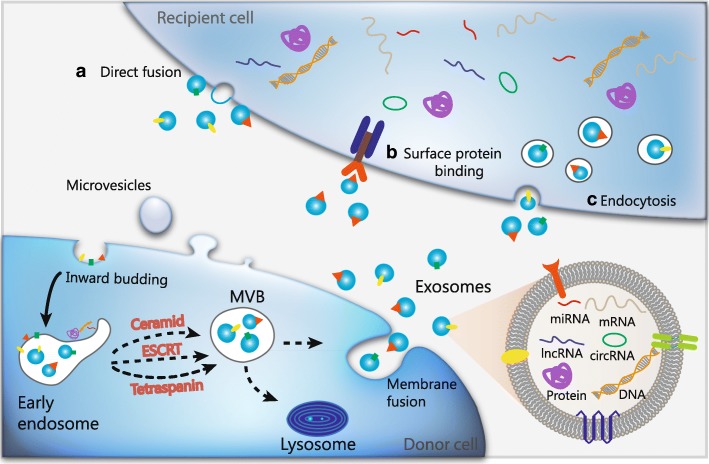
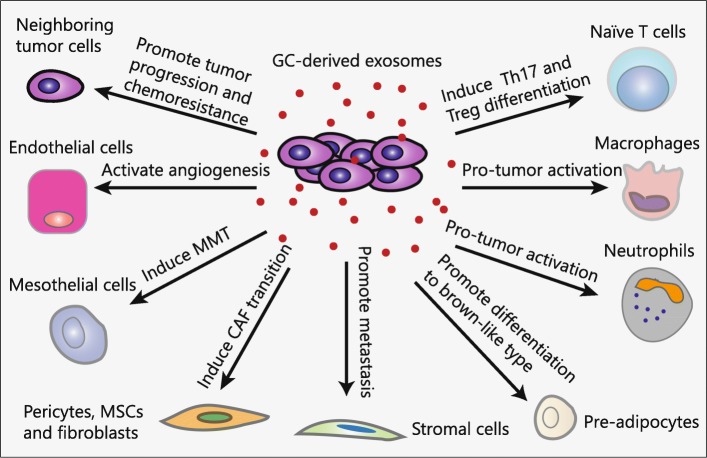
Exosomes are nanosized extracellular vesicles that can be released by almost all types of cells. Initially considered as the garbage bins acting to discard unwanted products of cells, exosomes are now recognized as an important way for cellular communication by transmitting bioactive molecules including proteins, DNA, mRNAs, and non-coding RNAs. The recent studies have shown that exosomes are critically involved in human health and diseases including cancer. Exosomes have been suggested to participate in the promotion of tumorigenesis, tumor growth and metastasis, tumor angiogenesis, tumor immune escape, and tumor therapy resistance. Increasing evidence indicate that exosomes play important roles in gastric cancer development and progression. In this review, we summarized the current understanding of exosomes in gastric cancer with an emphasis on the biological roles of exosomes in gastric cancer and their potential as biomarkers for gastric cancer diagnosis as well as potential targets for gastric cancer therapy.
外泌体是一种纳米大小的细胞外囊泡,几乎所有类型的细胞都可以释放外泌体。外泌体最初被认为是一种“垃圾桶”,可以丢弃细胞中不需要的产物,但现在被认为是一种通过传递生物活性分子(包括蛋白质、DNA、mRNA 和非编码 RNA)进行细胞间通讯的重要方式。最近的研究表明,外泌体与包括癌症在内的人类健康和疾病密切相关。外泌体被认为参与了肿瘤发生、肿瘤生长和转移、肿瘤血管生成、肿瘤免疫逃逸和肿瘤治疗耐药等过程。越来越多的证据表明,外泌体在胃癌的发生和发展中发挥着重要作用。在这篇综述中,我们总结了目前对外泌体在胃癌中作用的认识,重点讨论了外泌体在胃癌中的生物学作用及其作为胃癌诊断生物标志物的潜力,以及作为胃癌治疗靶点的潜力。