HemoShear Therapeutics, LLC, Charlottesville, Virginia, USA.
Department of Medicine and WT-MRC Cambridge Stem Cell Institute, University of Cambridge, Cambridge, United Kingdom.
Stem Cells Transl Med. 2017 Aug;6(8):1673-1683. doi: 10.1002/sctm.17-0004. Epub 2017 Jun 19.
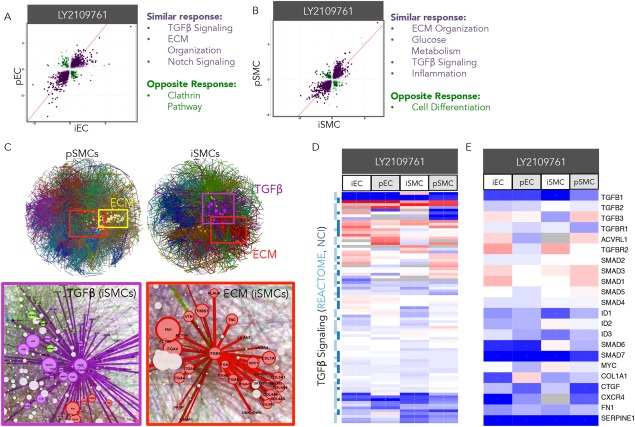
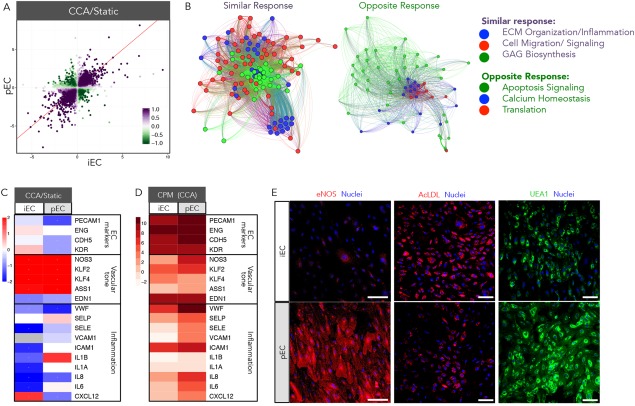
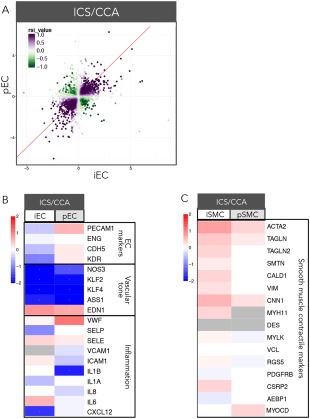
Human induced pluripotent stem cells (iPSCs) can be differentiated into vascular endothelial (iEC) and smooth muscle (iSMC) cells. However, because iECs and iSMCs are not derived from an intact blood vessel, they represent an immature phenotype. Hemodynamics and heterotypic cell:cell communication play important roles in vascular cell phenotypic modulation. Here we tested the hypothesis that hemodynamic exposure of iECs in coculture with iSMCs induces an in vivo-like phenotype. iECs and iSMCs were cocultured under vascular region-specific blood flow hemodynamics, and compared to hemodynamic cocultures of blood vessel-derived endothelial (pEC) and smooth muscle (pSMC) cells. Hemodynamic flow-induced gene expression positively correlated between pECs and iECs as well as pSMCs and iSMCs. While endothelial nitric oxide synthase 3 protein was lower in iECs than pECs, iECs were functionally mature as seen by acetylated-low-density lipoprotein (LDL) uptake. SMC contractile protein markers were also positively correlated between pSMCs and iSMCs. Exposure of iECs and pECs to atheroprone hemodynamics with oxidized-LDL induced an inflammatory response in both. Dysfunction of the transforming growth factor β (TGFβ) pathway is seen in several vascular diseases, and iECs and iSMCs exhibited a transcriptomic prolife similar to pECs and pSMCs, respectively, in their responses to LY2109761-mediated transforming growth factor β receptor I/II (TGFβRI/II) inhibition. Although there are differences between ECs and SMCs derived from iPSCs versus blood vessels, hemodynamic coculture restores a high degree of similarity in their responses to pathological stimuli associated with vascular diseases. Thus, iPSC-derived vascular cells exposed to hemodynamics may provide a viable system for modeling rare vascular diseases and testing new therapeutic approaches. Stem Cells Translational Medicine 2017;6:1673-1683.
人诱导多能干细胞(iPSCs)可分化为血管内皮细胞(iEC)和血管平滑肌细胞(iSMC)。然而,由于 iECs 和 iSMCs 并非源自完整的血管,因此它们代表了一种不成熟的表型。血流动力学和异质细胞间的细胞通讯在血管细胞表型调节中发挥着重要作用。在这里,我们检验了这样一种假设,即在与 iSMCs 共培养时,对 iECs 进行血流动力学暴露会诱导出类似于体内的表型。将 iECs 和 iSMCs 共培养于血管区域特异性血流动力学条件下,并与血管来源的内皮细胞(pEC)和血管平滑肌细胞(pSMC)的血流动力学共培养进行比较。血流诱导的基因表达在 pECs 和 iECs 以及 pSMCs 和 iSMCs 之间呈正相关。虽然 iECs 中的内皮型一氧化氮合酶 3 蛋白水平低于 pECs,但 iECs 具有功能成熟的特性,可通过乙酰化低密度脂蛋白(LDL)摄取来证实。SMC 收缩蛋白标志物在 pSMCs 和 iSMCs 之间也呈正相关。将 iECs 和 pECs 暴露于富含氧化型 LDL 的动脉粥样硬化血流中,会导致两者均出现炎症反应。转化生长因子 β(TGFβ)通路功能障碍可见于多种血管疾病中,iECs 和 iSMCs 分别对 LY2109761 介导的 TGFβRI/II (TGFβRI/II)抑制的反应与 pECs 和 pSMCs 具有相似的转录组谱。尽管 iPSCs 来源的 ECs 和 SMCs 与血管来源的 ECs 和 SMCs 之间存在差异,但血流共培养可在它们对与血管疾病相关的病理刺激的反应中恢复出高度相似性。因此,暴露于血流中的 iPSC 来源的血管细胞可能为模拟罕见血管疾病和测试新治疗方法提供一种可行的系统。《干细胞转化医学》2017 年;6:1673-1683.