Venkatesh Arjun K, Savage Dan, Sandefur Benjamin, Bernard Kenneth R, Rothenberg Craig, Schuur Jeremiah D
Department of Emergency Medicine, Yale University School of Medicine, New Haven, CT, United States of America.
Yale New Haven Hospital Center for Outcomes Research and Evaluation, New Haven, CT, United States of America.
PLoS One. 2017 Jun 19;12(6):e0178456. doi: 10.1371/journal.pone.0178456. eCollection 2017.
Over 25 years, emergency medicine in the United States has amassed a large evidence base that has been systematically assessed and interpreted through ACEP Clinical Policies. While not previously studied in emergency medicine, prior work has shown that nearly half of all recommendations in medical specialty practice guidelines may be based on limited or inconclusive evidence. We sought to describe the proportion of clinical practice guideline recommendations in Emergency Medicine that are based upon expert opinion and low level evidence.
Systematic review of clinical practice guidelines (Clinical Policies) published by the American College of Emergency Physicians from January 1990 to January 2016. Standardized data were abstracted from each Clinical Policy including the number and level of recommendations as well as the reported class of evidence. Primary outcomes were the proportion of Level C equivalent recommendations and Class III equivalent evidence. The primary analysis was limited to current Clinical Policies, while secondary analysis included all Clinical Policies.
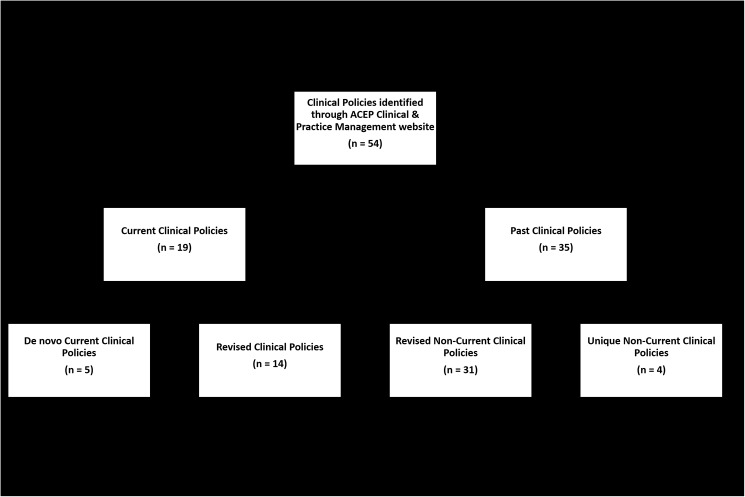
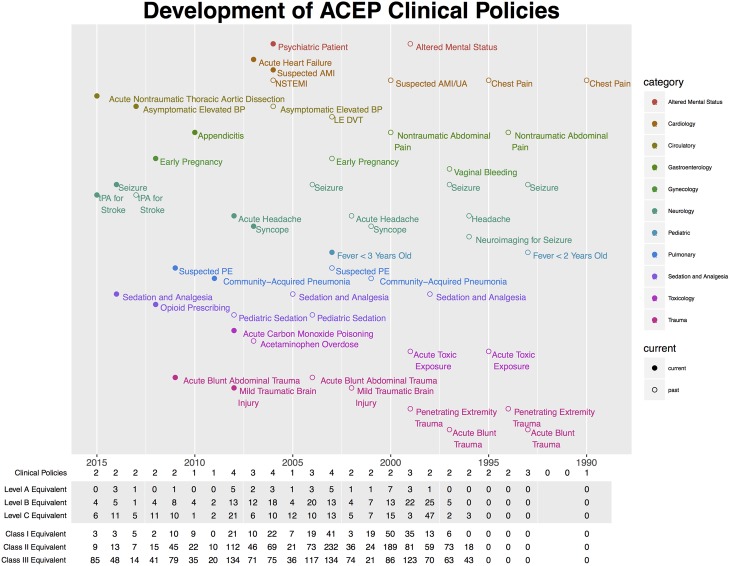
A total of 54 Clinical Policies including 421 recommendations and 2801 cited references, with an average of 7.8 recommendations and 52 references per guideline were included. Of 19 current Clinical Policies, 13 of 141 (9.2%) recommendations were Level A, 57 (40.4%) Level B, and 71 (50.4%) Level C. Of 845 references in current Clinical Policies, 67 (7.9%) were Class I, 272 (32.3%) Class II, and 506 (59.9%) Class III equivalent. Among all Clinical Policies, 200 (47.5%) recommendations were Level C equivalent, and 1371 (48.9%) of references were Class III equivalent.
Emergency medicine clinical practice guidelines are largely based on lower classes of evidence and a majority of recommendations are expert opinion based. Emergency medicine appears to suffer from an evidence gap that should be prioritized in the national research agenda and considered by policymakers prior to developing future quality standards.
在过去25年里,美国急诊医学积累了大量证据库,并通过美国急诊医师学会临床政策进行了系统评估和解读。虽然此前急诊医学领域未开展过此类研究,但先前的研究表明,医学专科实践指南中近一半的建议可能基于有限或不确定的证据。我们试图描述急诊医学临床实践指南中基于专家意见和低级别证据的建议比例。
对美国急诊医师学会1990年1月至2016年1月发布的临床实践指南(临床政策)进行系统评价。从每项临床政策中提取标准化数据,包括建议的数量和级别以及报告的证据类别。主要结局是C级等效建议的比例和III类等效证据。主要分析限于当前的临床政策,次要分析包括所有临床政策。
共纳入54项临床政策,包括421条建议和2801条引用参考文献,每项指南平均有7.8条建议和52条参考文献。在19项当前临床政策中,141条建议中有13条(9.2%)为A级,57条(40.4%)为B级,71条(50.4%)为C级。在当前临床政策的845条参考文献中,67条(7.9%)为I类,272条(32.3%)为II类,506条(59.9%)为III类等效。在所有临床政策中,200条(47.5%)建议为C级等效,1371条(48.9%)参考文献为III类等效。
急诊医学临床实践指南很大程度上基于较低级别的证据,且大多数建议基于专家意见。急诊医学似乎存在证据差距,应在国家研究议程中优先考虑,并在制定未来质量标准之前由政策制定者加以考虑。