Wong Ngai Sze, Tang Weiming, Han Larry, Best John, Zhang Ye, Huang Shujie, Zheng Heping, Yang Bin, Wei Chongyi, Pan Stephen W, Tucker Joseph D
University of North Carolina Project-China, Guangzhou, Guangdong, China.
Institute for Global Health & Infectious Diseases, University of North Carolina at Chapel Hill, Chapel Hill, NC, USA.
BMC Infect Dis. 2017 Jun 19;17(1):437. doi: 10.1186/s12879-017-2546-y.
Scaling up HIV testing is the first step in the HIV treatment continuum which is important for controlling the HIV epidemic among men who have sex with men (MSM). Following an online HIV testing intervention among MSM, we aim to examine sociodemographic and spatial factors associated with HIV testing.
We conducted a secondary analysis on data from an online HIV testing intervention among MSM who had never-tested for HIV. The survey was distributed through online networks connected to all provinces and regions of China. Univariate and multivariable analyses were performed to examine factors associated with testing three weeks post-intervention.
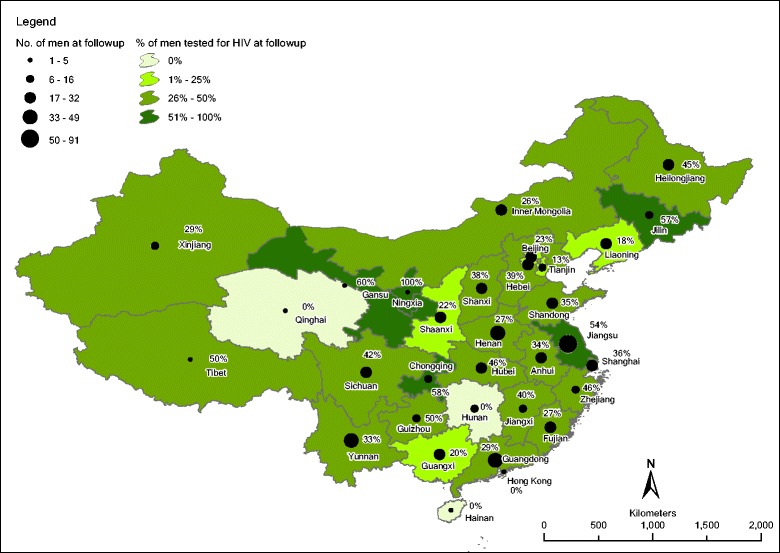
At three weeks after the intervention, 36% of 624 followed-up MSM underwent HIV testing, 69 men reported positive HIV test results. Having money for sex, ever tested for sexually transmitted infections and intimate partner violence experience were significant factors of post-intervention HIV testing. Students were less likely to undergo HIV testing at follow-up compared to others (adjusted odds ratio=0.69, 95% C.I.=0.47-0.99), adjusted by age and type of intervention. Moderate provincial spatial variation of testing was observed.
While high risk men generally had higher HIV testing rates, some MSM like students had lower testing rates, suggesting the need for further ways to enhance HIV testing in specific MSM communities.
扩大艾滋病毒检测是艾滋病毒治疗连续过程的第一步,这对于控制男男性行为者(MSM)中的艾滋病毒流行至关重要。在对男男性行为者进行在线艾滋病毒检测干预之后,我们旨在研究与艾滋病毒检测相关的社会人口学和空间因素。
我们对从未进行过艾滋病毒检测的男男性行为者在线艾滋病毒检测干预数据进行了二次分析。该调查通过连接中国所有省份和地区的在线网络进行分发。进行单变量和多变量分析以检查干预后三周与检测相关的因素。
干预后三周,624名接受随访的男男性行为者中有36%进行了艾滋病毒检测,69名男性报告艾滋病毒检测结果呈阳性。有偿性行为、曾接受过性传播感染检测以及亲密伴侣暴力经历是干预后艾滋病毒检测的重要因素。与其他人相比,学生在随访时进行艾滋病毒检测的可能性较小(调整后的优势比=0.69,95%置信区间=0.47-0.99),按年龄和干预类型进行调整。观察到检测存在中等程度的省级空间差异。
虽然高危男性的艾滋病毒检测率普遍较高,但一些男男性行为者,如学生,检测率较低,这表明需要进一步采取措施加强特定男男性行为者群体中的艾滋病毒检测。