De Assis Machado Marta Rodriguez, Maciel Débora Alves
Professor at the Getulio Vargas Foundation School of Law and a researcher at the Brazilian Center of Analysis and Planning (CEBRAP), São Paulo, Brazil.
Professor of sociology at the Federal University of São Paulo, and a researcher at the Brazilian Center of Analysis and Planning (CEBRAP), São Paulo, Brazil.
Health Hum Rights. 2017 Jun;19(1):119-132.
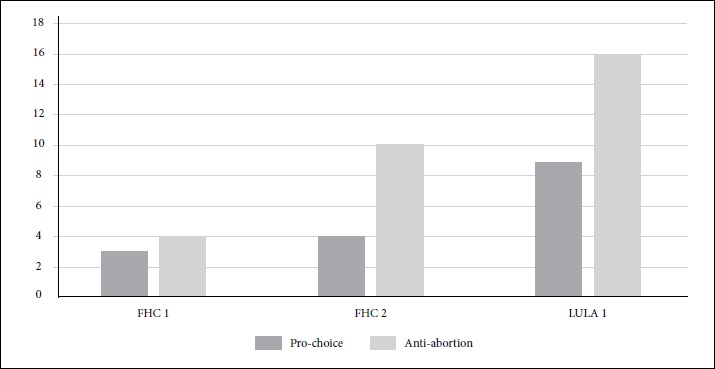
This article proposes a relational approach to the study of abortion law reform in Brazil. It focuses on the interaction of pro-choice and anti-abortion movements in different state arenas and political contexts. It details the emergence of a strategic action field on abortion during the Brazilian re-democratization process and the National Constituent Assembly. We offer analysis on pro-choice and anti-abortion mobilization in state arenas-mainly in the executive and legislative powers-during the two terms of President Fernando Henrique Cardoso (FHC), 1995-1998 and 1999-2002, and the first term of President Luís Inácio Lula da Silva (Lula), 2003-2006. We then map political resources for mobilization, such as legislative bills, public policy norms, and judicial decisions, and track legal continuities and changes. Finally, we analyze anti-abortion reaction, which was consolidated through an increased conservative presence in congress after 2006, and discuss how the abortion debate has migrated from congress to the Supreme Court and the public sphere.
本文提出了一种研究巴西堕胎法改革的关系方法。它聚焦于支持堕胎选择权运动和反堕胎运动在不同州领域及政治背景下的互动。详细阐述了巴西重新民主化进程和国民制宪议会期间堕胎问题战略行动领域的出现。我们分析了在费尔南多·恩里克·卡多佐(FHC)总统执政的1995 - 1998年和1999 - 2002年这两个任期,以及路易斯·伊纳西奥·卢拉·达席尔瓦(卢拉)总统执政的2003 - 2006年第一个任期内,支持堕胎选择权和反堕胎运动在州领域(主要是行政和立法权力方面)的动员情况。然后,我们梳理了动员的政治资源,如立法法案、公共政策规范和司法判决,并追踪法律的延续性和变化。最后,我们分析了反堕胎反应,这种反应在2006年后因国会中保守派势力的增加而得到巩固,并探讨了堕胎辩论是如何从国会转移到最高法院和公共领域的。