Aloe L, Levi-Montalcini R
Proc Natl Acad Sci U S A. 1979 Mar;76(3):1246-50. doi: 10.1073/pnas.76.3.1246.
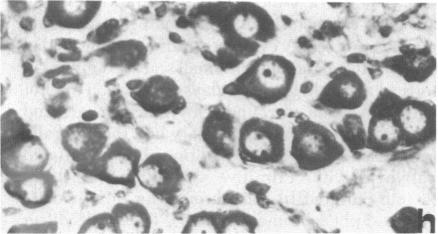
Pre- and postnatal injections of nerve growth factor, initiated with one dose on day 17 of gestation and continued after birth with daily subcutaneous administration until day 10 of life, produce massive transformation of chromaffin in sympathetic nerve cells in the rat adrenal medulla. Large sympathetic ganglia, absent in controls, adhere to the medial external surface of the gland. Nerve fibers produced by the transformed chromaffin cells invade the inner and outer cortical zones of the organ, producing cell depletion and substantial alteration of the structure of the cortical layers. When the growth factor treatment is initiated after birth, only a partial replacement of chromaffin with nerve cells takes place. The treatment is ineffective after the second postnatal week. Injections of a specific antiserum to nerve growth factor in 17-day-old rat fetuses, which were continued after birth, produce progressive and massive destruction of chromaffin cell precursors and of immature chromaffin cells in the adrenal medullary gland.
在妊娠第17天开始进行产前和产后神经生长因子注射,起始剂量为一剂,出生后继续每日皮下给药直至出生后第10天,这会使大鼠肾上腺髓质中嗜铬交感神经细胞发生大规模转变。对照组中不存在的大型交感神经节附着于腺体的内侧外表面。转化后的嗜铬细胞产生的神经纤维侵入该器官的内皮质区和外皮质区,导致细胞减少并使皮质层结构发生实质性改变。当出生后开始生长因子治疗时,仅发生嗜铬细胞被神经细胞部分替代的情况。产后第二周后该治疗无效。在17日龄大鼠胎儿中注射针对神经生长因子的特异性抗血清,并在出生后继续注射,会导致肾上腺髓质中嗜铬细胞前体和未成熟嗜铬细胞进行性大量破坏。