Al-Thani Mohammed, Al-Thani Al-Anoud, Al-Mahdi Nasser, Al-Kareem Hefzi, Barakat Darine, Al-Chetachi Walaa, Tawfik Afaf, Akram Hammad
Ministry of Public Health, State of Qatar.
Ministry of Development Planning and Statistics.
Cureus. 2017 May 15;9(5):e1249. doi: 10.7759/cureus.1249.
Availability of accurate data pertaining to a population's dietary patterns and associated health outcomes is critical for proper development and implementation of related policies. This article is a first attempt to share the food patterns, amounts and diet quality among households (HH) in Qatar.
Data from the 2012-2013 Qatar National Household Income and Expenditure Survey (HIES) was used. This cross-sectional survey included 3723 HH (1826 Qatari HH and 1897 non-Qatari HH). Dietary data on monthly amounts food items available at HH according to the nationality was used. The food items were expressed in terms of grams per capita per day and aggregated into groups to examine the food patterns, energy, and adequacy.
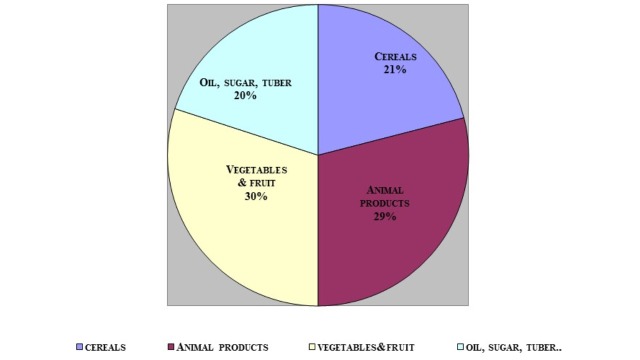
The overall average amount of purchased food at HH in Qatar was 1885 g/capita/day. Qatari HH purchased more food (2118 g/capita/day) versus non-Qataris (1373 g/capita/day); however, the percentages of the amounts purchased by food types were similar among both nationalities. Average daily energy (kcal) per capita was almost double among Qatari HH (4275 kcal) vs. non-Qatari HH (2424 kcal). The food items under subsidy program for Qatari citizens provided 1753 kcal/capita/day and accounted for 41% of total daily energy. Proteins (29.2), fats (39.2), sodium (3.3), and vitamin C (32.5) had higher than recommended levels of nutrient density (grams per 1000 kcal). Calcium (227), vitamin A (302.3), fiber (2.0), and carbohydrates (132.6) had lower than recommended levels of nutrient energy density (g/1000 kcal).
The study predicts unhealthy dietary habits among HH in Qatar and provides useful information for policy makers and healthcare community.
获取有关人群饮食模式及相关健康结果的准确数据,对于相关政策的合理制定与实施至关重要。本文首次尝试分享卡塔尔家庭(HH)的食物模式、摄入量及饮食质量。
使用了2012 - 2013年卡塔尔国家家庭收入与支出调查(HIES)的数据。这项横断面调查涵盖了3723个家庭(1826个卡塔尔家庭和1897个非卡塔尔家庭)。采用了按国籍划分的家庭每月各类食物可获得量的饮食数据。食物量以人均每日克数表示,并汇总成组以研究食物模式、能量及充足性。
卡塔尔家庭购买食物的总体平均量为1885克/人/天。卡塔尔家庭购买的食物更多(2118克/人/天),而非卡塔尔家庭为(1373克/人/天);然而,两个国籍的家庭按食物类型购买量的百分比相似。卡塔尔家庭人均每日能量(千卡)几乎是非卡塔尔家庭的两倍(分别为4275千卡和2424千卡)。卡塔尔公民补贴计划下的食物提供了1753千卡/人/天,占每日总能量的41%。蛋白质(29.2)、脂肪(39.2)、钠(3.3)和维生素C(32.5)的营养密度高于推荐水平(每1000千卡克数)。钙(227)、维生素A(302.3)、纤维(2.0)和碳水化合物(132.6)的营养能量密度低于推荐水平(克/1000千卡)。
该研究预测了卡塔尔家庭不健康的饮食习惯,并为政策制定者和医疗界提供了有用信息。