Sweeney Charles B, Lackey Blake A, Pospisil Martin J, Achee Thomas C, Hicks Victoria K, Moran Aaron G, Teipel Blake R, Saed Mohammad A, Green Micah J
Artie McFerrin Department of Chemical Engineering, Texas A&M University, College Station, TX 77843, USA.
Department of Materials Science and Engineering, Texas A&M University, College Station, TX 77843, USA.
Sci Adv. 2017 Jun 14;3(6):e1700262. doi: 10.1126/sciadv.1700262. eCollection 2017 Jun.
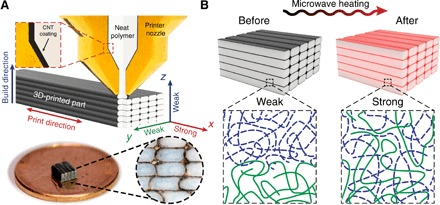
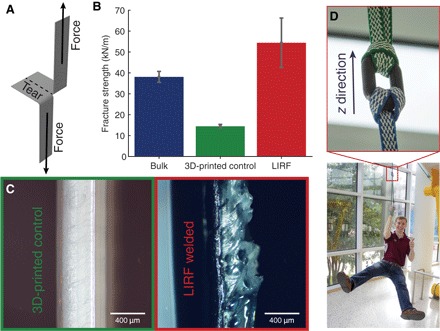
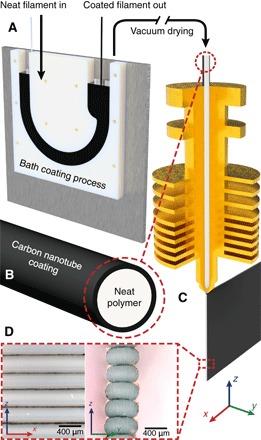
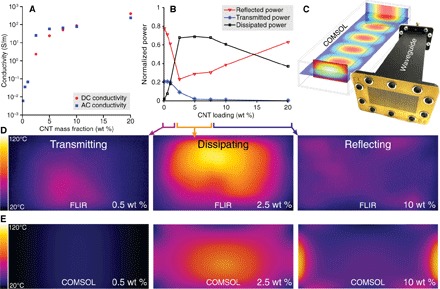
Additive manufacturing through material extrusion, often termed three-dimensional (3D) printing, is a burgeoning method for manufacturing thermoplastic components. However, a key obstacle facing 3D-printed plastic parts in engineering applications is the weak weld between successive filament traces, which often leads to delamination and mechanical failure. This is the chief obstacle to the use of thermoplastic additive manufacturing. We report a novel concept for welding 3D-printed thermoplastic interfaces using intense localized heating of carbon nanotubes (CNTs) by microwave irradiation. The microwave heating of the CNT-polymer composites is a function of CNT percolation, as shown through in situ infrared imaging and simulation. We apply CNT-loaded coatings to a 3D printer filament; after printing, microwave irradiation is shown to improve the weld fracture strength by 275%. These remarkable results open up entirely new design spaces for additive manufacturing and also yield new insight into the coupling between dielectric properties and radio frequency field response for nanomaterial networks.
通过材料挤出的增材制造,通常称为三维(3D)打印,是一种新兴的制造热塑性部件的方法。然而,工程应用中3D打印塑料部件面临的一个关键障碍是连续长丝痕迹之间的焊接薄弱,这常常导致分层和机械故障。这是热塑性增材制造应用的主要障碍。我们报告了一种新颖的概念,即通过微波辐射对碳纳米管(CNT)进行强烈的局部加热来焊接3D打印的热塑性界面。如通过原位红外成像和模拟所示,CNT-聚合物复合材料的微波加热是CNT渗流的函数。我们将负载CNT的涂层应用于3D打印机长丝;打印后,微波辐射显示可将焊接断裂强度提高275%。这些显著的结果为增材制造开辟了全新的设计空间,也为纳米材料网络的介电性能与射频场响应之间的耦合提供了新的见解。