Bunderson-Schelvan Melisa, Holian Andrij, Hamilton Raymond F
a Center for Environmental Health Sciences , University of Montana , Missoula , MT , USA.
J Toxicol Environ Health B Crit Rev. 2017;20(4):230-248. doi: 10.1080/10937404.2017.1305924.
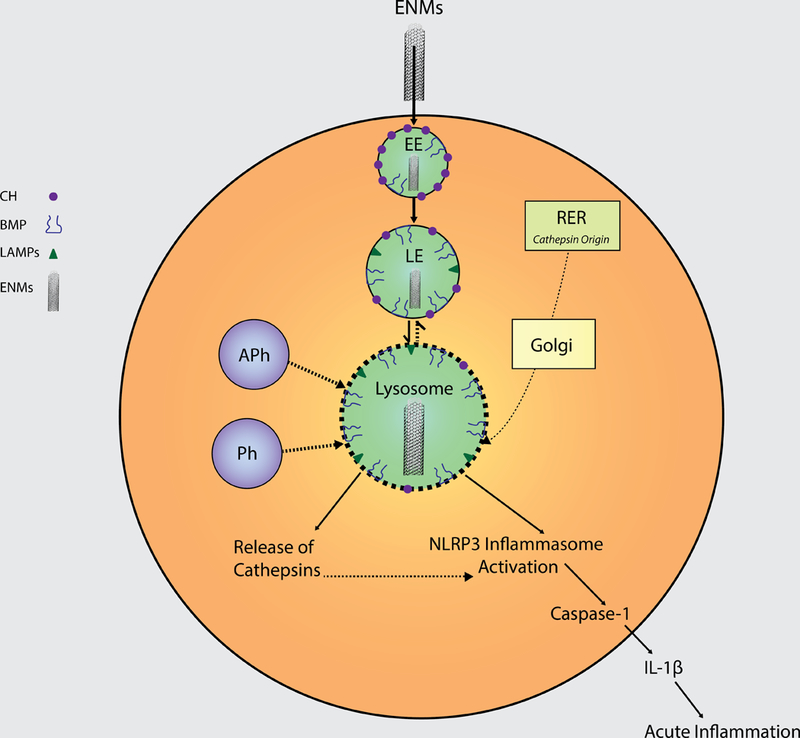
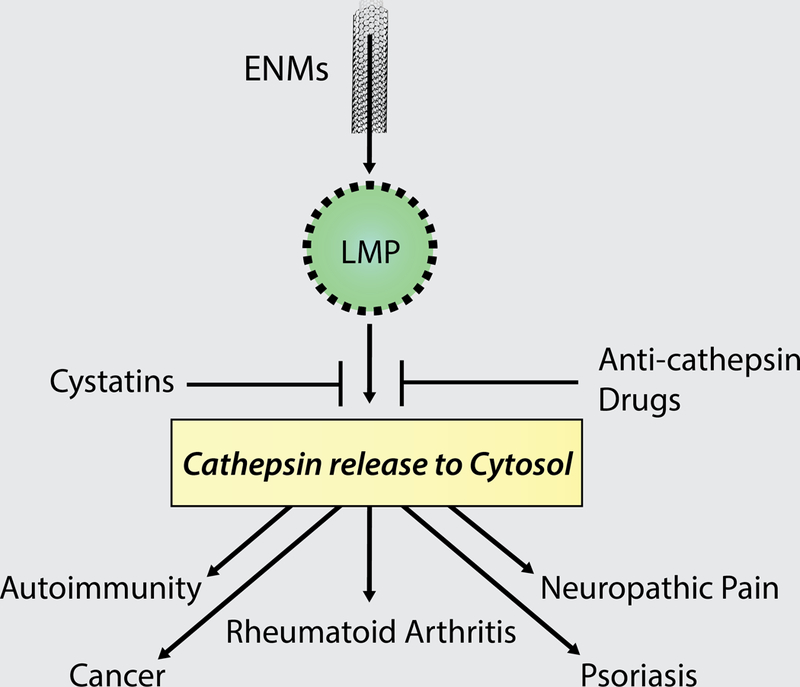
Engineered nanomaterials (ENMs), or small anthropogenic particles approximately < 100 nm in size and of various shapes and compositions, are increasingly incorporated into commercial products and used for industrial and medical purposes. There is an exposure risk to both the population at large and individuals in the workplace with inhalation exposures to ENMs being a primary concern. Further, there is increasing evidence to suggest that certain ENMs may represent a significant health risk, and many of these ENMs exhibit distinct similarities with other particles and fibers that are known to induce adverse health effects, such as asbestos, silica, and particulate matter (PM). Evidence regarding the importance of lysosomal membrane permeabilization (LMP) and release of cathepsins in ENM toxicity has been accumulating. The aim of this review was to describe our current understanding of the mechanisms leading to ENM-associated pathologies, including LMP and the role of cathepsins with a focus on inflammation. In addition, anti-cathepsin agents, some of which have been tested in clinical trials and may prove useful for ameliorating the harmful effects of ENM exposure, are examined.
工程纳米材料(ENMs),即尺寸约小于100纳米、具有各种形状和组成的小型人为颗粒,正越来越多地被纳入商业产品中,并用于工业和医疗目的。普通人群和工作场所的个体都面临接触风险,吸入ENMs是主要担忧。此外,越来越多的证据表明,某些ENMs可能构成重大健康风险,其中许多ENMs与其他已知会导致不良健康影响的颗粒和纤维(如石棉、二氧化硅和颗粒物(PM))表现出明显的相似性。关于溶酶体膜通透性(LMP)和组织蛋白酶释放在ENM毒性中的重要性的证据一直在积累。本综述的目的是描述我们目前对导致ENM相关病理的机制的理解,包括LMP以及组织蛋白酶在炎症方面的作用。此外还研究了抗组织蛋白酶药物,其中一些已在临床试验中进行了测试,可能证明对减轻ENM暴露的有害影响有用。