Department of Psychiatry, Icahn School of Medicine at Mount Sinai Hospital, New York, NY.
Seaver Autism Center, Icahn School of Medicine at Mount Sinai Hospital, New York, NY.
Autism Res. 2017 Nov;10(11):1845-1856. doi: 10.1002/aur.1820. Epub 2017 Jun 20.
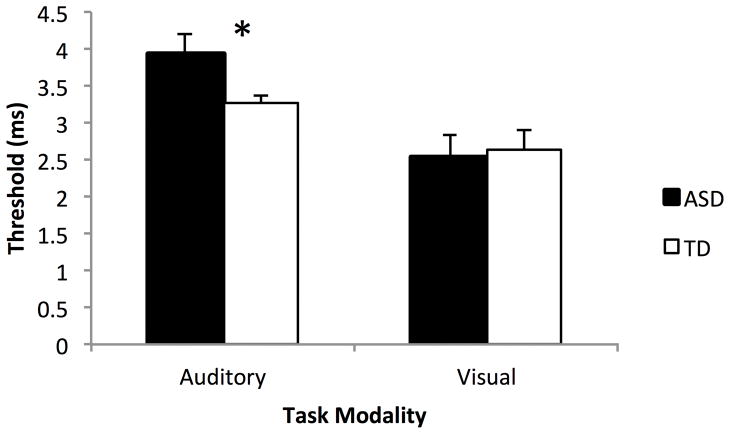
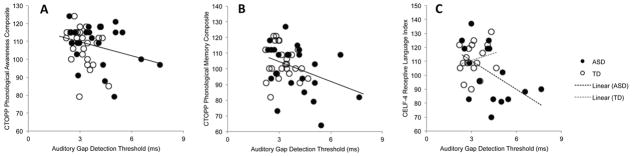
Sensory processing alterations are highly prevalent in autism spectrum disorder (ASD). Neurobiologically-based theories of ASD propose that abnormalities in the processing of temporal aspects of sensory input could underlie core symptoms of ASD. For example, rapid auditory temporal processing is critical for speech perception, and language difficulties are central to the social communication deficits defining the disorder. This study assessed visual and auditory temporal processing abilities and tested their relation to core ASD symptoms. 53 children (26 ASD, 27 TD) completed visual and auditory psychophysical gap detection tasks to measure gap detection thresholds (i.e., the minimum interval between sequential stimuli needed for individuals to perceive an interruption between the stimuli) in each domain. Children were also administered standardized language assessments such that the relation between individual differences in auditory gap detection thresholds and degree of language and communication difficulties among children with ASD could be assessed. Children with ASD had substantially higher auditory gap detection thresholds compared to children with TD, and auditory gap detection thresholds were correlated significantly with several measures of language processing in this population. No group differences were observed in the visual temporal processing. Results indicate a domain-specific impairment in rapid auditory temporal processing in ASD that is associated with greater difficulties in language processing. Findings provide qualified support for temporal processing theories of ASD and highlight the need for future research testing the nature, extent, and universality of auditory temporal processing deficits in this population. Autism Res 2017, 10: 1845-1856. © 2017 International Society for Autism Research, Wiley Periodicals, Inc.
Sensory symptoms are common in ASD. Temporal processing alterations are often implicated, but understudied. The ability to process rapid sensory information, particularly auditory input, is critical for language functioning. This study tested auditory and visual temporal processing in ASD and controls. Findings suggest that rapid auditory (but not visual) processing is impaired in ASD and related to language functioning. These results could provide mechanistic clues to understanding core symptoms and lead to novel intervention targets.
感觉处理改变在自闭症谱系障碍(ASD)中非常普遍。基于神经生物学的 ASD 理论提出,感觉输入的时间方面处理异常可能是 ASD 的核心症状的基础。例如,快速听觉时间处理对于语音感知至关重要,语言困难是定义该障碍的社交沟通缺陷的核心。本研究评估了视觉和听觉时间处理能力,并测试了它们与 ASD 的核心症状的关系。53 名儿童(26 名 ASD,27 名 TD)完成了视觉和听觉心理物理缺口检测任务,以测量每个领域的缺口检测阈值(即个体感知刺激之间中断所需的连续刺激之间的最小间隔)。还对儿童进行了标准化语言评估,以便可以评估 ASD 儿童听觉缺口检测阈值的个体差异与语言和沟通困难程度之间的关系。与 TD 儿童相比,ASD 儿童的听觉缺口检测阈值明显较高,并且在该人群中,听觉缺口检测阈值与语言处理的几个测量值显著相关。在视觉时间处理中未观察到组间差异。结果表明 ASD 中快速听觉时间处理存在特定于域的损伤,与语言处理困难更大相关。这些发现为 ASD 的时间处理理论提供了有条件的支持,并强调了未来研究测试该人群中听觉时间处理缺陷的性质、程度和普遍性的必要性。自闭症研究 2017,10:1845-1856。©2017 自闭症国际研究协会,Wiley 期刊,Inc.
在 ASD 中,感觉症状很常见。时间处理改变通常被牵涉,但研究不足。处理快速感觉信息,特别是听觉输入的能力,对语言功能至关重要。本研究测试了 ASD 和对照组的听觉和视觉时间处理。研究结果表明,ASD 中快速听觉(但不是视觉)处理受损,与语言功能有关。这些结果可以为理解核心症状提供机制线索,并为新的干预靶点提供线索。