Rodriguez-Cristobal Juan Jose, Alonso-Villaverde Carlos, Panisello Jose Ma, Travé-Mercade Pere, Rodriguez-Cortés Francisca, Marsal Josep Ramon, Peña Esther
Centre Atenció Primària Florida Sud. Direcció Atenció Primària Costa de Ponent-ICS. L'Hospitalet, Institut Universitari d'Investigació en Atenció Primària Jordi Gol (IDIAP Jordi Gol), Barcelona, Spain.
Cardiovascular Research Center, CSIC-ICCC, Hospital de la Santa Creu i Sant Pau (UAB), IIB-Sant Pau, Barcelona, Spain.
BMC Fam Pract. 2017 Jun 20;18(1):74. doi: 10.1186/s12875-017-0644-y.
Overweight and obesity are common health problems which increase the risk of developing several serious health conditions. The main difficulty in the management of weight-loss lies in its maintenance, once it is achieved. The aim of this study was to investigate whether a motivational intervention, together with current clinical practice, was more efficient than a traditional intervention, in the treatment of overweight and obesity and whether this intervention reduces cardiovascular risk factors associated with overweight and obesity.
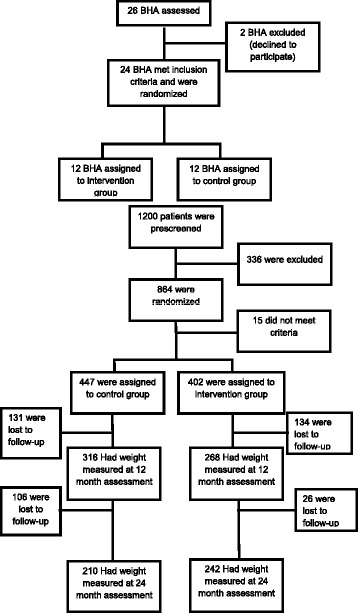
Multi-centre cluster randomized trial with a 24-month follow-up included 864 overweight/obese patients randomly assigned. Motivational intervention group (400 patients), delivered by a nurse trained by an expert psychologist, in 32 sessions, 1 to 12 fortnightly, and 13 to 32, monthly, on top of their standard programmed diet and exercise. The control group (446 patients), received the usual follow-up.
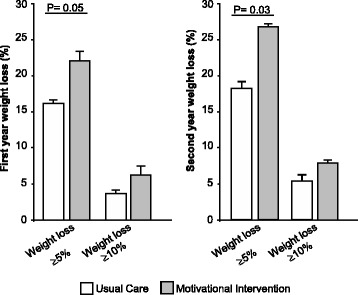
Weight reduction was statistically significant in the second year with a mean reduction of 1.0 Kg in the control group and 2.5 Kg in the intervention group (p = 0. 02). While 18.1% of patients in the control group reduced their weight by more than 5%, this percentage rose to 26.9% in the intervention group, which is statistically significant (p = 0.04). Patients in the motivational intervention group had significantly greater improvements in triglycerides and APOB/APOA1ratio.
The results highlight the importance of the group motivational interview in the treatment of overweight /obese patients in primary care, and in the improvement of their associated cardiovascular risks factors.
ClinicalTrials.gov Identifier: NCT01006213 October 30, 2009.
超重和肥胖是常见的健康问题,会增加患多种严重健康状况的风险。减肥管理的主要困难在于体重一旦减轻后如何维持。本研究的目的是调查在超重和肥胖的治疗中,动机干预与当前临床实践相结合是否比传统干预更有效,以及这种干预是否能降低与超重和肥胖相关的心血管危险因素。
一项为期24个月随访的多中心整群随机试验,纳入了864名随机分配的超重/肥胖患者。动机干预组(400名患者),由一名经过专家心理学家培训的护士进行干预,共32次,第1至12次每两周进行一次,第13至32次每月进行一次,干预内容是在标准的节食和运动计划基础上进行。对照组(446名患者)接受常规随访。
第二年体重减轻具有统计学意义,对照组平均减轻1.0千克,干预组平均减轻2.5千克(p = 0.02)。对照组中有18.1%的患者体重减轻超过5%,而干预组这一比例升至26.9%,具有统计学意义(p = 0.04)。动机干预组患者的甘油三酯和载脂蛋白B/载脂蛋白A1比值有显著改善。
结果凸显了团体动机访谈在基层医疗中治疗超重/肥胖患者以及改善其相关心血管危险因素方面的重要性。
ClinicalTrials.gov标识符:NCT01006213,2009年10月30日。