Webb Anderson H, Gao Bradley T, Goldsmith Zachary K, Irvine Andrew S, Saleh Nabil, Lee Ryan P, Lendermon Justin B, Bheemreddy Rajini, Zhang Qiuhua, Brennan Rachel C, Johnson Dianna, Steinle Jena J, Wilson Matthew W, Morales-Tirado Vanessa M
Department of Ophthalmology, Hamilton Eye Institute, the University of Tennessee Health Science Center, 930 Madison Ave, Room 756, Memphis, TN, 38163, USA.
Department of Oncology, St. Jude Children's Research Hospital, Memphis, TN, USA.
BMC Cancer. 2017 Jun 20;17(1):434. doi: 10.1186/s12885-017-3418-y.
Retinoblastoma (Rb) is the most common primary intraocular tumor in children. Local treatment of the intraocular disease is usually effective if diagnosed early; however advanced Rb can metastasize through routes that involve invasion of the choroid, sclera and optic nerve or more broadly via the ocular vasculature. Metastatic Rb patients have very high mortality rates. While current therapy for Rb is directed toward blocking tumor cell division and tumor growth, there are no specific treatments targeted to block Rb metastasis. Two such targets are matrix metalloproteinases-2 and -9 (MMP-2, -9), which degrade extracellular matrix as a prerequisite for cellular invasion and have been shown to be involved in other types of cancer metastasis. Cancer Clinical Trials with an anti-MMP-9 therapeutic antibody were recently initiated, prompting us to investigate the role of MMP-2, -9 in Rb metastasis.
We compare MMP-2, -9 activity in two well-studied Rb cell lines: Y79, which exhibits high metastatic potential and Weri-1, which has low metastatic potential. The effects of inhibitors of MMP-2 (ARP100) and MMP-9 (AG-L-66085) on migration, angiogenesis, and production of immunomodulatory cytokines were determined in both cell lines using qPCR, and ELISA. Cellular migration and potential for invasion were evaluated by the classic wound-healing assay and a Boyden Chamber assay.
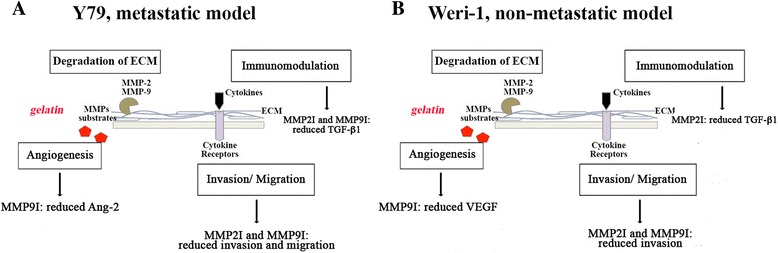
Our results showed that both inhibitors had differential effects on the two cell lines, significantly reducing migration in the metastatic Y79 cell line and greatly affecting the viability of Weri-1 cells. The MMP-9 inhibitor (MMP9I) AG-L-66085, diminished the Y79 angiogenic response. In Weri-1 cells, VEGF was significantly reduced and cell viability was decreased by both MMP-2 and MMP-9 inhibitors. Furthermore, inhibition of MMP-2 significantly reduced secretion of TGF-β1 in both Rb models.
Collectively, our data indicates MMP-2 and MMP-9 drive metastatic pathways, including migration, viability and secretion of angiogenic factors in Rb cells. These two subtypes of matrix metalloproteinases represent new potential candidates for targeted anti-metastatic therapy for Rb.
视网膜母细胞瘤(Rb)是儿童最常见的原发性眼内肿瘤。如果早期诊断,眼内疾病的局部治疗通常有效;然而,晚期Rb可通过脉络膜、巩膜和视神经的侵袭途径转移,或更广泛地通过眼血管系统转移。转移性Rb患者的死亡率非常高。虽然目前针对Rb的治疗旨在阻断肿瘤细胞分裂和肿瘤生长,但尚无针对阻断Rb转移的特异性治疗方法。基质金属蛋白酶-2和-9(MMP-2、-9)就是这样两个靶点,它们降解细胞外基质是细胞侵袭的前提条件,并且已被证明参与其他类型的癌症转移。最近启动了一项使用抗MMP-9治疗性抗体的癌症临床试验,促使我们研究MMP-2、-9在Rb转移中的作用。
我们比较了两种经过充分研究的Rb细胞系中MMP-2、-9的活性:具有高转移潜能的Y79和具有低转移潜能的Weri-1。使用qPCR和ELISA在两种细胞系中测定MMP-2(ARP100)和MMP-9(AG-L-66085)抑制剂对迁移、血管生成和免疫调节细胞因子产生的影响。通过经典的伤口愈合试验和博伊登室试验评估细胞迁移和侵袭潜能。
我们的结果表明,两种抑制剂对两种细胞系有不同的影响,显著降低转移性Y79细胞系中的迁移,并极大地影响Weri-1细胞的活力。MMP-9抑制剂(MMP9I)AG-L-66085减弱了Y79的血管生成反应。在Weri-1细胞中,MMP-2和MMP-9抑制剂均显著降低VEGF水平并降低细胞活力。此外,在两种Rb模型中,抑制MMP-2均显著降低TGF-β1的分泌。
总体而言,我们的数据表明MMP-2和MMP-9驱动转移途径,包括Rb细胞中的迁移、活力和血管生成因子的分泌。这两种基质金属蛋白酶亚型代表了Rb靶向抗转移治疗的新潜在候选物。