Hiligsmann Mickael, Neuprez Audrey, Buckinx Fanny, Locquet Médéa, Reginster Jean-Yves
Department of Health Services Research, CAPHRI Care and Public Health Research Institute, Maastricht University, P.O. Box 616, 6200 MD, Maastricht, the Netherlands.
Department of Public Health, Epidemiology and Health Economics, University of Liège, Liège, Belgium.
Arch Osteoporos. 2017 Dec;12(1):57. doi: 10.1007/s11657-017-0352-1. Epub 2017 Jun 21.
Dairy products are rich in nutrients that positively influence bone health and hence fracture risk, and have therefore been recommended and used for fracture prevention. To help decision makers to efficiently allocate scare resources, it is further important to assess the public health and economic impact of any health intervention. In recent years, several studies have been conducted to estimate the public health and/or economic impact of dairy products but no overview is currently available. This article aims therefore to summarize evidence and review articles that estimated the public health and/or economic impact of vitamin D-fortified dairy products for fracture prevention.
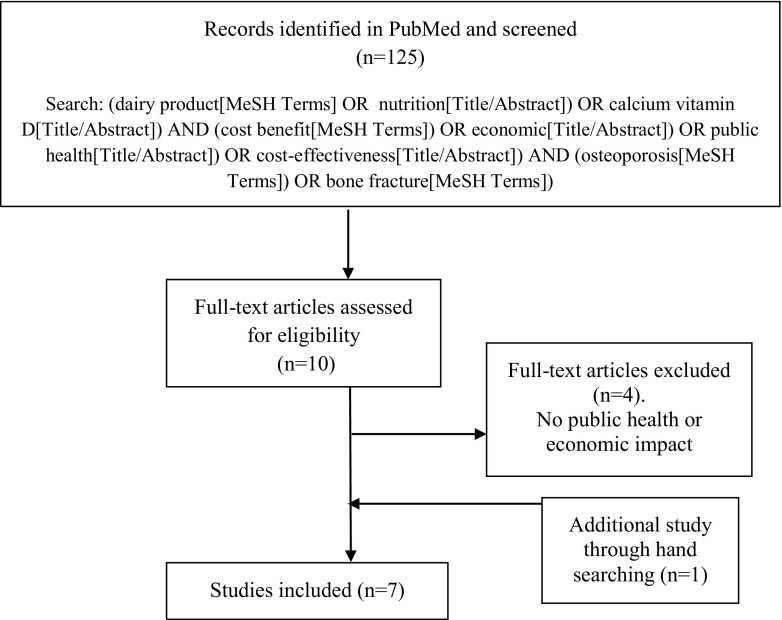
A literature review was conducted using PubMed to identify original studies that assessed the public health and/or economic impact of dairy products (or of calcium/vitamin D supplementation) for fracture prevention up to January 15, 2017.
Seven articles were identified. Different strategies were used by the authors to model the economic/public health impact of dairy products. The four studies assessing the public health impact of dairy products revealed a substantial benefit in terms of fracture prevented, life years, disability-adjusted life years and/or quality-adjusted life years gained. Studies assessing the cost-effectiveness revealed that the use of dairy products is generally cost-effective in the general population aged above 70 years, and from the age of 60 years in populations at high risk of fractures.
This systematic review suggests that the use of dairy products could substantially reduce the burden of osteoporotic fractures and seem to be an economically beneficial strategy.
乳制品富含对骨骼健康有积极影响从而影响骨折风险的营养物质,因此已被推荐并用于预防骨折。为帮助决策者有效分配稀缺资源,评估任何健康干预措施的公共卫生和经济影响也很重要。近年来,已开展多项研究来估计乳制品的公共卫生和/或经济影响,但目前尚无综述。因此,本文旨在总结证据并回顾那些估计了维生素D强化乳制品预防骨折的公共卫生和/或经济影响的文章。
使用PubMed进行文献综述,以识别截至2017年1月15日评估乳制品(或补充钙/维生素D)预防骨折的公共卫生和/或经济影响的原始研究。
共识别出7篇文章。作者使用了不同策略来模拟乳制品的经济/公共卫生影响。评估乳制品公共卫生影响的4项研究表明,在预防骨折、获得的生命年、伤残调整生命年和/或质量调整生命年方面有显著益处。评估成本效益的研究表明,在70岁以上的普通人群以及60岁以上骨折高风险人群中,食用乳制品通常具有成本效益。
本系统综述表明,食用乳制品可大幅减轻骨质疏松性骨折的负担,似乎是一种具有经济益处的策略。