Graham Caroline, Chooniedass Rishma, Stefura William P, Becker Allan B, Sears Malcolm R, Turvey Stuart E, Mandhane Piush J, Subbarao Padmaja, HayGlass Kent T
Department of Immunology, University of Manitoba, Winnipeg, Manitoba, Canada.
Department of Pediatrics and Child Health, University of Manitoba, Winnipeg, Manitoba, Canada.
PLoS One. 2017 Jun 21;12(6):e0177813. doi: 10.1371/journal.pone.0177813. eCollection 2017.
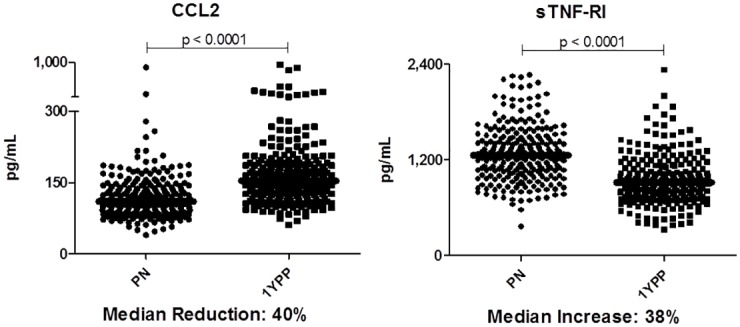
Changes in maternal innate immunity during healthy human pregnancy are not well understood. Whether basal immune status in vivo is largely unaffected by pregnancy, is constitutively biased towards an inflammatory phenotype (transiently enhancing host defense) or exhibits anti-inflammatory bias (reducing potential responsiveness to the fetus) is unclear. Here, in a longitudinal study of healthy women who gave birth to healthy infants following uncomplicated pregnancies within the Canadian Healthy Infant Longitudinal Development (CHILD) cohort, we test the hypothesis that a progressively altered bias in resting innate immune status develops. Women were examined during pregnancy and again, one and/or three years postpartum. Most pro-inflammatory cytokine expression, including CCL2, CXCL10, IL-18 and TNFα, was reduced in vivo during pregnancy (20-57%, p<0.0001). Anti-inflammatory biomarkers (sTNF-RI, sTNF-RII, and IL-1Ra) were elevated by ~50-100% (p<0.0001). Systemic IL-10 levels were unaltered during vs. post-pregnancy. Kinetic studies demonstrate that while decreased pro-inflammatory biomarker expression (CCL2, CXCL10, IL-18, and TNFα) was constant, anti-inflammatory expression increased progressively with increasing gestational age (p<0.0001). We conclude that healthy resting maternal immune status is characterized by an increasingly pronounced bias towards a systemic anti-inflammatory innate phenotype during the last two trimesters of pregnancy. This is resolved by one year postpartum in the absence of repeat pregnancy. The findings provide enhanced understanding of immunological changes that occur in vivo during healthy human pregnancy.
健康人类孕期母体固有免疫的变化尚未得到充分了解。孕期体内的基础免疫状态究竟是基本不受影响、固有地偏向炎症表型(短暂增强宿主防御)还是呈现抗炎偏向(降低对胎儿的潜在反应性)尚不清楚。在此,在加拿大健康婴儿纵向发育(CHILD)队列中对孕期无并发症并产下健康婴儿的健康女性进行的一项纵向研究中,我们检验了这样一个假设,即静息固有免疫状态会逐渐发生改变。在孕期以及产后一年和/或三年对女性进行检查。大多数促炎细胞因子表达,包括CCL2、CXCL10、IL - 18和TNFα,在孕期体内降低(20 - 57%,p<0.0001)。抗炎生物标志物(sTNF - RI、sTNF - RII和IL - 1Ra)升高了约50 - 100%(p<0.0001)。孕期与产后相比,全身IL - 10水平未改变。动力学研究表明,虽然促炎生物标志物表达(CCL2、CXCL10、IL - 18和TNFα)的降低是持续的,但抗炎表达随着孕周增加而逐渐升高(p<0.0001)。我们得出结论,在孕期的最后两个阶段,健康的静息母体免疫状态的特征是对全身抗炎固有表型的偏向日益明显。在没有再次怀孕的情况下,这种情况在产后一年得到缓解。这些发现增进了我们对健康人类孕期体内发生的免疫变化的理解。