Fontanilles Maxime, Marguet Florent, Bohers Élodie, Viailly Pierre-Julien, Dubois Sydney, Bertrand Philippe, Camus Vincent, Mareschal Sylvain, Ruminy Philippe, Maingonnat Catherine, Lepretre Stéphane, Veresezan Elena-Liana, Derrey Stéphane, Tilly Hervé, Picquenot Jean-Michel, Laquerrière Annie, Jardin Fabrice
Department of Hematology, Cancer Center Henri Becquerel, 76000 Rouen, France.
INSERM U1245, Cancer Center Henri Becquerel, Institute of Research and Innovation in Biomedicine (IRIB), University of Normandy, UNIVROUEN, 76000 Rouen, France.
Oncotarget. 2017 Jul 18;8(29):48157-48168. doi: 10.18632/oncotarget.18325.
Primary central nervous system lymphomas (PCNSL) have recurrent genomic alterations. The main objective of our study was to demonstrate that targeted sequencing of circulating cell-free DNA (cfDNA) released by PCNSL at the time of diagnosis could identify somatic mutations by next-generation sequencing (NGS).
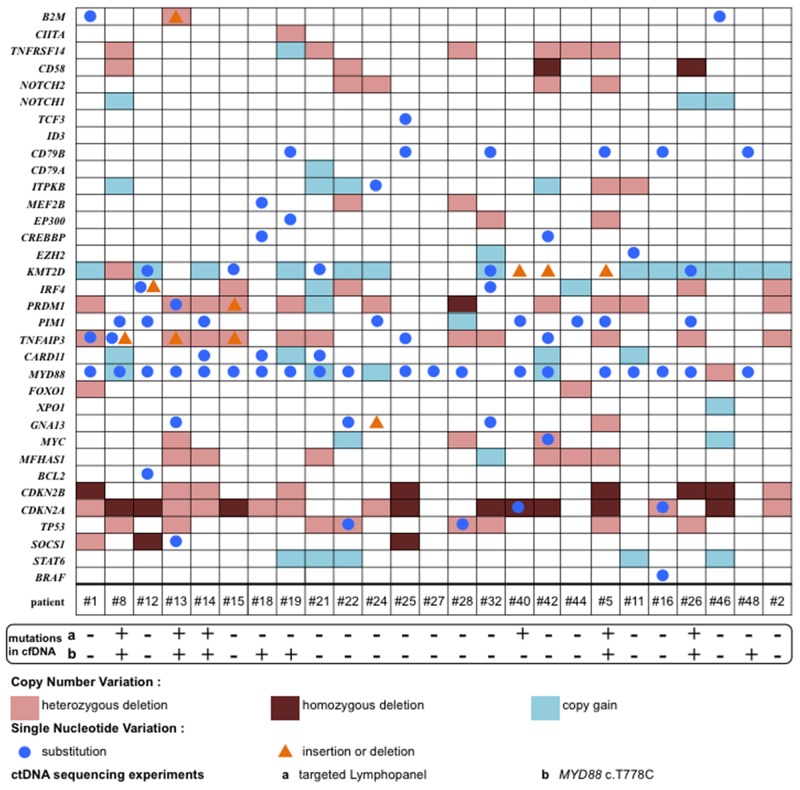
PlasmacfDNA and matched tumor DNA (tDNA) from 25 PCNSL patients were sequenced using an Ion Torrent Personal Genome Machine (Life Technologies®). First, patient-specific targeted sequencing of identified somatic mutations in tDNA was performed. Then, a second sequencing targeting MYD88 c.T778C was performed and compared to plasma samples from 25 age-matched control patients suffering from other types of cancer.
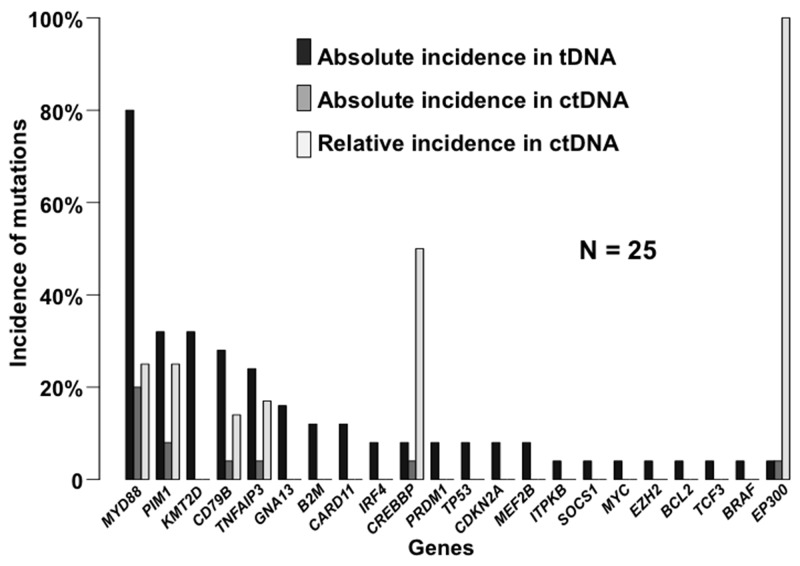
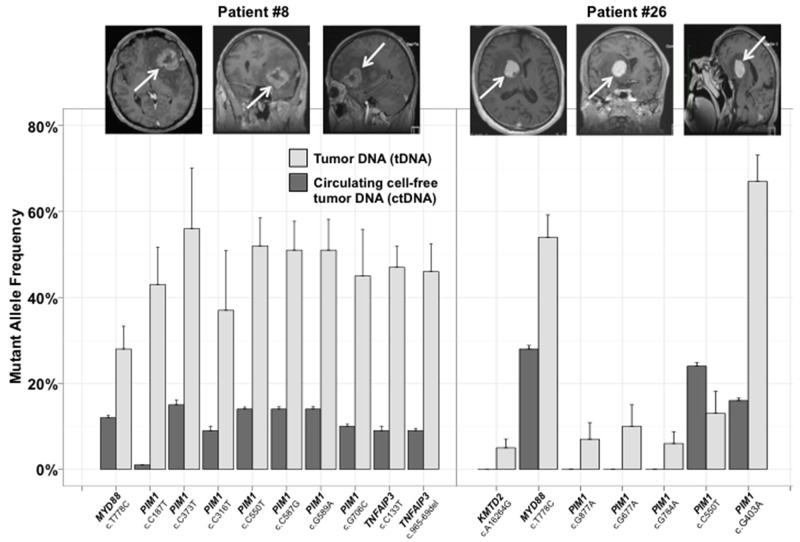
According to the patient-specific targeted sequencing, eight patients (32% [95% CI 15-54%]) had detectable somatic mutations in cfDNA. Considering MYD88 sequencing, six patients had the specific c.T778C alteration detected in plasma. Using a control group, the sensitivity was 24% [9-45%] and the specificity was 100%. Tumor volume or deep brain structure involvement did not influence the detection of somatic mutations in plasma.
This pilot study provided evidence that somatic mutations can be detected by NGS in the cfDNA of a subset of patients suffering from PCNSL.
原发性中枢神经系统淋巴瘤(PCNSL)存在复发性基因组改变。我们研究的主要目的是证明在诊断时由PCNSL释放的循环游离DNA(cfDNA)的靶向测序能够通过下一代测序(NGS)鉴定体细胞突变。
使用Ion Torrent个人基因组测序仪(Life Technologies®)对25例PCNSL患者的血浆cfDNA和匹配的肿瘤DNA(tDNA)进行测序。首先,对tDNA中鉴定出的体细胞突变进行患者特异性靶向测序。然后,进行针对MYD88 c.T778C的第二次测序,并与25例年龄匹配的患有其他类型癌症的对照患者的血浆样本进行比较。
根据患者特异性靶向测序,8例患者(32%[95%CI 15 - 54%])的cfDNA中存在可检测到的体细胞突变。考虑到MYD88测序,6例患者的血浆中检测到特定的c.T778C改变。使用对照组,敏感性为24%[9 - 45%],特异性为100%。肿瘤体积或深部脑结构受累不影响血浆中体细胞突变的检测。
这项初步研究提供了证据,表明通过NGS可以在一部分PCNSL患者的cfDNA中检测到体细胞突变。