Baylor College of Medicine, Children's Foundation-Uganda, Box 72052, Kampala, Uganda.
Mulago National Referral Hospital, Block 5 Clock Tower, Kampala, Uganda.
Biomed Res Int. 2017;2017:8036535. doi: 10.1155/2017/8036535. Epub 2017 May 30.
Assessment of pregnant mothers for nutritional status is a neglected intervention. In Kaabong Hospital, nutritional status of pregnant mothers was not assessed during antenatal care (ANC) visits. A quality improvement (QI) project was initiated to increase nutritional assessment using midupper arm circumference (MUAC) among pregnant mothers during ANC visits from 0 to 90% between April and September 2015.
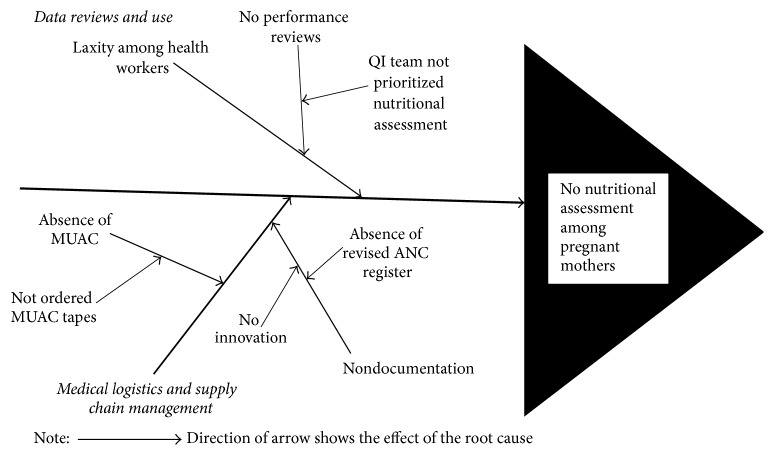
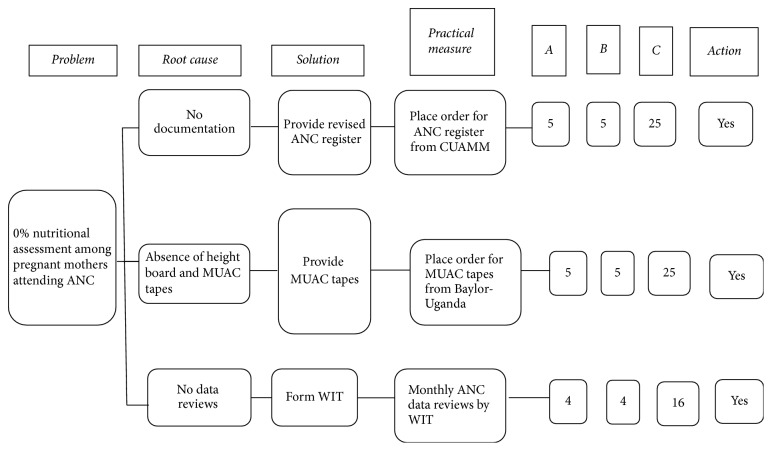
Baylor-Uganda formed ANC Work Improvement Team (WIT) that reviewed ANC register, identified gaps in quality of care, analyzed root causes using cause-effect diagram, developed solutions, and tested and implemented the solution using Plan-Do-Study-Act cycles. Planned and tested changes included the provision of anthropometric tools, integrated ANC register, and data use.
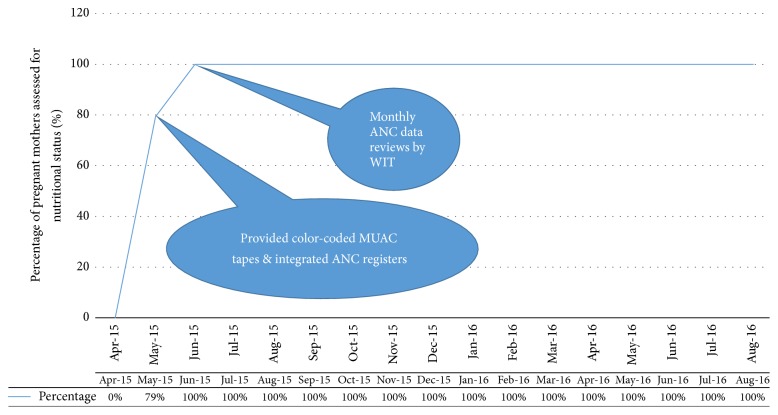
In April 2015 (baseline), none (0/235) of the pregnant women were assessed for nutritional status using MUAC. Following QI interventions, nutritional assessment improved to 79% (200/252) in May 2015 and to 100% (241/241) in June 2015. The 100% performance was sustained until August 2016. Overall, 39 cases of malnutrition-1 (2.6%) severe (MUAC < 19.0 cm) and 38 (97.4%) moderate acute malnutrition (MUAC 19-22.0 cm)-were identified and linked to nutritional rehabilitation program.
QI interventions are critical in achieving high rates of nutritional status assessment and identifying malnourished pregnant women during ANC visits.
评估孕妇的营养状况是一项被忽视的干预措施。在 Kaabong 医院,孕妇的营养状况在产前保健 (ANC) 就诊时并未得到评估。2015 年 4 月至 9 月期间,一项质量改进 (QI) 项目启动,旨在通过 ANC 就诊时的上臂中部周长 (MUAC) 增加对孕妇的营养评估,将其比例从 0%提高到 90%。
Baylor-Uganda 成立了 ANC 工作改进团队 (WIT),该团队审查了 ANC 登记册,确定了护理质量差距,使用因果关系图分析根本原因,制定解决方案,并使用计划-执行-研究-行动 (PDSA) 循环测试和实施解决方案。计划和测试的变更包括提供人体测量工具、整合 ANC 登记册和数据使用。
2015 年 4 月(基线),没有(0/235)孕妇通过 MUAC 评估营养状况。在 QI 干预后,营养评估在 2015 年 5 月提高到 79%(200/252),2015 年 6 月提高到 100%(241/241)。这一 100%的表现一直持续到 2016 年 8 月。总的来说,发现了 39 例营养不良病例——1 例(2.6%)为严重营养不良(MUAC<19.0cm),38 例(97.4%)为中度急性营养不良(MUAC 19-22.0cm)——并将其与营养康复计划联系起来。
QI 干预对于实现高比例的营养状况评估和在 ANC 就诊期间识别营养不良孕妇至关重要。