Gebre Betemariam, Biadgilign Sibhatu, Taddese Zinaw, Legesse Tsigereda, Letebo Mekitew
International Medical Corps, Country Office, Khartoum, Sudan.
Public Health and Nutrition Consultant, P.O. Box 24414, Addis Ababa, Ethiopia.
BMC Nutr. 2018 Mar 27;4:11. doi: 10.1186/s40795-018-0222-2. eCollection 2018.
Despite significant gains and progress in the last decade, malnutrition remains a major public health problem in Ethiopia. Pregnant and lactating women (PLW), along with children, are among the most vulnerable groups of population during emergencies and droughts. Identifying and targeting of PLW with malnutrition is among the priorities in humanitarian emergencies. However, there is dearth of evidence on PLW nutritional status and its determinants in humanitarian context.
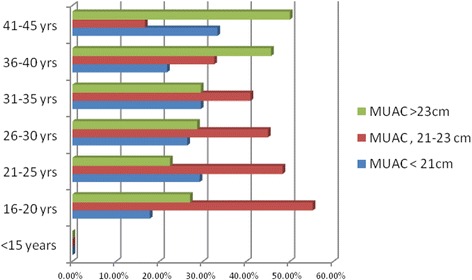
A community-based cross-sectional study was conducted in 10 kebeles of Rayitu district of Ethiopia in June 2013. A total of 900 PLW were assessed for malnutrition using mid-upper-arm circumference (MUAC).
Using MUAC < 21 cm as a criteria, 216 (24%) surveyed mothers were found to be malnourished. In multivariable logistic regression analysis, those mothers who did not received antenatal care (ANC) during their pregnancy had 1.83 higher odds of (adjusted odds ratio[AOR] = 1.83, 95% confidence interval [CI]:1.10,3.02) to be malnourished (MUAC < 21 cm) as compared to mothers who received ANC. Housewives had lower odds of (AOR = 0.59, 95 %CI: 0.37, 0.95) to be malnourished compared to those who engaged in as a pastoralist. Mothers belonging to families from which at least one person did not receive targeted supplementary feeding (TSF) in the 6 months before the study had lower odds of (AOR = 0.38, 95 %CI:0.23,0.62) to have acute malnutrition compared to those who lived in families who received TSF.
Malnutrition is common among PLW in humanitarian settings, including those with ongoing interventions. Attending antenatal care, maternal occupational status and being a member of families who received TSF were factors associated with maternal nutritional status in this study. This signifies the need for sustainable solutions that address the high prevalence of malnutrition among PLW. Interventions targeting health system responses such as comprehensive nutrition education, support through antenatal care and women empowerment are recommended.
尽管在过去十年中取得了显著进展,但营养不良在埃塞俄比亚仍然是一个主要的公共卫生问题。孕妇和哺乳期妇女以及儿童是紧急情况和干旱期间最脆弱的人群。在人道主义紧急情况下,识别和针对营养不良的孕妇和哺乳期妇女是优先事项之一。然而,在人道主义背景下,关于孕妇和哺乳期妇女营养状况及其决定因素的证据很少。
2013年6月,在埃塞俄比亚雷伊图区的10个社区开展了一项基于社区的横断面研究。使用上臂中部周长(MUAC)对总共900名孕妇和哺乳期妇女进行了营养不良评估。
以上臂中部周长小于21厘米为标准,发现216名(24%)接受调查的母亲营养不良。在多变量逻辑回归分析中,与接受产前护理的母亲相比,那些在孕期未接受产前护理(ANC)的母亲营养不良(上臂中部周长小于21厘米)的几率高1.83倍(调整优势比[AOR]=1.83,95%置信区间[CI]:1.10,3.02)。与从事牧民工作的母亲相比,家庭主妇营养不良的几率较低(AOR=0.59,95%CI:0.37,0.95)。与生活在接受目标性补充喂养(TSF)家庭的母亲相比,在研究前6个月中,家庭中至少有一人未接受目标性补充喂养的母亲发生急性营养不良的几率较低(AOR=0.38,95%CI:0.23,0.62)。
在人道主义环境中,包括那些正在进行干预措施的环境中,孕妇和哺乳期妇女营养不良的情况很常见。在本研究中,接受产前护理、母亲职业状况以及是否属于接受目标性补充喂养家庭的成员是与母亲营养状况相关的因素。这表明需要有可持续的解决方案来解决孕妇和哺乳期妇女中营养不良的高流行率问题。建议采取针对卫生系统反应的干预措施,如全面营养教育、通过产前护理提供支持以及增强妇女权能。