Keijser Jan N, van Heuvelen Marieke J G, Nyakas Csaba, Tóth Kata, Schoemaker Regien G, Zeinstra Edzard, van der Zee Eddy A
Molecular Neurobiology, Groningen Institute for Evolutionary Life Sciences (GELIFES), University of Groningen, Groningen, the Netherlands.
Center for Human Movement Sciences, University of Groningen, University Medical Center Groningen, Groningen, the Netherlands.
Afr J Tradit Complement Altern Med. 2017 Jun 5;14(4):128-134. doi: 10.21010/ajtcam.v14i4.15. eCollection 2017.
Whole body vibration (WBV) is a form of physical stimulation via mechanical vibrations transmitted to a subject. It is assumed that WBV induces sensory stimulation in cortical brain regions through the activation of skin and muscle receptors responding to the vibration. The effects of WBV on muscle strength are well described. However, little is known about the impact of WBV on the brain. Recently, it was shown in humans that WBV improves attention in an acute WBV protocol. Preclinical research is needed to unravel the underlying brain mechanism. As a first step, we examined whether chronic WBV improves attention in mice.
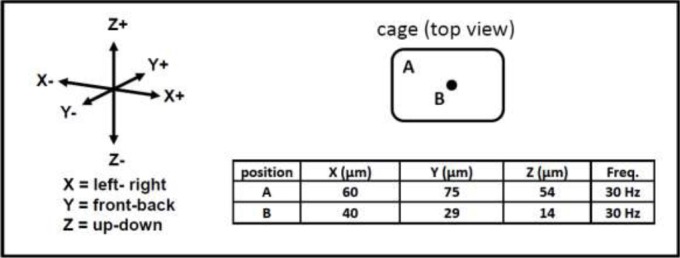
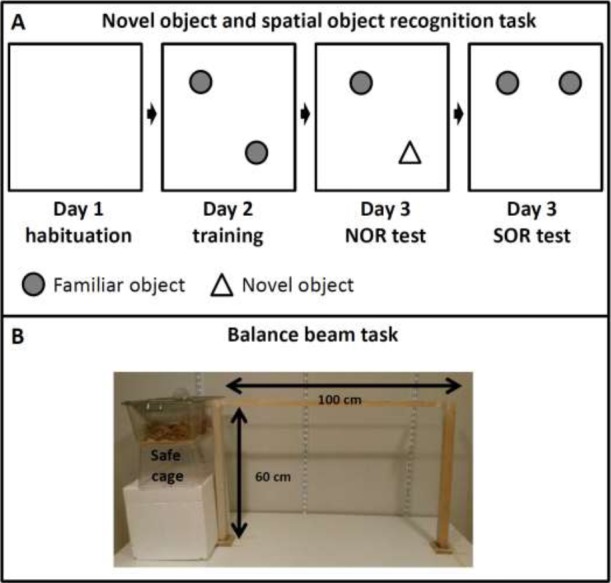
A custom made vibrating platform for mice with low intensity vibrations was used. Male CD1 mice (3 months of age) received five weeks WBV (30 Hz; 1.9 G), five days a week with sessions of five (n=12) or 30 (n=10) minutes. Control mice (pseudo-WBV; n=12 and 10 for the five and 30 minute sessions, respectively) were treated in a similar way, but did not receive the actual vibration. Object recognition tasks were used as an attention test (novel and spatial object recognition - the primary outcome measure). A Balance beam was used for motor performance, serving as a secondary outcome measure.
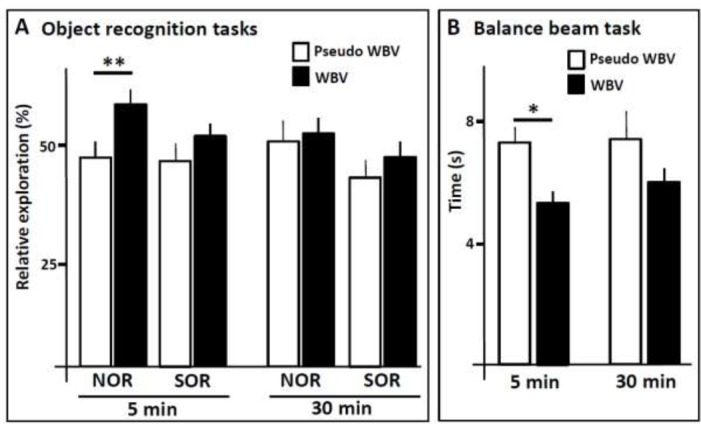
WBV sessions of five (but not WBV sessions of 30 minutes) improved balance beam performance (mice gained 28% in time needed to cross the beam) and novel object recognition (mice paid significantly more attention to the novel object) as compared to pseudo WBV, but no change was found for spatial object performance (mice did not notice the relocation). Although 30 minutes WBV sessions were not beneficial, it did not impair either attention or motor performance.
These results show that brief sessions of WBV improve, next to motor performance, attention for object recognition, but not spatial cues of the objects. The selective improvement of attention in mice opens the avenue to unravel the underlying brain mechanisms.
全身振动(WBV)是一种通过传递给受试者的机械振动进行的物理刺激形式。据推测,WBV通过激活对振动做出反应的皮肤和肌肉感受器,在大脑皮层区域诱发感觉刺激。WBV对肌肉力量的影响已有充分描述。然而,关于WBV对大脑的影响却知之甚少。最近,在人体研究中发现,急性WBV方案可改善注意力。需要进行临床前研究来阐明潜在的脑机制。作为第一步,我们研究了慢性WBV是否能改善小鼠的注意力。
使用定制的低强度振动小鼠振动平台。雄性CD1小鼠(3月龄)接受为期五周的WBV(30Hz;1.9G),每周五天,每次训练5分钟(n = 12)或30分钟(n = 10)。对照小鼠(假WBV;5分钟组和30分钟组分别为n = 12和10)接受类似处理,但未接受实际振动。使用物体识别任务作为注意力测试(新颖和空间物体识别——主要观察指标)。使用平衡木测试运动表现,作为次要观察指标。
与假WBV相比,5分钟的WBV训练(而非30分钟的WBV训练)改善了平衡木表现(小鼠通过平衡木所需时间增加了28%)和新颖物体识别能力(小鼠对新颖物体的关注度显著提高),但空间物体表现未发现变化(小鼠未注意到物体的重新放置)。虽然30分钟的WBV训练没有益处,但也未损害注意力或运动表现。
这些结果表明,短暂的WBV训练除了改善运动表现外,还能提高对物体识别的注意力,但不能提高对物体空间线索的注意力。小鼠注意力的选择性改善为阐明潜在的脑机制开辟了道路。