Narusyte Jurgita, Ropponen Annina, Alexanderson Kristina, Svedberg Pia
Division of Insurance Medicine, Department of Clinical Neuroscience, Karolinska Institute, 17177, Stockholm, Sweden.
Finnish Institute of Occupational Health, Helsinki, Finland.
Soc Psychiatry Psychiatr Epidemiol. 2017 Sep;52(9):1159-1168. doi: 10.1007/s00127-017-1409-6. Epub 2017 Jun 21.
There is limited information regarding the association between youth mental health problems and work incapacity in adulthood. We investigated whether internalizing (depressive, anxious, somatic complaints) and externalizing (aggressive, rule-breaking) behavior problems in childhood and adolescence were associated with sickness absence (SA) and disability pension (DP) in young adulthood.
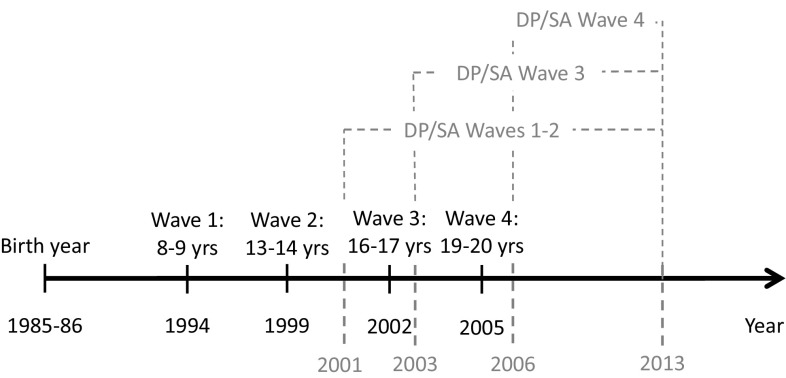
Data were used from the population-based and prospective Twin Study of Child and Adolescent Development (TCHAD) which includes all Swedish twins born in 1985-1986 (N = 2570). Internalizing and externalizing behavior problems were assessed with the Child Behavior Checklist at ages of 8-9, 13-14, 16-17, and 19-20 years. Individuals participating in TCHAD were followed regarding SA and DP during 2001-2013 using nationwide registers. Cox regression models were applied to assess hazard ratios (HR) with 95% confidence intervals (CI).
Each one-unit increase of rule-breaking behavior implied a significant higher risk for SA in early adulthood, despite of age at assessment, with the highest HR of 1.12 (95% CI 1.05-1.19) at age of 8-9 years. Higher levels of anxious and depressive symptoms in childhood and adolescence were associated with DP in early adulthood despite age at assessment, with the highest risk at age 19-20 years [HR 1.31 (95% CI 1.12-1.53)]. The associations attenuated slightly when familial factors were taken into account.
Internalizing and externalizing behavior problems identified at an early age (8-9 years) increased risk for SA and DP in young adulthood. These findings indicate that early prevention and intervention efforts to reduce behavior problems may promote a successful start in working life.
关于青少年心理健康问题与成年后工作能力丧失之间的关联,相关信息有限。我们调查了儿童期和青少年期的内化(抑郁、焦虑、躯体不适)和外化(攻击、违规)行为问题是否与青年期的病假(SA)和残疾抚恤金(DP)有关。
数据来自基于人群的前瞻性儿童和青少年发展双胞胎研究(TCHAD),该研究纳入了1985 - 1986年出生的所有瑞典双胞胎(N = 2570)。在8 - 9岁、13 - 14岁、16 - 17岁和19 - 20岁时,使用儿童行为量表评估内化和外化行为问题。利用全国性登记册对参与TCHAD的个体在2001 - 2013年期间的病假和残疾抚恤金情况进行随访。应用Cox回归模型评估风险比(HR)及95%置信区间(CI)。
无论评估年龄如何,违规行为每增加一个单位,成年早期患SA的风险显著更高,8 - 9岁时HR最高,为1.12(95%CI 1.05 - 1.19)。儿童期和青少年期较高水平的焦虑和抑郁症状与成年早期的DP有关,无论评估年龄如何,19 - 20岁时风险最高[HR 1.31(95%CI 1.12 - 1.53)]。考虑家族因素后,这种关联略有减弱。
早年(8 - 9岁)发现的内化和外化行为问题会增加成年早期患SA和DP的风险。这些发现表明,早期预防和干预措施以减少行为问题可能有助于在工作生活中取得成功开端。