Takahashi Hidenori, Tampo Hironobu, Arai Yusuke, Inoue Yuji, Kawashima Hidetoshi
Department of Ophthalmology, Jichi Medical University, 3311-1 Yakushiji, Shimotsuke-shi, Tochigi, Japan.
PLoS One. 2017 Jun 22;12(6):e0179790. doi: 10.1371/journal.pone.0179790. eCollection 2017.
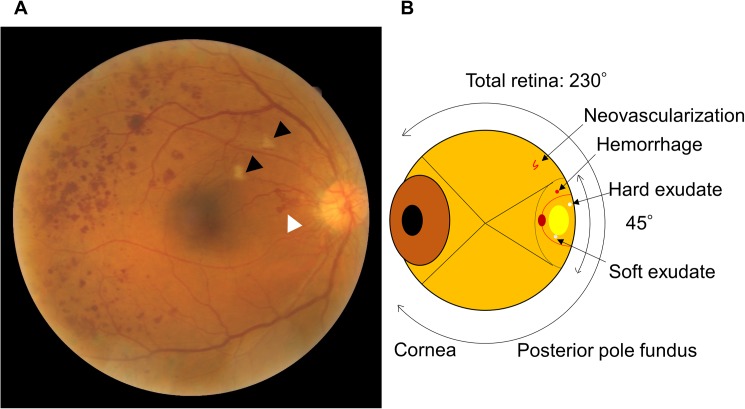
Disease staging involves the assessment of disease severity or progression and is used for treatment selection. In diabetic retinopathy, disease staging using a wide area is more desirable than that using a limited area. We investigated if deep learning artificial intelligence (AI) could be used to grade diabetic retinopathy and determine treatment and prognosis.
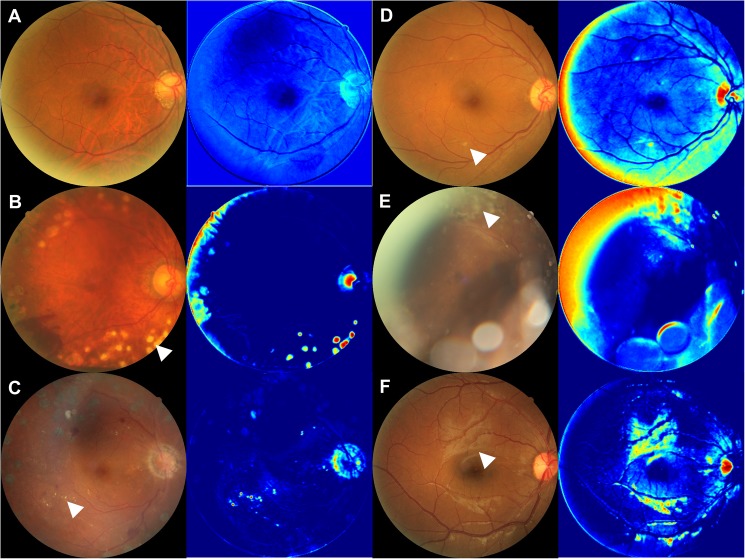
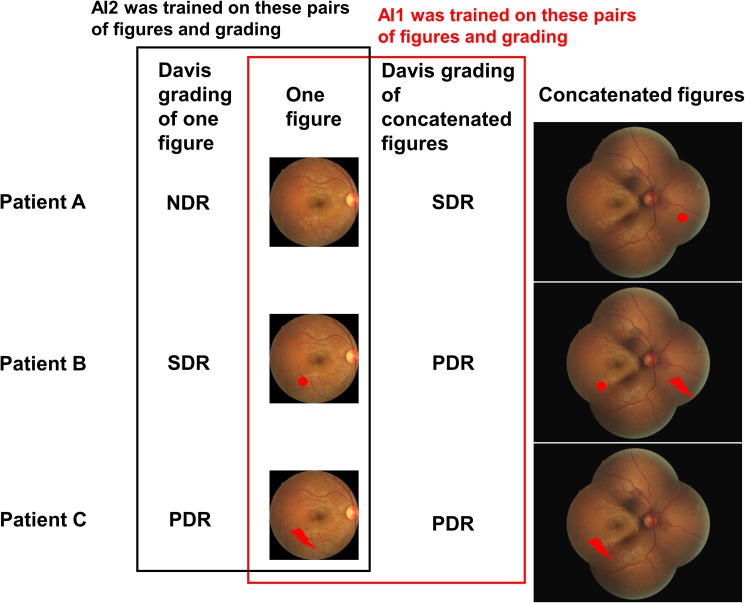
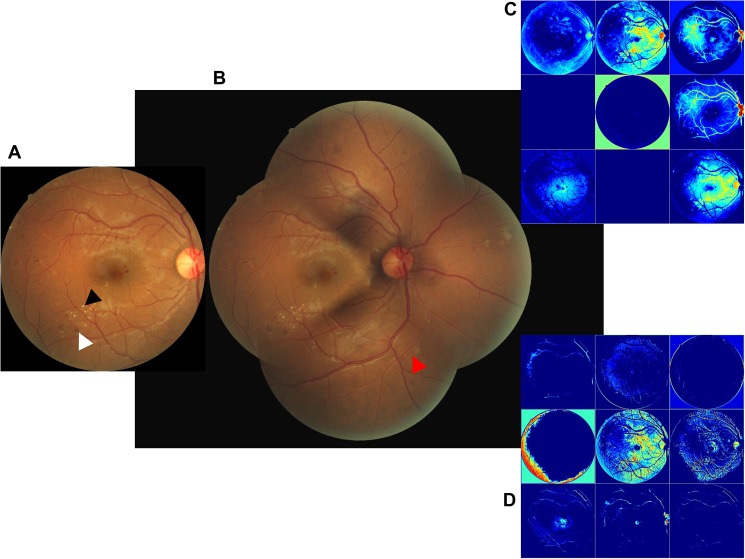
The retrospective study analyzed 9,939 posterior pole photographs of 2,740 patients with diabetes. Nonmydriatic 45° field color fundus photographs were taken of four fields in each eye annually at Jichi Medical University between May 2011 and June 2015. A modified fully randomly initialized GoogLeNet deep learning neural network was trained on 95% of the photographs using manual modified Davis grading of three additional adjacent photographs. We graded 4,709 of the 9,939 posterior pole fundus photographs using real prognoses. In addition, 95% of the photographs were learned by the modified GoogLeNet. Main outcome measures were prevalence and bias-adjusted Fleiss' kappa (PABAK) of AI staging of the remaining 5% of the photographs.
The PABAK to modified Davis grading was 0.64 (accuracy, 81%; correct answer in 402 of 496 photographs). The PABAK to real prognosis grading was 0.37 (accuracy, 96%).
We propose a novel AI disease-staging system for grading diabetic retinopathy that involves a retinal area not typically visualized on fundoscopy and another AI that directly suggests treatments and determines prognoses.
疾病分期涉及对疾病严重程度或进展的评估,并用于治疗选择。在糖尿病视网膜病变中,使用大面积进行疾病分期比使用有限区域更可取。我们研究了深度学习人工智能(AI)是否可用于对糖尿病视网膜病变进行分级,并确定治疗方法和预后。
这项回顾性研究分析了2740例糖尿病患者的9939张后极部照片。2011年5月至2015年6月期间,在秩父医科大学每年对每只眼睛的四个视野拍摄非散瞳45°视野彩色眼底照片。使用另外三张相邻照片的手动修改后的戴维斯分级法,在95%的照片上训练一个经过修改的完全随机初始化的谷歌神经网络。我们使用实际预后对9939张后极部眼底照片中的4709张进行分级。此外,95%的照片由修改后的谷歌神经网络学习。主要观察指标是其余5%照片的AI分期的患病率和偏差调整后的Fleiss卡帕(PABAK)。
与修改后的戴维斯分级法相比,PABAK为0.64(准确率81%;496张照片中有402张正确答案)。与实际预后分级法相比,PABAK为0.37(准确率96%)。
我们提出了一种用于对糖尿病视网膜病变进行分级的新型AI疾病分期系统,该系统涉及在眼底镜检查中通常不可见的视网膜区域,以及另一种直接建议治疗方法并确定预后的AI。