Liu Chia-Ying, Lai Shenghan, Kawel-Boehm Nadine, Chahal Harjit, Ambale-Venkatesh Bharath, Lima Joao A C, Bluemke David A
Radiology and Imaging Sciences, National Institutes of Health (NIH), Bethesda, Maryland, United States of America.
Department of Pathology, Johns Hopkins School of Medicine, Baltimore, Maryland, United States of America.
PLoS One. 2017 Jun 22;12(6):e0179947. doi: 10.1371/journal.pone.0179947. eCollection 2017.
Understanding the relationship of cardiovascular structure and function to age is confounded by the high prevalence of traditional risk factors in the United States. The purpose of the study is to compare left ventricular (LV) and aortic structural, and functional parameters in individuals with and without traditional risk factors in a population-based cohort.
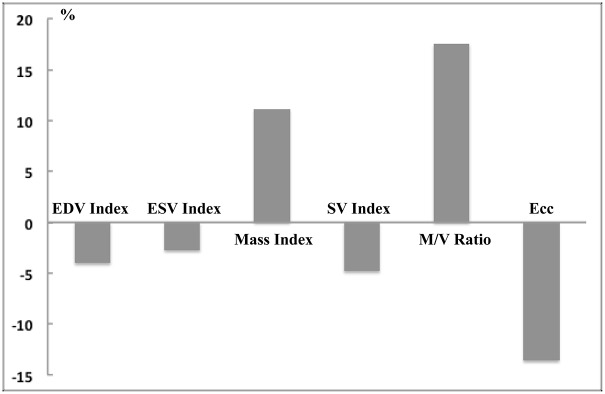
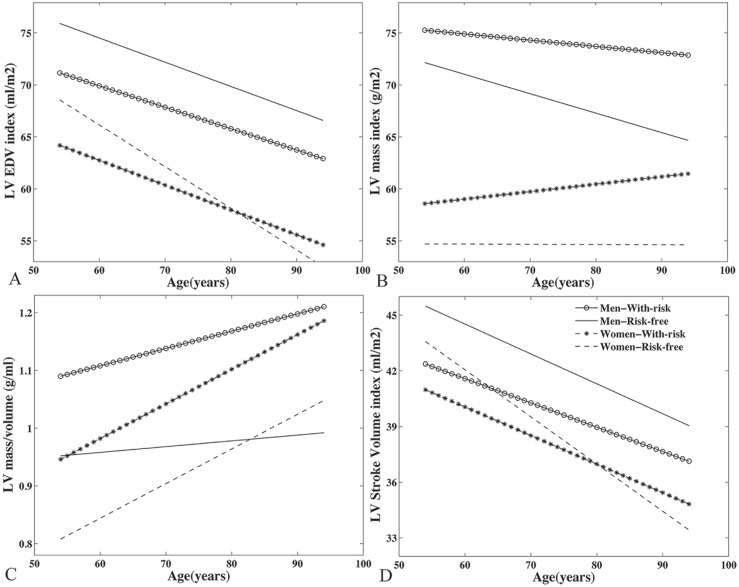
3015 study participants (48% men, age 55-94, mean 69.01±9.17 years) in the Multi-Ethnic Study of Atherosclerosis (MESA) underwent cardiovascular magnetic resonance (CMR) imaging from 2010-2012. Absence of cardiovascular (CV) risk factors (no hypertension, diabetes or impaired fasting glucose, obesity, smoking or hypercholesterolemia) was infrequent, occurring in just 314 (10.4%, 38% men) of 3015 participants. In multivariable analyses adjusting for age, sex and race, individuals with CV risk factors had significantly larger LV mass index (by 17%) and lower LV contractibility (circumference strain, lower by 14%). Indexed LV volumes and stroke volume were inversely associated with age, but such relationships were not statistically significant in risk-free male subjects (p>0.05). Men with CV risk factors showed positive association of CMR T1 indices of myocardial fibrosis with age. Aortic function was similar in individuals with and without risk factors; age was associated with decline of aortic function in both CV and no CV risk factor groups.
Our results support that LV structure and function are better preserved in senescent hearts in the absence of traditional cardiovascular risk factors, and such protection is more prominent in men than in women.
在美国,传统风险因素的高患病率混淆了对心血管结构和功能与年龄关系的理解。本研究的目的是在一个基于人群的队列中,比较有无传统风险因素个体的左心室(LV)和主动脉结构及功能参数。
动脉粥样硬化多民族研究(MESA)中的3015名研究参与者(48%为男性,年龄55 - 94岁,平均69.01±9.17岁)在2010 - 2012年接受了心血管磁共振(CMR)成像检查。无心血管(CV)风险因素(无高血压、糖尿病或空腹血糖受损、肥胖、吸烟或高胆固醇血症)的情况很少见,在3015名参与者中仅314人(10.4%,38%为男性)出现。在对年龄、性别和种族进行调整的多变量分析中,有CV风险因素的个体左心室质量指数显著更大(高17%),左心室收缩性更低(圆周应变,低14%)。左心室容积指数和每搏输出量与年龄呈负相关,但在无风险男性受试者中这种关系无统计学意义(p>0.05)。有CV风险因素的男性中,心肌纤维化的CMR T₁指数与年龄呈正相关。有风险因素和无风险因素个体的主动脉功能相似;年龄与CV风险因素组和无CV风险因素组的主动脉功能下降均相关。
我们的结果支持,在没有传统心血管风险因素的情况下,衰老心脏中的左心室结构和功能能得到更好的保留,且这种保护在男性中比在女性中更显著。