Elmesmari Rabha, Reilly John J, Martin Anne, Paton James Y
School of Medicine, College of Medical, Veterinary, and Life Sciences, University of Glasgow, Glasgow, Scotland.
Al-Fatah Hospital, Medical School, Benghazi University, Benghazi, Libya.
PLoS One. 2017 Jun 22;12(6):e0179429. doi: 10.1371/journal.pone.0179429. eCollection 2017.
Moderate-to-vigorous physical activity (MVPA) and sedentary time (ST) are important for child and adolescent health.
To examine habitual levels of accelerometer measured MVPA and ST in children and adolescents with chronic disease, and how these levels compare with healthy peers.
Data sources: An extensive search was carried out in Medline, Cochrane library, EMBASE, SPORTDiscus and CINAHL from 2000-2017. Study selection: Studies with accelerometer-measured MVPA and/or ST (at least 3 days and 6 hours/day to provide estimates of habitual levels) in children 0-19 years of age with chronic diseases but without co-morbidities that would present major impediments to physical activity. In all cases patients were studied while well and clinically stable.
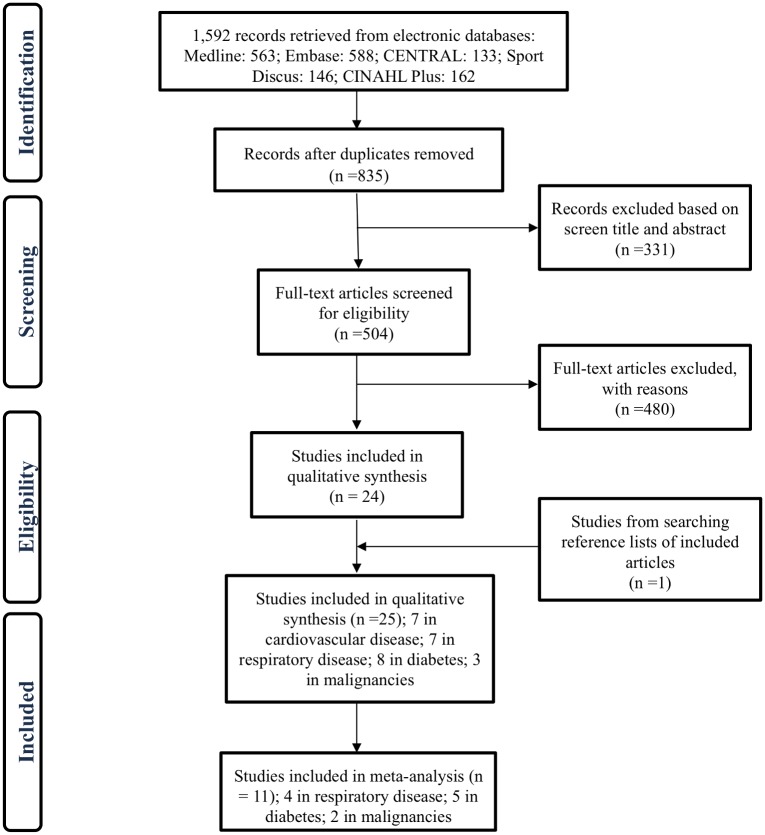
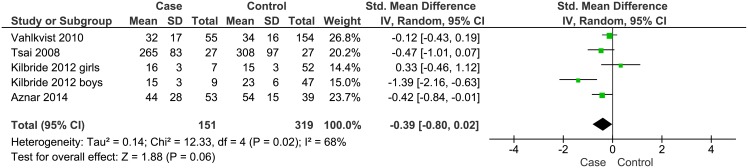
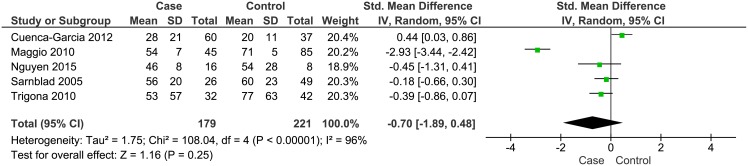
Out of 1592 records, 25 studies were eligible, in four chronic disease categories: cardiovascular disease (7 studies), respiratory disease (7 studies), diabetes (8 studies), and malignancy (3 studies). Patient MVPA was generally below the recommended 60 min/day and ST generally high regardless of the disease condition. Comparison with healthy controls suggested no marked differences in MVPA between controls and patients with cardiovascular disease (1 study, n = 42) and type 1 diabetes (5 studies, n = 400; SMD -0.70, 95% CI -1.89 to 0.48, p = 0.25). In patients with respiratory disease, MVPA was lower in patients than controls (4 studies, n = 470; SMD -0.39, 95% CI -0.80, 0.02, p = 0.06). Meta-analysis indicated significantly lower MVPA in patients with malignancies than in the controls (2 studies, n = 90; SMD -2.2, 95% CI -4.08 to -0.26, p = 0.03). Time spent sedentary was significantly higher in patients in 4/10 studies compared with healthy control groups, significantly lower in 1 study, while 5 studies showed no significant group difference.
MVPA in children/adolescents with chronic disease appear to be well below guideline recommendations, although comparable with activity levels of their healthy peers except for children with malignancies. Tailored and disease appropriate intervention strategies may be needed to increase MVPA and reduce ST in children and adolescents with chronic disease.
中等到剧烈身体活动(MVPA)和久坐时间(ST)对儿童和青少年的健康很重要。
研究慢性病儿童和青少年通过加速度计测量的MVPA和ST的习惯水平,以及这些水平与健康同龄人相比如何。
数据来源:2000年至2017年在Medline、Cochrane图书馆、EMBASE、SPORTDiscus和CINAHL中进行了广泛检索。研究选择:对0至19岁患有慢性病但无合并症(这些合并症会对身体活动造成重大障碍)的儿童进行加速度计测量MVPA和/或ST的研究(至少3天且每天6小时,以提供习惯水平的估计值)。在所有情况下,患者均在病情良好且临床稳定时进行研究。
在1592条记录中,有25项研究符合条件,涉及四类慢性病:心血管疾病(7项研究)、呼吸系统疾病(7项研究)、糖尿病(8项研究)和恶性肿瘤(3项研究)。无论疾病状况如何,患者的MVPA通常低于建议的每天60分钟,而ST通常较高。与健康对照组相比,心血管疾病患者(1项研究,n = 42)和1型糖尿病患者(5项研究,n = 400;标准化均数差 -0.70,95%可信区间 -1.89至0.48,p = 0.25)的MVPA与对照组之间无明显差异。在呼吸系统疾病患者中,患者的MVPA低于对照组(4项研究,n = 470;标准化均数差 -0.39,95%可信区间 -0.80,0.02,p = 0.06)。荟萃分析表明,恶性肿瘤患者的MVPA明显低于对照组(2项研究,n = 90;标准化均数差 -2.2,95%可信区间 -4.08至 -0.26,p = 0.03)。在10项研究中的4项中,患者的久坐时间明显高于健康对照组,1项研究中明显较低,而5项研究显示组间无显著差异。
患有慢性病的儿童/青少年的MVPA似乎远低于指南建议,尽管除了患有恶性肿瘤的儿童外,其活动水平与健康同龄人相当。可能需要量身定制且适合疾病的干预策略,以增加患有慢性病的儿童和青少年的MVPA并减少ST。