Faivre-Finn Corinne, Snee Michael, Ashcroft Linda, Appel Wiebke, Barlesi Fabrice, Bhatnagar Adityanarayan, Bezjak Andrea, Cardenal Felipe, Fournel Pierre, Harden Susan, Le Pechoux Cecile, McMenemin Rhona, Mohammed Nazia, O'Brien Mary, Pantarotto Jason, Surmont Veerle, Van Meerbeeck Jan P, Woll Penella J, Lorigan Paul, Blackhall Fiona
Division of Molecular and Clinical Cancer Sciences, School of Medical Sciences, Faculty of Biology, Medicine and Health, University of Manchester, Manchester, UK; Department of Radiotherapy Related Research, The Christie NHS Foundation Trust, Manchester, UK.
St James Institute of Oncology, Leeds, UK.
Lancet Oncol. 2017 Aug;18(8):1116-1125. doi: 10.1016/S1470-2045(17)30318-2. Epub 2017 Jun 20.
Concurrent chemoradiotherapy is the standard of care in limited-stage small-cell lung cancer, but the optimal radiotherapy schedule and dose remains controversial. The aim of this study was to establish a standard chemoradiotherapy treatment regimen in limited-stage small-cell lung cancer.
The CONVERT trial was an open-label, phase 3, randomised superiority trial. We enrolled adult patients (aged ≥18 years) who had cytologically or histologically confirmed limited-stage small-cell lung cancer, Eastern Cooperative Oncology Group performance status of 0-2, and adequate pulmonary function. Patients were recruited from 73 centres in eight countries. Patients were randomly assigned to receive either 45 Gy radiotherapy in 30 twice-daily fractions of 1·5 Gy over 19 days, or 66 Gy in 33 once-daily fractions of 2 Gy over 45 days, starting on day 22 after commencing cisplatin-etoposide chemotherapy (given as four to six cycles every 3 weeks in both groups). The allocation method used was minimisation with a random element, stratified by institution, planned number of chemotherapy cycles, and performance status. Treatment group assignments were not masked. The primary endpoint was overall survival, defined as time from randomisation until death from any cause, analysed by modified intention-to-treat. A 12% higher overall survival at 2 years in the once-daily group versus the twice-daily group was considered to be clinically significant to show superiority of the once-daily regimen. The study is registered with ClinicalTrials.gov (NCT00433563) and is currently in follow-up.
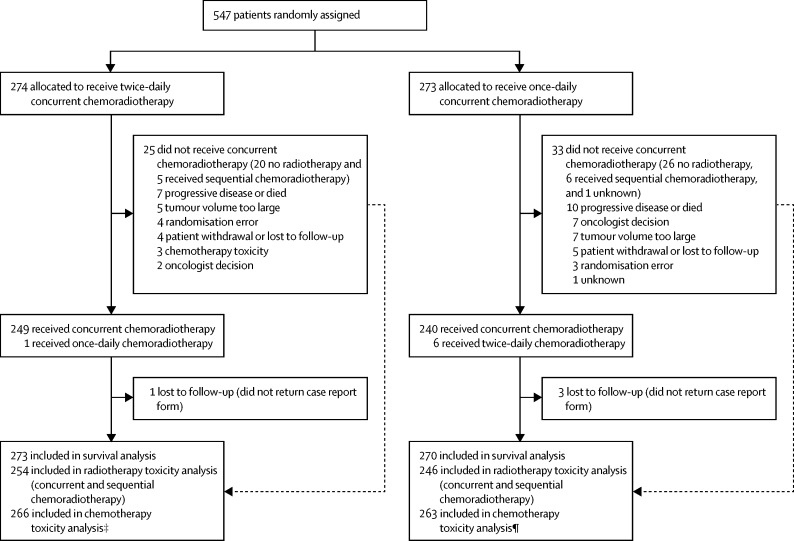
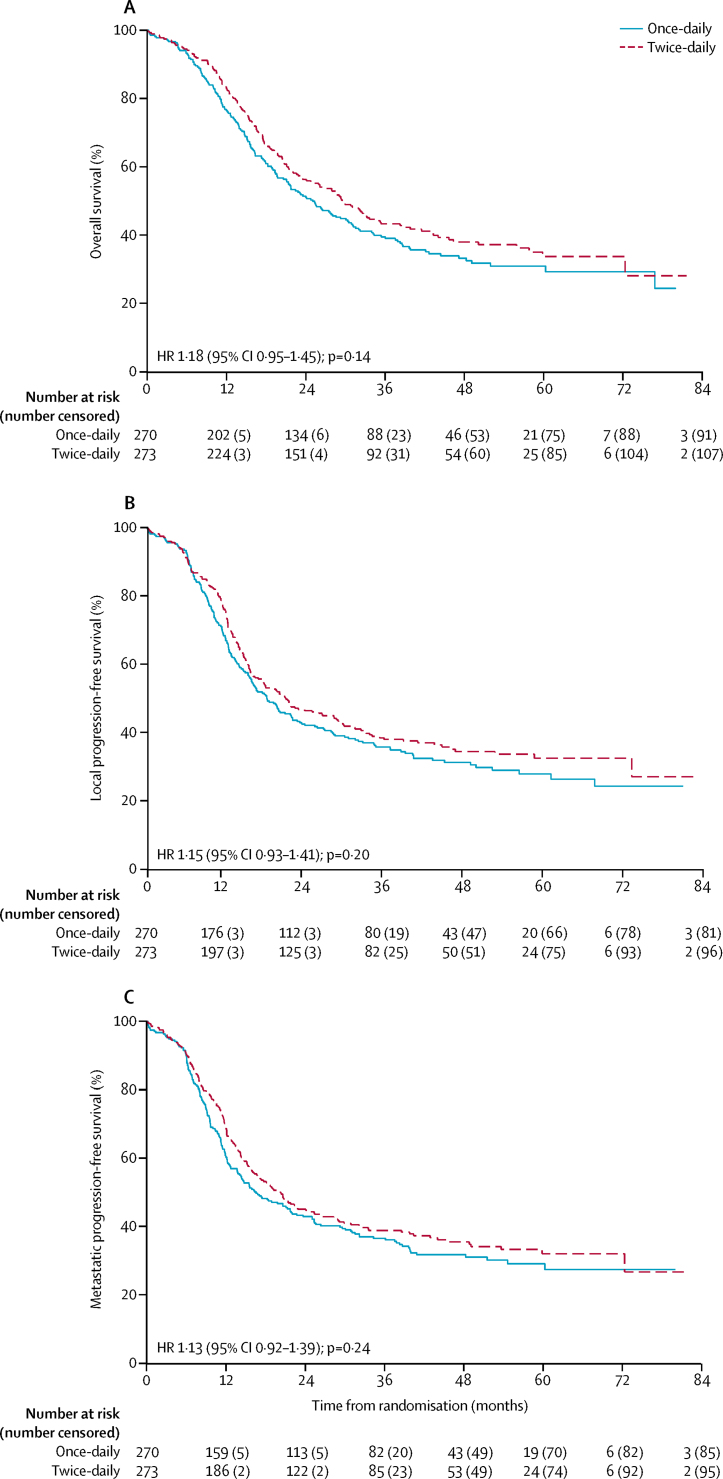
Between April 7, 2008, and Nov 29, 2013, 547 patients were enrolled and randomly assigned to receive twice-daily concurrent chemoradiotherapy (274 patients) or once-daily concurrent chemoradiotherapy (273 patients). Four patients (one in the twice-daily group and three in the once-daily group) did not return their case report forms and were lost to follow-up; these patients were not included in our analyses. At a median follow-up of 45 months (IQR 35-58), median overall survival was 30 months (95% CI 24-34) in the twice-daily group versus 25 months (21-31) in the once-daily group (hazard ratio for death in the once daily group 1·18 [95% CI 0·95-1·45]; p=0·14). 2-year overall survival was 56% (95% CI 50-62) in the twice-daily group and 51% (45-57) in the once-daily group (absolute difference between the treatment groups 5·3% [95% CI -3·2% to 13·7%]). The most common grade 3-4 adverse event in patients evaluated for chemotherapy toxicity was neutropenia (197 [74%] of 266 patients in the twice-daily group vs 170 [65%] of 263 in the once-daily group). Most toxicities were similar between the groups, except there was significantly more grade 4 neutropenia with twice-daily radiotherapy (129 [49%] vs 101 [38%]; p=0·05). In patients assessed for radiotherapy toxicity, was no difference in grade 3-4 oesophagitis between the groups (47 [19%] of 254 patients in the twice-daily group vs 47 [19%] of 246 in the once-daily group; p=0·85) and grade 3-4 radiation pneumonitis (4 [3%] of 254 vs 4 [2%] of 246; p=0·70). 11 patients died from treatment-related causes (three in the twice-daily group and eight in the once-daily group).
Survival outcomes did not differ between twice-daily and once-daily concurrent chemoradiotherapy in patients with limited-stage small-cell lung cancer, and toxicity was similar and lower than expected with both regimens. Since the trial was designed to show superiority of once-daily radiotherapy and was not powered to show equivalence, the implication is that twice-daily radiotherapy should continue to be considered the standard of care in this setting.
Cancer Research UK (Clinical Trials Awards and Advisory Committee), French Ministry of Health, Canadian Cancer Society Research Institute, European Organisation for Research and Treatment of Cancer (Cancer Research Fund, Lung Cancer, and Radiation Oncology Groups).
同步放化疗是局限期小细胞肺癌的标准治疗方案,但最佳放疗方案和剂量仍存在争议。本研究旨在确立局限期小细胞肺癌的标准放化疗治疗方案。
CONVERT试验是一项开放标签、3期、随机优效性试验。我们纳入了年龄≥18岁、经细胞学或组织学确诊为局限期小细胞肺癌、东部肿瘤协作组体能状态为0 - 2且肺功能良好的成年患者。患者来自8个国家的73个中心。患者被随机分配接受以下两种治疗之一:在开始顺铂 - 依托泊苷化疗(两组均每3周进行4 - 6个周期)后的第22天开始,19天内每天两次、每次1.5 Gy共30次分割给予45 Gy放疗,或45天内每天一次、每次2 Gy共33次分割给予66 Gy放疗。所采用的分配方法是带有随机因素的最小化法,按机构、计划化疗周期数和体能状态进行分层。治疗组分配未设盲。主要终点是总生存期,定义为从随机分组至因任何原因死亡的时间,采用改良意向性分析。每日一次组与每日两次组相比,2年总生存期提高12%被认为具有临床显著性,以显示每日一次方案的优越性。该研究已在ClinicalTrials.gov注册(NCT00433563),目前正在随访中。
2008年4月7日至2013年11月29日期间,共纳入547例患者并随机分配接受每日两次同步放化疗(274例患者)或每日一次同步放化疗(273例患者)。4例患者(每日两次组1例,每日一次组3例)未返回病例报告表且失访;这些患者未纳入我们的分析。在中位随访45个月(IQR 35 - 58)时,每日两次组的中位总生存期为30个月(95%CI 24 - 34),而每日一次组为25个月(21 - 31)(每日一次组的死亡风险比为1.18 [95%CI 0.95 - 1.45];p = 0.14)。2年总生存率在每日两次组为56%(95%CI 50 - 62),在每日一次组为51%(45 - 57)(治疗组间的绝对差异为5.3% [95%CI - 3.2%至13.7%])。在评估化疗毒性的患者中,最常见的3 - 4级不良事件是中性粒细胞减少(每日两次组266例患者中有197例[74%],每日一次组263例患者中有170例[65%])。两组间大多数毒性反应相似,但每日两次放疗的4级中性粒细胞减少明显更多(129例[49%]对101例[38%];p = 0.05)。在评估放疗毒性的患者中,两组间3 - 4级食管炎(每日两次组254例患者中有47例[19%],每日一次组246例患者中有47例[19%];p = 0.85)和3 - 4级放射性肺炎(每日两次组254例中有4例[3%],每日一次组246例中有4例[2%];p = 0.70)无差异。11例患者死于治疗相关原因(每日两次组3例,每日一次组8例)。
局限期小细胞肺癌患者中,每日两次与每日一次同步放化疗的生存结果无差异,且两种方案的毒性相似且低于预期。由于该试验旨在显示每日一次放疗的优越性,而没有检验等效性的效能,这意味着在这种情况下,每日两次放疗应继续被视为标准治疗方案。
英国癌症研究中心(临床试验奖项与咨询委员会)、法国卫生部、加拿大癌症协会研究所、欧洲癌症研究与治疗组织(癌症研究基金、肺癌和放射肿瘤学组)