• 文献检索
  • 文档翻译
  • 深度研究
  • 学术资讯
  • Suppr Zotero 插件Zotero 插件
  • 邀请有礼
  • 套餐&价格
  • 历史记录
应用&插件
Suppr Zotero 插件Zotero 插件浏览器插件Mac 客户端Windows 客户端微信小程序
定价
高级版会员购买积分包购买API积分包
服务
文献检索文档翻译深度研究API 文档MCP 服务
关于我们
关于 Suppr公司介绍联系我们用户协议隐私条款
关注我们

Suppr 超能文献

核心技术专利:CN118964589B侵权必究
粤ICP备2023148730 号-1Suppr @ 2026

文献检索

告别复杂PubMed语法,用中文像聊天一样搜索,搜遍4000万医学文献。AI智能推荐,让科研检索更轻松。

立即免费搜索

文件翻译

保留排版,准确专业,支持PDF/Word/PPT等文件格式,支持 12+语言互译。

免费翻译文档

深度研究

AI帮你快速写综述,25分钟生成高质量综述,智能提取关键信息,辅助科研写作。

立即免费体验

人体耳蜗电图中同侧传出效应的评估

Assessment of Ipsilateral Efferent Effects in Human ECochG.

作者信息

Verschooten Eric, Strickland Elizabeth A, Verhaert Nicolas, Joris Philip X

机构信息

Laboratory of Auditory Neurophysiology, Department of Neurosciences, University of LeuvenLeuven, Belgium.

Department of Speech, Language, and Hearing Sciences, Purdue UniversityWest Lafayette, IN, United States.

出版信息

Front Neurosci. 2017 Jun 8;11:331. doi: 10.3389/fnins.2017.00331. eCollection 2017.

DOI:10.3389/fnins.2017.00331
PMID:28642679
原文链接:https://pmc.ncbi.nlm.nih.gov/articles/PMC5462931/
Abstract

Development of electrophysiological means to assess the medial olivocochlear (MOC) system in humans is important to further our understanding of the function of that system and for the refinement and validation of psychoacoustical and otoacoustic emission methods which are thought to probe the MOC. Based on measurements in anesthetized animals it has been hypothesized that the MOC-reflex (MOCR) can enhance the response to signals in noise, and several lines of evidence support such a role in humans. A difficulty in these studies is the isolation of efferent effects. Efferent activation can be triggered by acoustic stimulation of the contralateral or ipsilateral ear, but ipsilateral stimulation is thought to be more effective. However, ipsilateral stimulation complicates interpretation of effects since these sounds can affect the perception of other ipsilateral sounds by mechanisms not involving olivocochlear efferents. We assessed the ipsilaterally evoked MOCR in human using a transtympanic procedure to record mass-potentials from the cochlear promontory or the niche of the round window. Averaged compound action potential (CAP) responses to masked probe tones of 4 kHz with and without a precursor (designed to activate the MOCR but not the stapedius reflex) were extracted with a polarity alternating paradigm. The masker was either a simultaneous narrow band noise masker or a short (20-ms) tonal ON- or OFF-frequency forward masker. The subjects were screened for normal hearing (audiogram, tympanogram, threshold stapedius reflex) and psychoacoustically tested for the presence of a precursor effect. We observed a clear reduction of CAP amplitude by the precursor, for different masking conditions. Even without an MOCR, this is expected because the precursor will affect the response to subsequent stimuli via neural adaptation. To determine whether the precursor also activated the efferent system, we measured the CAP over a range of masker levels, with or without precursor, and for different types of masker. The results show CAP reduction consistent with the type of gain reduction caused by the MOCR. These results generally support psychoacoustical paradigms designed to probe the efferent system as indeed activating the MOCR system, but not all observations are consistent with this mechanism.

摘要

开发评估人类内侧橄榄耳蜗(MOC)系统的电生理方法,对于增进我们对该系统功能的理解以及完善和验证被认为可探测MOC的心理声学和耳声发射方法非常重要。基于对麻醉动物的测量,有人提出假设,即MOC反射(MOCR)可以增强对噪声中信号的反应,并且有几条证据支持其在人类中的这种作用。这些研究中的一个困难是分离传出效应。传出激活可由对侧或同侧耳的声刺激触发,但同侧刺激被认为更有效。然而,同侧刺激使效应的解释变得复杂,因为这些声音可通过不涉及橄榄耳蜗传出神经的机制影响对其他同侧声音的感知。我们使用经鼓膜程序记录来自耳蜗岬或圆窗龛的群体电位,评估人类同侧诱发的MOCR。采用极性交替范式提取对4kHz带掩蔽探测音有无前导刺激(设计用于激活MOCR但不激活镫骨肌反射)的平均复合动作电位(CAP)反应。掩蔽音要么是同时的窄带噪声掩蔽音,要么是短(20毫秒)的音调开或关频率前向掩蔽音。对受试者进行正常听力筛查(听力图、鼓室图、镫骨肌反射阈值),并进行心理声学测试以检测前导刺激效应的存在。我们观察到,在不同的掩蔽条件下,前导刺激使CAP幅度明显降低。即使没有MOCR,这也是预期的,因为前导刺激会通过神经适应影响对后续刺激的反应。为了确定前导刺激是否也激活了传出系统,我们在有或无前导刺激以及不同类型掩蔽音的情况下,测量了一系列掩蔽音水平下的CAP。结果显示CAP降低与MOCR引起的增益降低类型一致。这些结果总体上支持旨在探测传出系统的心理声学范式确实激活了MOCR系统,但并非所有观察结果都与该机制一致。
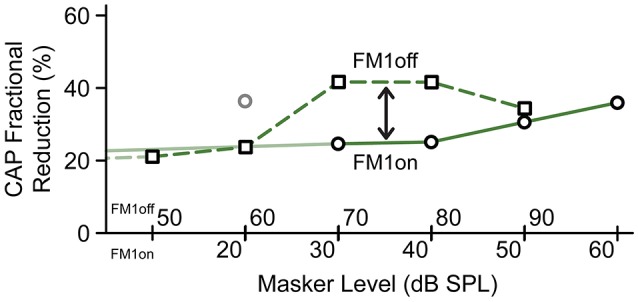
https://cdn.ncbi.nlm.nih.gov/pmc/blobs/d7ad/5462931/5444ffe7024a/fnins-11-00331-g0007.jpg
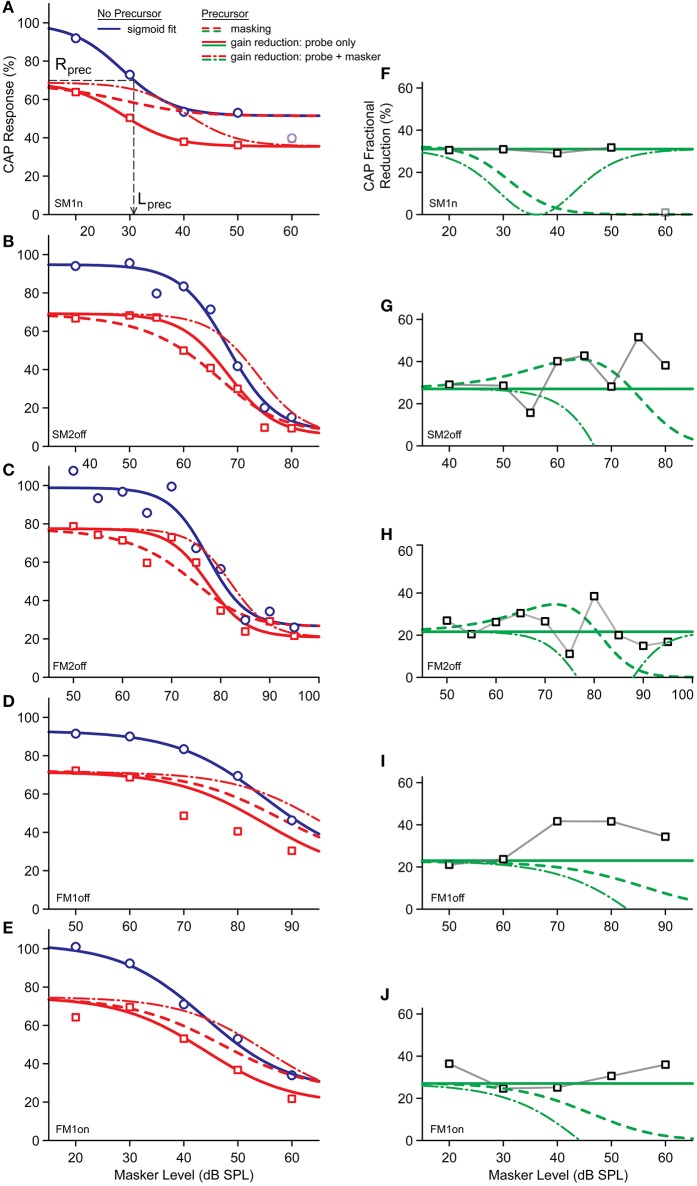
https://cdn.ncbi.nlm.nih.gov/pmc/blobs/d7ad/5462931/a063081ce15a/fnins-11-00331-g0001.jpg
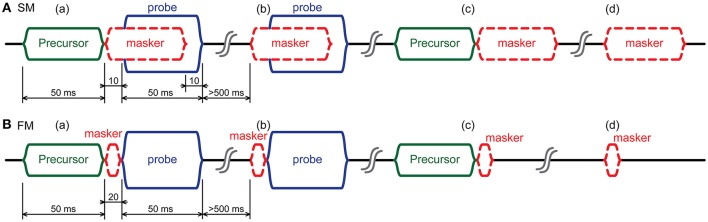
https://cdn.ncbi.nlm.nih.gov/pmc/blobs/d7ad/5462931/46a9f90e6dc5/fnins-11-00331-g0002.jpg
https://cdn.ncbi.nlm.nih.gov/pmc/blobs/d7ad/5462931/fad447070bd6/fnins-11-00331-g0003.jpg
https://cdn.ncbi.nlm.nih.gov/pmc/blobs/d7ad/5462931/ffa9f4c92862/fnins-11-00331-g0004.jpg
https://cdn.ncbi.nlm.nih.gov/pmc/blobs/d7ad/5462931/ae894caef49d/fnins-11-00331-g0005.jpg
https://cdn.ncbi.nlm.nih.gov/pmc/blobs/d7ad/5462931/034ac14e6e62/fnins-11-00331-g0006.jpg
https://cdn.ncbi.nlm.nih.gov/pmc/blobs/d7ad/5462931/5444ffe7024a/fnins-11-00331-g0007.jpg
https://cdn.ncbi.nlm.nih.gov/pmc/blobs/d7ad/5462931/a063081ce15a/fnins-11-00331-g0001.jpg
https://cdn.ncbi.nlm.nih.gov/pmc/blobs/d7ad/5462931/46a9f90e6dc5/fnins-11-00331-g0002.jpg
https://cdn.ncbi.nlm.nih.gov/pmc/blobs/d7ad/5462931/fad447070bd6/fnins-11-00331-g0003.jpg
https://cdn.ncbi.nlm.nih.gov/pmc/blobs/d7ad/5462931/ffa9f4c92862/fnins-11-00331-g0004.jpg
https://cdn.ncbi.nlm.nih.gov/pmc/blobs/d7ad/5462931/ae894caef49d/fnins-11-00331-g0005.jpg
https://cdn.ncbi.nlm.nih.gov/pmc/blobs/d7ad/5462931/034ac14e6e62/fnins-11-00331-g0006.jpg
https://cdn.ncbi.nlm.nih.gov/pmc/blobs/d7ad/5462931/5444ffe7024a/fnins-11-00331-g0007.jpg

相似文献

1
Assessment of Ipsilateral Efferent Effects in Human ECochG.人体耳蜗电图中同侧传出效应的评估
Front Neurosci. 2017 Jun 8;11:331. doi: 10.3389/fnins.2017.00331. eCollection 2017.
2
Medial olivocochlear efferent reflex inhibition of human cochlear nerve responses.内侧橄榄耳蜗传出神经对人耳蜗神经反应的反射性抑制
Hear Res. 2016 Mar;333:216-224. doi: 10.1016/j.heares.2015.09.001. Epub 2015 Sep 11.
3
Effects of ipsilateral, contralateral, and bilateral noise precursors on psychoacoustical tuning curves in humans.同侧、对侧和双侧噪声前导对人类听觉调谐曲线的影响。
Hear Res. 2024 Nov;453:109111. doi: 10.1016/j.heares.2024.109111. Epub 2024 Sep 8.
4
Human medial olivocochlear reflex: effects as functions of contralateral, ipsilateral, and bilateral elicitor bandwidths.人类内侧橄榄耳蜗反射:作为对侧、同侧和双侧刺激器带宽函数的效应。
J Assoc Res Otolaryngol. 2009 Sep;10(3):459-70. doi: 10.1007/s10162-009-0163-1. Epub 2009 Mar 5.
5
Stronger efferent suppression of cochlear neural potentials by contralateral acoustic stimulation in awake than in anesthetized chinchilla.清醒状态下对侧声刺激对耳蜗神经电位的传出抑制作用强于麻醉状态下的南美栗鼠。
Front Syst Neurosci. 2015 Mar 2;9:21. doi: 10.3389/fnsys.2015.00021. eCollection 2015.
6
Antimasking effects of the olivocochlear reflex. I. Enhancement of compound action potentials to masked tones.橄榄耳蜗反射的抗掩蔽效应。I. 复合动作电位对掩蔽音的增强作用。
J Neurophysiol. 1993 Dec;70(6):2519-32. doi: 10.1152/jn.1993.70.6.2519.
7
Contralateral efferent reflex effects on threshold and suprathreshold psychoacoustical tuning curves at low and high frequencies.低频和高频时,对侧传出反射对阈上和阈下心理声学调谐曲线的影响。
J Assoc Res Otolaryngol. 2013 Jun;14(3):341-57. doi: 10.1007/s10162-013-0373-4. Epub 2013 Feb 20.
8
Behavioral Measures of Cochlear Gain Reduction Depend on Precursor Frequency, Bandwidth, and Level.耳蜗增益降低的行为测量取决于前驱频率、带宽和水平。
Front Neurosci. 2021 Oct 4;15:716689. doi: 10.3389/fnins.2021.716689. eCollection 2021.
9
Reflex control of the human inner ear: a half-octave offset in medial efferent feedback that is consistent with an efferent role in the control of masking.人类内耳的反射控制:内侧传出反馈中的半个八度偏移,这与传出在掩蔽控制中的作用一致。
J Neurophysiol. 2009 Mar;101(3):1394-406. doi: 10.1152/jn.90925.2008. Epub 2008 Dec 31.
10
Medial olivocochlear efferent reflex in humans: otoacoustic emission (OAE) measurement issues and the advantages of stimulus frequency OAEs.人类内侧橄榄耳蜗传出反射:耳声发射(OAE)测量问题及刺激频率耳声发射的优势
J Assoc Res Otolaryngol. 2003 Dec;4(4):521-40. doi: 10.1007/s10162-002-3037-3. Epub 2003 Jun 13.

引用本文的文献

1
The role of the medial olivocochlear reflex in psychophysical masking and intensity resolution in humans: a review.人类中内侧橄榄耳蜗反射在心理物理掩蔽和强度分辨中的作用:综述。
J Neurophysiol. 2021 Jun 1;125(6):2279-2308. doi: 10.1152/jn.00672.2020. Epub 2021 Apr 28.
2
Exploring the Role of Medial Olivocochlear Efferents on the Detection of Amplitude Modulation for Tones Presented in Noise.探讨内侧橄榄耳蜗传出神经在探测噪声中呈现的调幅声音中的作用。
J Assoc Res Otolaryngol. 2019 Aug;20(4):395-413. doi: 10.1007/s10162-019-00722-6. Epub 2019 May 28.
3
High-resolution frequency tuning but not temporal coding in the human cochlea.

本文引用的文献

1
Medial olivocochlear efferent reflex inhibition of human cochlear nerve responses.内侧橄榄耳蜗传出神经对人耳蜗神经反应的反射性抑制
Hear Res. 2016 Mar;333:216-224. doi: 10.1016/j.heares.2015.09.001. Epub 2015 Sep 11.
2
Stronger efferent suppression of cochlear neural potentials by contralateral acoustic stimulation in awake than in anesthetized chinchilla.清醒状态下对侧声刺激对耳蜗神经电位的传出抑制作用强于麻醉状态下的南美栗鼠。
Front Syst Neurosci. 2015 Mar 2;9:21. doi: 10.3389/fnsys.2015.00021. eCollection 2015.
3
Is off-frequency overshoot caused by adaptation of suppression?
人耳蜗的高分辨率频率调谐而非时间编码。
PLoS Biol. 2018 Oct 15;16(10):e2005164. doi: 10.1371/journal.pbio.2005164. eCollection 2018 Oct.
4
Olivocochlear Efferents in Animals and Humans: From Anatomy to Clinical Relevance.动物和人类的橄榄耳蜗传出神经:从解剖学到临床意义
Front Neurol. 2018 Mar 26;9:197. doi: 10.3389/fneur.2018.00197. eCollection 2018.
5
Temporal Effects on Monaural Amplitude-Modulation Sensitivity in Ipsilateral, Contralateral and Bilateral Noise.同侧、对侧和双侧噪声下单耳幅度调制敏感性的时间效应
J Assoc Res Otolaryngol. 2018 Apr;19(2):147-161. doi: 10.1007/s10162-018-0656-x. Epub 2018 Mar 5.
6
Olivocochlear efferents: Their action, effects, measurement and uses, and the impact of the new conception of cochlear mechanical responses.橄榄耳蜗传出神经:它们的作用、效应、测量与应用,以及耳蜗机械反应新概念的影响。
Hear Res. 2018 May;362:38-47. doi: 10.1016/j.heares.2017.12.012. Epub 2017 Dec 21.
频率偏移过冲是由抑制适应引起的吗?
J Assoc Res Otolaryngol. 2015 Apr;16(2):241-53. doi: 10.1007/s10162-014-0498-0. Epub 2014 Dec 3.
4
Effect of human auditory efferent feedback on cochlear gain and compression.人类听觉传出反馈对耳蜗增益和压缩的影响。
J Neurosci. 2014 Nov 12;34(46):15319-26. doi: 10.1523/JNEUROSCI.1043-14.2014.
5
Is overshoot caused by an efferent reduction in cochlear gain?超量是否是由于耳蜗增益的传出减少引起的?
Adv Exp Med Biol. 2013;787:65-72. doi: 10.1007/978-1-4614-1590-9_8.
6
Modeling effects of precursor duration on behavioral estimates of cochlear gain.建立模型,研究前导时长对耳蜗增益行为估计的影响。
Adv Exp Med Biol. 2013;787:55-63. doi: 10.1007/978-1-4614-1590-9_7.
7
Evaluating the effects of olivocochlear feedback on psychophysical measures of frequency selectivity.评估橄榄耳蜗反馈对频率选择性心理物理测量的影响。
J Acoust Soc Am. 2012 Oct;132(4):2483-96. doi: 10.1121/1.4742723.
8
Auditory nerve frequency tuning measured with forward-masked compound action potentials.利用前掩蔽复合动作电位测量听神经频率调谐。
J Assoc Res Otolaryngol. 2012 Dec;13(6):799-817. doi: 10.1007/s10162-012-0346-z. Epub 2012 Sep 5.
9
Frequency tuning of medial-olivocochlear-efferent acoustic reflexes in humans as functions of probe frequency.人类中内侧橄榄耳蜗传出性声反射的频率调谐作为探测频率的函数。
J Neurophysiol. 2012 Mar;107(6):1598-611. doi: 10.1152/jn.00549.2011. Epub 2011 Dec 21.
10
N1 action potentials in humans: influence of simultaneous contralateral stimulation.人类的N1动作电位:对侧同时刺激的影响。
Acta Otolaryngol. 1987 May-Jun;103(5-6):262-5. doi: 10.3109/00016488709107792.