Ruiz Silva Mariana, Aguilar Briseño José A, Upasani Vinit, van der Ende-Metselaar Heidi, Smit Jolanda M, Rodenhuis-Zybert Izabela A
Department of Medical Microbiology, University of Groningen and University Medical Center Groningen, Groningen, The Netherlands.
PLoS Negl Trop Dis. 2017 Jun 23;11(6):e0005712. doi: 10.1371/journal.pntd.0005712. eCollection 2017 Jun.
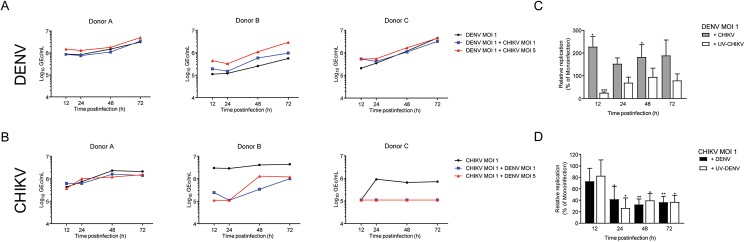
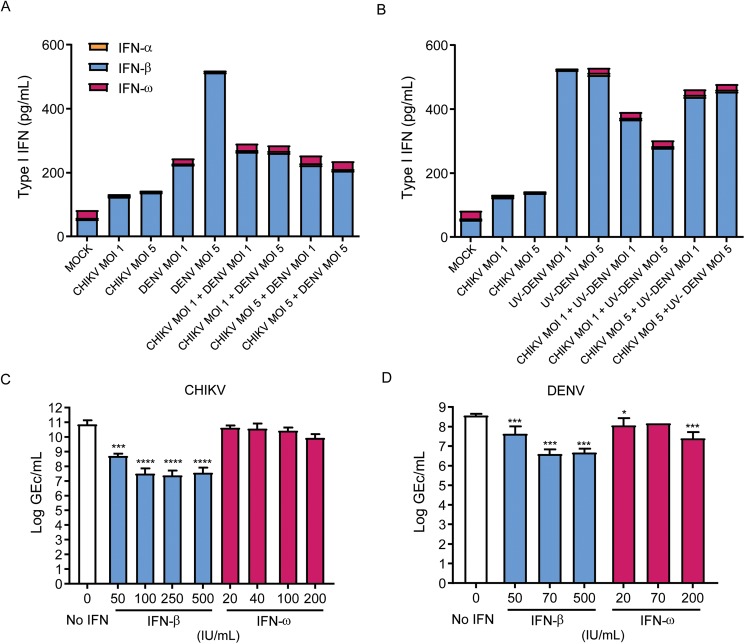
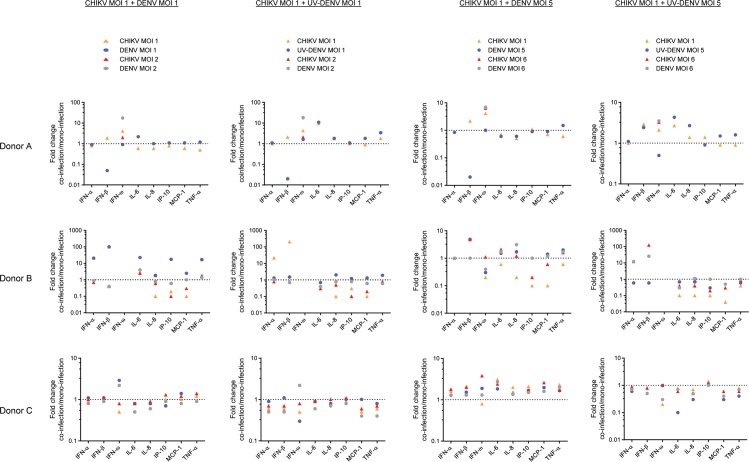
Dengue and chikungunya are viral diseases transmitted to humans by infected Aedes spp. mosquitoes. With an estimated 390 million infected people per year dengue virus (DENV) currently causes the most prevalent arboviral disease. During the last decade chikungunya virus (CHIKV) has caused large outbreaks and has expanded its territory causing millions of cases in Asia, Africa and America. The viruses share a common mosquito vector and during the acute phase cause similar flu-like symptoms that can proceed to more severe or debilitating symptoms. The growing overlap in the geographical distribution of these mosquito-borne infections has led to an upsurge in reported cases of DENV/CHIKV co-infections. Unfortunately, at present we have little understanding of consequences of the co-infections to the human host. The overall aim of this study was to define viral replication dynamics and the innate immune signature involved in concurrent DENV and CHIKV infections in human peripheral blood mononuclear cells (PBMCs). We demonstrate that concomitant infection resulted in a significant reduction of CHIKV progeny and moderate enhancement of DENV production. Remarkably, the inhibitory effect of DENV on CHIKV infection occurred independently of DENV replication. Furthermore, changes in type I IFN, IL-6, IL-8, TNF-α, MCP-1 and IP-10 production were observed during concomitant infections. Notably, co-infections led to a significant increase in the levels of TNF-α and IL-6, cytokines that are widely considered to play a crucial role in the early pathogenesis of both viral diseases. In conclusion, our study reveals the interplay of DENV/CHIKV during concomitant infection and provides a framework to investigate viral interaction during co-infections.
登革热和基孔肯雅热是由受感染的伊蚊属蚊子传播给人类的病毒性疾病。登革热病毒(DENV)目前每年估计有3.9亿人感染,是最普遍的虫媒病毒病。在过去十年中,基孔肯雅病毒(CHIKV)引发了大规模疫情,并扩大了其传播范围,在亚洲、非洲和美洲造成了数百万病例。这两种病毒共享一种共同的蚊子媒介,在急性期会引起类似流感的症状,这些症状可能会发展为更严重或使人衰弱的症状。这些蚊媒感染在地理分布上的重叠日益增加,导致登革热病毒/基孔肯雅病毒合并感染的报告病例激增。不幸的是,目前我们对合并感染对人类宿主的影响了解甚少。本研究的总体目标是确定人类外周血单核细胞(PBMCs)中同时感染登革热病毒和基孔肯雅病毒时的病毒复制动态以及固有免疫特征。我们证明,同时感染会导致基孔肯雅病毒子代显著减少,登革热病毒产量适度增加。值得注意的是,登革热病毒对基孔肯雅病毒感染的抑制作用独立于登革热病毒的复制。此外,在同时感染期间观察到I型干扰素、白细胞介素-6、白细胞介素-8、肿瘤坏死因子-α、单核细胞趋化蛋白-1和干扰素诱导蛋白10的产生发生了变化。值得注意的是,合并感染导致肿瘤坏死因子-α和白细胞介素-6水平显著升高,这两种细胞因子被广泛认为在这两种病毒性疾病的早期发病机制中起关键作用。总之,我们的研究揭示了同时感染期间登革热病毒/基孔肯雅病毒的相互作用,并为研究合并感染期间的病毒相互作用提供了一个框架。